

Any time, any place, any pace: A closer look at discussion and dropbox assignments

Time, place, and pace in online learning
Online learning affords students the flexibility to learn and submit assignments "any time, any place, and at any pace." Across five reports, Cuccolo and DeBruler examined how each construct relates to course performance.
The fifth report in the series, the synthesis report, highlighted how time, place, and pace converge by examining the relationships among assignment type, pacing, and performance. Both the timing of students' first assignment submission and the proportion of assignments completed by week 4 distinguished students who failed from those who demonstrated content mastery. Taken together, these findings suggest that poor performance in online courses does not boil down to a quality-of-work issue alone. Students who failed and those who demonstrated content mastery had a larger progress gap (i.e., quantity of work) than a performance gap (i.e., quality of work).
The synthesis report, however, provided details only on quizzes while discussing dropbox and discussion assignments more broadly. This blog is meant to devote more space to students' pacing and performance on those two assignment types.
Methodology snapshot
Student-level assignment and performance data from highly enrolled core subject area courses in Spring 2024 were used to facilitate the analyses. Assignments were categorized within the LMS as quizzes, discussions, or dropbox assignments. These groupings were used to support assignment-level analyses. Students were categorized as passing if they received a final course score greater than 60%, and as failing if they earned less than 60%. Students were categorized as showing content mastery if they received a final course score greater than 80%, while those earning less than that were categorized as not demonstrating mastery. For a more detailed discussion of the methodology used in this series, please review ‘Any time, any place, any pace: How students use time in online courses.’
As with the synthesis report, to better understand what distinguishes students who go on to fail their courses from those who demonstrate mastery, we broke down course progression by the quality of work submitted (scores earned) and the quantity of work submitted (proportion of available work submitted).
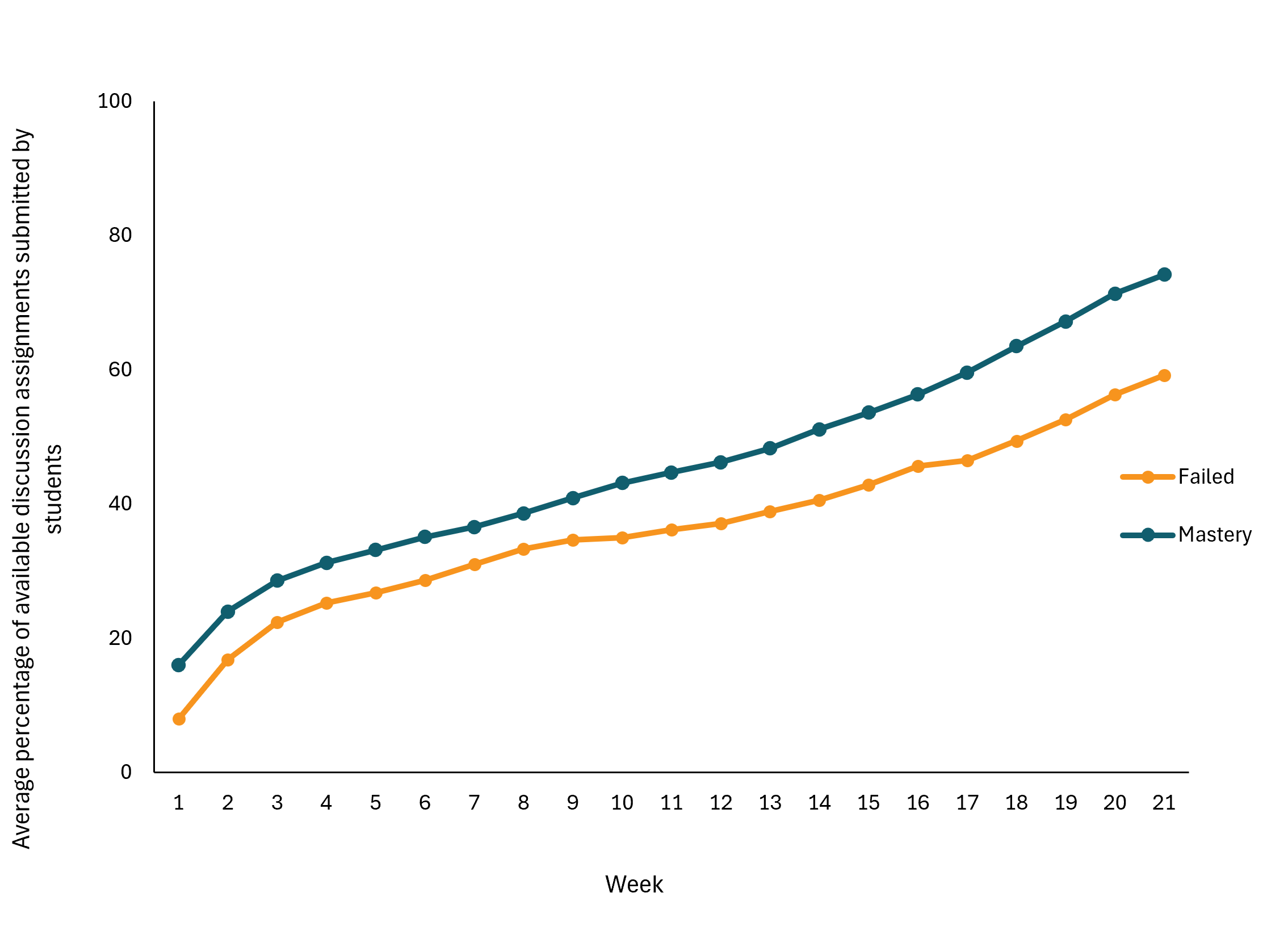
A gap in the percentage of cumulative discussions submitted existed between students who failed and those who demonstrated content mastery from week 1, and remained relatively stable throughout the course. In other words, there was a sizable gap between students who failed and those who demonstrated content mastery in the number of assignments submitted each week. Notably, while students who demonstrated content mastery submitted 50% of available discussion submissions by week 14, students who failed their courses didn’t hit this milestone until week 18. While this means that students who failed hit 50% of the available discussion submissions earlier than they did with their quizzes, this delay is still problematic, as the remaining 50% would need to be crammed (alongside other assignments) into the remaining three weeks of the course (review Figure 1).
Figure 1. Average cumulative percentage of discussions submitted by week
 Cumulative dropbox submissions looked slightly different in weeks 1 and 2, compared to discussions, but developed into a similar trend. Students who failed and those who showed content mastery looked very similar in weeks 1 and 2 but diverged in week 3, with the gap widening significantly thereafter. Students who failed did not reach 50% of submissions until halfway through week 19, compared to week 13 for students who showed content mastery (review Figure 2). This delay is notably larger than the delays observed for quizzes and discussion assignments, suggesting that dropbox assignments may warrant closer monitoring by instructors and mentors.
Figure 2. Average cumulative percentage of dropbox submitted by week 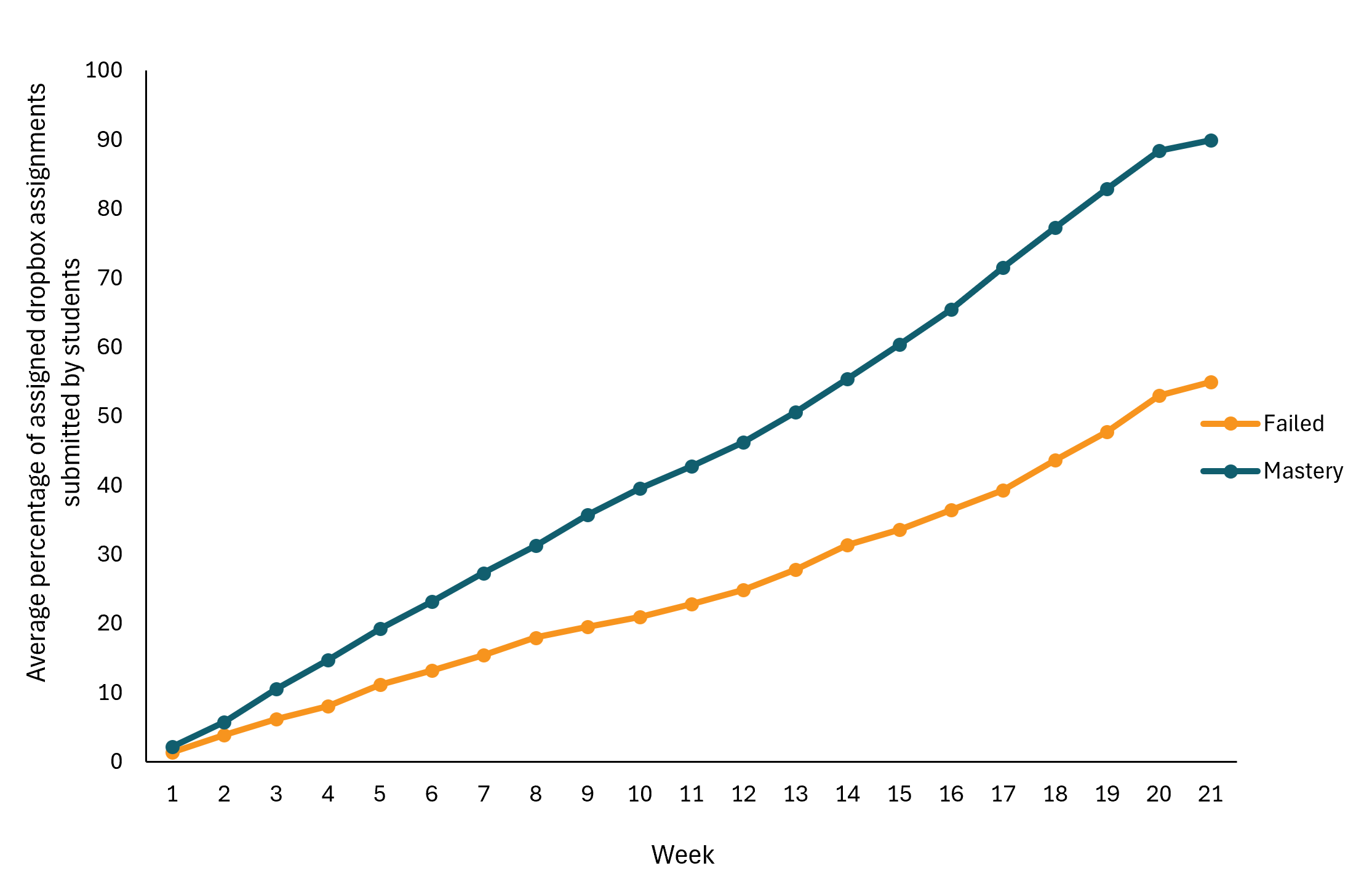
Connecting pacing and performance across assignment types
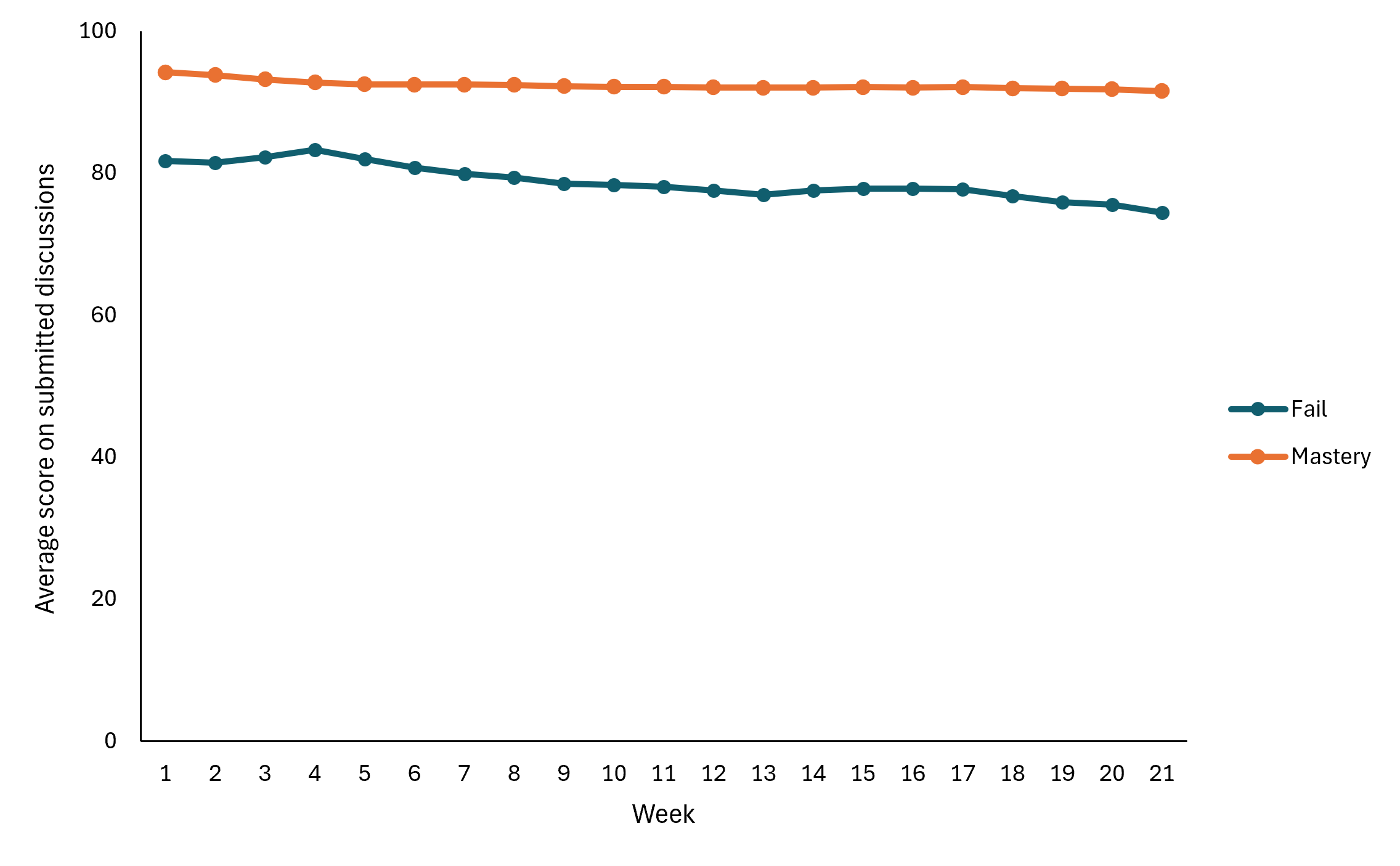
Students who demonstrated content mastery averaged higher, more stable performance on discussion assignments than those who failed. Students who failed showed a slight decline in performance on discussions after week 4, which then persisted throughout the course (review Figure 3). Notably, however, students who failed still averaged about 75% on their discussions, suggesting that the quality of work alone does not explain their inability to reach more than 60% of total course points.
Figure 3. Average cumulative percentage of submitted discussion scores by week
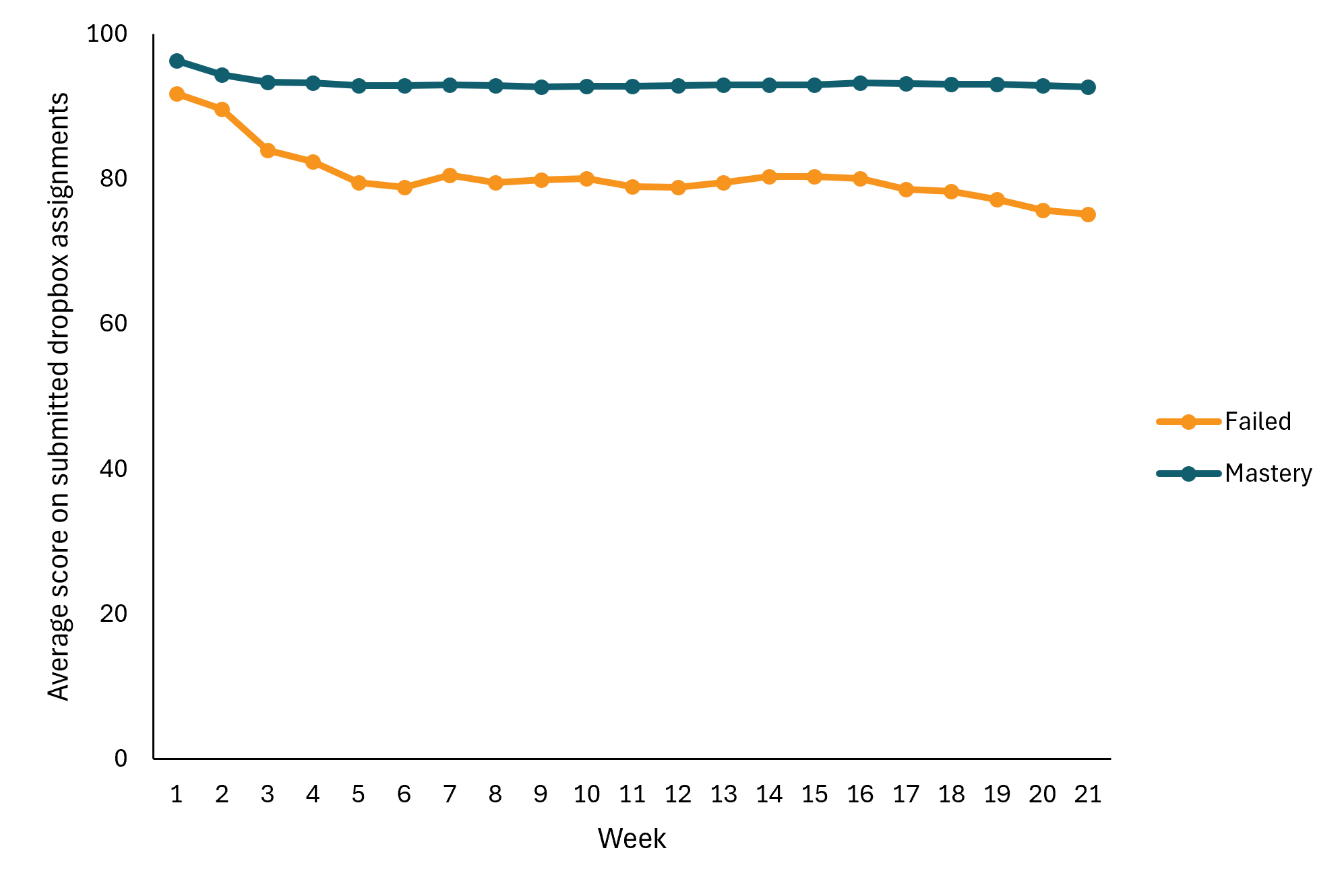
 Students who failed and those who showed content mastery started off with comparable scores on dropbox assignments. However, while students who demonstrated mastery showed consistency in performance, students who failed exhibited a downward trend that was slightly more pronounced between weeks 2 and 6. Scores among students who failed held steady from weeks 7 to 18, then declined slightly through the end of the course (review Figure 4). Interestingly, students who failed still averaged 75% or greater of points earned on dropbox assignments, pointing to a need for greater attention to the volume of work these students are submitting.
Figure 4. Average cumulative percentage of submitted dropbox scores by week
 Key findings
Performance gaps exist. Students who demonstrated content mastery consistently averaged discussion scores in the mid-90s and dropbox scores in the mid to low-90s, while students who failed averaged scores in 70s and 80s.
Progress gaps emerge early and persist. A small gap existed between students who demonstrated content mastery and those who failed in the percentage of available discussions submitted at week 1, this gap remained fairly stable until about week 9, after which it widened slightly. While no gap in the percentage of available dropbox assignments existed between the groups at week 1, by week 4, a significant gap existed and persisted throughout the course.
Overall, one of the biggest takeaways is that when thinking about students who fail their online courses, performance (points earned on assignments) does not tell the whole story and instructors and mentors should pay attention to the quantity of work submitted and intervene by week 4 if necessary.
Implications for educators
In light of the reviewed evidence, understanding how to balance flexibility with structured support may be an ideal path forward for promoting positive student outcomes in virtual learning.
Educators should assess and discuss students' readiness for online learning. Given that online learning presents unique challenges and often requires a different approach from face-to-face instruction, understanding what students need to succeed can help inform decisions about whether online learning is appropriate for a specific student. Because students' first course access is likely to occur outside of traditional school hours, course orientations should give students everything they need to hit the ground running, including information on the unique aspects of online learning, the skills needed for success (i.e., time management, self-regulated learning), and how to navigate and leverage technology appropriately.
Educators should monitor and address issues with course progress (i.e., the percentage of available assignments submitted each week), which may help students who are struggling. To support students' planning and time management skills, instructors and mentors should routinely monitor course progress, checking for:
Submissions within the first week of enrollment
Significant delays in submissions
Submissions made in close succession, where it is unlikely the student had time to review auto-generated or instructor-provided feedback
Submissions that do not align with the order outlined in the syllabus or pacing guide (Cuccolo & DeBruler, 2024; Cuccolo & Green, 2025)
If instructors or mentors notice any or several of these behaviors, prompt communication and personalized feedback may be leveraged to help re-engage students and align them with course pacing guides and expectations.
You can check out the full reports below:
Any time, any place, any pace: An introduction to the flexibility of K-12 virtual learning
Any time, any place, any pace: How students use time in online courses
Any time, any place, any pace: How students use place in online courses
Any time, any place, any pace: How students use pace in online courses

Kelly Cuccolo, PhD
Sr. Research Specialist
Dr. Kelly Cuccolo holds a PhD in Experimental Psychology. Having served as an educator and researcher, her professional career focuses on the scholarship of teaching and learning. She is particularly focused on researching practices that help to support both students and teachers, and is passionate about improving their experiences in the classroom. In her free time, Kelly enjoys kayaking, baking, and spending time with loved ones.
Related Posts

Understanding How Students and Teachers Think About Responsible AI Use: An Interview with a Researcher
Students and teachers generally understand the risks of AI misuse, but they are less clear about what responsible AI-supported learning should look like in practice. This interview highlights findings from a Michigan Virtual study showing that students need clearer examples, consistent expectations, and practical guidance for using AI transparently and appropriately in schoolwork.

What Happens to Students' Online Course Scores After the Course Ends?
The moment an online course ends, a new question begins: how will that score be recorded locally? Drawing on a 2025 brief and a small follow-up survey, this blog post outlines three common approaches districts use to interpret and record students’ online course scores and why the differences can matter for students.

Just the essentials: What mentors of online students want and need from professional learning
Research indicates that online learners perform better when they have strong onsite mentor support. But mentors need support, too. Drawing on survey responses, this blog examines mentors’ current practices, key challenges, and unmet needs—and what those insights mean for designing more effective professional learning.

Have You Considered AI in Your Classroom? A Khanmigo Pilot Story
In a two-phase pilot across Michigan schools, educators used Khanmigo, an AI-powered tutor and teaching assistant, to explore how AI might support teaching and learning. Their reflections surfaced both opportunities and challenges. The big takeaway? AI has potential, but only with intentional support.

Out of Order, Still Out of Reach: Variations in Pacing among World Language Students
Cuccolo & Green’s (2025) report highlighted the relationship between students’ assignment submission patterns and final course scores. Given that pacing has important implications for student performance, knowing what assignment submission patterns look like across schools with varying demographics could help prompt early identification and intervention. As such, this blog explores students’ assignment submission patterns based on school-level demographic information.

From Curiosity to Career: Exploring Possibilities with VR
Explore how immersive VR simulations helped students step into real-world roles: from EMTs to chefs, all without leaving the classroom.