
Introduction
Online learning offers students the opportunity to learn ‘any time, any place, and at any pace’ (Connections Academy, 2020). This flexibility is one of the driving forces for families seeking out online learning (Beck et al., 2014). Although flexibility is a desired feature, students often need to adapt to the unique demands of online learning, and learn how to learn online. This observation raises questions about how students actually use the flexibility afforded by online learning. The Introductory Report in this series explored what is known about learning ‘any time, any place, and at any pace,’ highlighting critical gaps in K-12 research. The second report (Any Time, Any Place, Any Pace: How Students Use Time in Online Courses) described how students learned ‘any time’ and its relationship to final course scores. The third report (Any Time, Any Place, Any Pace: How Students Use Place in Online Courses) focused on describing students’ use of learning from ‘any place’ and exploring its association with course performance. This report will first unpack what is typically meant by learning at ‘any pace’ and then examine what typical pacing looks like for students in online courses, and how this may relate to final course scores.
Understanding the meaning of learning at ‘any pace,’ and why it matters for students
In online self-paced courses, all students’ coursework is typically available at the start of the course, and assignments are dictated by an end-of-course deadline rather than weekly submission deadlines. Paired with the lack of (or reductions in) required synchronicity between students and instructors, this generally means that students have greater freedom to set the pace of their learning. In other words, because online courses allow students to access course materials at any time, from any place, and in any order they choose, students can personalize how quickly (or slowly) and in what order they navigate and engage with material (Digital Learning Institute, n.d.). Thus, learning at any pace, typically refers to students’ ability to customize their course progression to meet their needs, preferences, or interests (Cuccolo & DeBruler, 2023; Green et al., 2023).
The flexibility and autonomy provided by online learning mean that ‘pace’ can take on multiple meanings. It isn’t a singular construct but a constellation of behaviors, including: the amount of time students spend with course material, the rate at which coursework is completed, and the order in which they progress through modules and complete assignments. Both having long delays between learning (i.e., procrastinating) and rapidly attempting to learn a large amount of information in a short timeframe (i.e., cramming) have been associated with negative learning outcomes like lower final course grades and test scores (Carvalho et al., 2020; DeBruler, 2021; Dunlosky & Rawson, 2015; Michigan Virtual Learning Research Institute, 2019; Kim & Seo, 2015; Lim, 2016a; Miyamoto et al., 2015; You, 2015). Research also suggests that the way students navigate course materials matters. Students who deviate from course pacing guides tend to earn lower grades than their peers. Further, low-performing students tend to be disproportionately affected when they move out of sequence (Cuccolo & DeBruler, 2024; Cuccolo & Green, 2025). Pacing behaviors may be an early indicator that students need additional support to regulate their learning and manage their time effectively.
The Current Study
Pace is an important aspect of students’ online learning experience, as it not only relates to course performance but can also serve as an early signal to teachers and mentors that students may need additional support. Painting a clearer picture of how students pace themselves in their online courses can help inform the development of more specific and effective support systems, resources, and communication. To achieve this goal, this study used learning management system (LMS) assignment data to explore students’ assignment-submission behaviors.
The following research questions guided this study:
What does student pacing look like in online asynchronous courses?
How is student pacing in online asynchronous courses related to their performance?
Methods
Spring 2024 enrollment, course access, and assignment submission information from students in highly enrolled core subject-area courses were used to answer the research questions guiding the current study. Only students who completed their courses were included in the analyses. More information about the methods used in this report can be found in the ‘Any Time, Any Place, Any Pace: How Students Use Time in Online Courses’ publication.
Pace variables
To help clarify how students progressed through their courses, we examined the alignment (or misalignment) between the order of each student's assignment submissions and the intended submission order as outlined in the course pacing guides. Based on this assignment level information, students were then categorized into two groups (students who completed their course in alignment with their course pacing guides, and those who did not). We also examined the extent of any pacing guide deviations by comparing the order in which the student submitted an assignment with the order it was intended to be submitted according to the course pacing guide. For example, the deviation between an assignment that was intended to be submitted 5th but handed in 10th by the student would have a deviation of 5 (referred to in the results as ‘magnitude’).
Performance variables
Students were grouped by their final course score. Students who achieved less than 60% of course points were considered to have failed the course. Students who earned more than 60% but less than 80% of course points were considered to have passed the course but failed to demonstrate content mastery. Students who finished with 80% or more course points were considered to have achieved content mastery.
Results
What does the rate of assignment submissions look like throughout online asynchronous courses?
In self-paced asynchronous courses, students likely do not have weekly assignment deadlines, but rather, an end-of-term deadline by which all assignments should be completed. This flexibility means that students are in control of when and how far apart assignments are completed. Because pacing has been associated with course performance, it is helpful to understand when students begin working, and how that workload is distributed over the course.
Just under 65% of students submitted at least one assignment in the first week of their course; this number increased to 88% when looking at the first two weeks. Examining assignment submissions early on in the course may help teachers and mentors identify early warning signs that students may be disengaged or struggling with the unique challenges of online learning. Indeed, students who submitted an assignment in the first week had, on average, higher final course scores (M = 79.9, SD = 21.3) than peers who failed to do so (M = 73.4, SD = 25.5). This suggests that first-week assignment submissions, alongside other metrics, could serve as an early warning indicator of course outcomes. Future research should focus on assessing the significance of this finding and exploring it with a larger sample of courses. Examining the accuracy of first-week assignment submissions to predict pass/fail status could have important implications for how instructors and mentors monitor students early in the course.
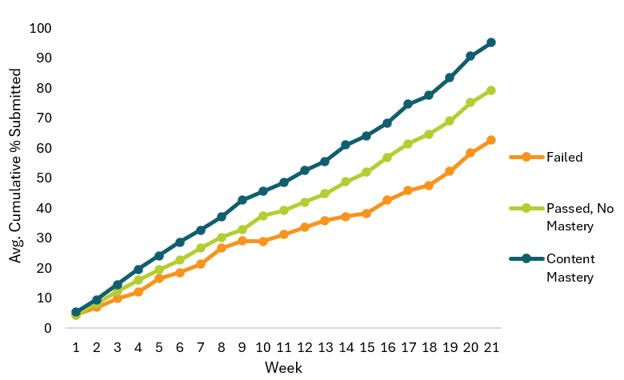
To better understand the trajectory of students’ course performance, assignment submission behaviors were examined based on whether students failed, passed but failed to demonstrate content mastery, or demonstrated content mastery. Three distinct trends in assignment submissions emerged when students were grouped in this way. The proportion of assignments submitted in week 1 of a course was similar across groups, but differences steadily emerged and became notable by week 4. By the midpoint of the course, students who had demonstrated content mastery submitted roughly 1.5 times as many assignments as students who failed. By the end of the course, the gap between students who demonstrated content mastery and those who failed had nearly doubled. While students who failed their courses showed somewhat linear progress in the proportion of assignments they submitted each week, they were never able to fully close the gap that emerged in week 4. Thus, while the groupings (content mastery, passed but failed to achieve mastery, and failed) may imply differences in the number of points students earn throughout the course, the trends observed here also indicate noticeable differences in the number of points attempted. In other words, there is a noticeable gap in the number of assignments submitted.
Figure 1. Cumulative Assignment Submissions Over the Course
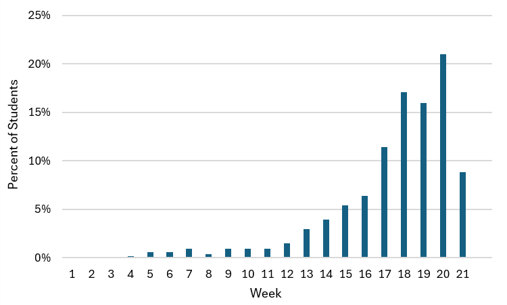
 Beyond identifying whether students reach 60% and 80% of course points, knowing when they are likely to hit these thresholds is important, as these represent inflection points for students moving from failing to passing and into content mastery, respectively. Knowing when students are likely to hit these milestones provides a window during which interventions are likely to be effective. For example, a student who is not on pace to reach the 60% threshold between weeks 15 and 17 may be on a trajectory that’s difficult to come back from. Identifying this trend early can facilitate interventions that help students get back on track.
Figure 2. Percent of Students Reaching 60% of Course Points by Week
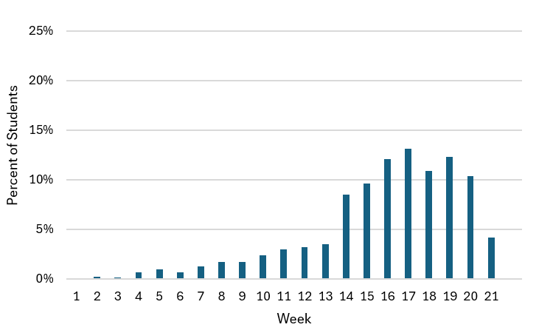 Approximately 79% of students earned 60% of available course points. The most common weeks in which students reached 60% were 15, 17, and 19. Review Figure 2. Just under 45% of students achieved content mastery. The most common weeks in which students reached 80% of course points were 18, 19, and 20. Review Figure 3. The incremental build for students reaching content mastery likely reflects the intentional design choices of course designers to scaffold and distribute assignments by point value and format, thereby facilitating appropriately paced course completion. This is especially important to consider in the context of previous research suggesting that students may cherry-pick assignments based on point value or format (e.g., autograded versus instructor-graded; Cuccolo, 2024).
Figure 3. Percent of Students Reaching 80% of Course Points by Week
 How do students use flexibility to navigate through their online asynchronous courses?
While self-paced asynchronous courses allow students to navigate the course according to their needs, preferences, and interests, they are also designed to be completed in a linear fashion (National Standards for Quality, n.d.). Courses are often designed such that material becomes increasingly complex, with prior knowledge from previous lessons and assignments serving as a bridge to connect new ideas and complete more complex tasks, deviating from this may affect student learning
The overwhelming majority of students (99%) went out of alignment with course pacing guides at least once. This is comparable to research examining the frequency of pacing guide deviations in World Language courses (97% of students deviate; Cuccolo & Green, 2025), but slightly higher than that reported in STEM courses (93% of students deviate; Cuccolo & DeBruler, 2024). Interestingly, the percentage of assignments submitted out of order (58%) was notably higher than what was reported for exclusively World Language (45%) and STEM courses (38%). This may suggest that the frequency of students' deviations from their pacing guides varies across courses and subject areas. When students deviated from course pacing guides, they were typically “off” by about four assignments (SD = 3.6), consistent with trends observed in previous research with both STEM and World Language courses (Cuccolo & DeBruler, 2024; Cuccolo & Green, 2025).
Overall, a small but statistically significant negative relationship was observed between moving through a course out of order and final course score. Previous research by Cuccolo and colleagues also found that students with lower final course scores were more adversely affected by deviations from course pacing guides, a pattern similar to what we observed in this sample. Students’ movement through a course is complex, and likely driven by the interplay of both student- and course-level factors such as prior knowledge, personal interests, goals, self-regulated learning skills, and course design features (e.g., auto versus instructor-graded assignments, point distribution), all of which may impact final course outcomes in complex and interrelated ways.
Conclusions
Flexibility is a common reason students switch to online learning, and it seems that a large majority of students leverage that flexibility when navigating their online courses. Almost all students in the current study did not submit assignments in line with their course pacing guide recommendations. Importantly, pacing matters for course performance. Moving out of alignment with course pacing guides was associated with lower final course scores, and submitting an assignment within the first week of the course was associated with higher final course scores. Moving through a course out of order may signal reduced performance, but it also invites dialogue about students' motivations. Asking 'why' builds relationships and strengthens students' self-reflection and metacognitive skills, while helping distinguish struggling students from those who intentionally personalize their path.
In addition to examining the order in which students move through their courses, understanding when students typically hit critical course milestones (first assignment submission, reaching 60% and 80% of course points) can help facilitate effective early outreach and interventions. A clear difference in final course scores emerged when students were separated into those who submitted an assignment within the first week of the course and those who did not. Given that students who submitted an assignment in the first week outperformed their peers, this behavior could serve as an early indicator for mentors and instructors that students may need closer monitoring and motivation to engage with their coursework. Relatedly, early assignment submission behaviors may help distinguish among students who fail, pass but don’t reach content mastery, and those who achieve content mastery. From weeks 1 to 3, submission pace is similar across groups. However, between weeks 4 and 7, gaps start to emerge. The biggest gaps emerge between students who fail and those who go on to demonstrate content mastery. After week 7, the trends associated with course performance seem well-established. Further, the gap between the groups widens rather than closing or even leveling off. This suggests that early submission behaviors may be a strong predictor of course outcomes. Based on these trends, it is recommended that mentors and instructors closely examine the proportion of assignments students have submitted between weeks 4 and 6 to intervene before the gaps become difficult to close.
References
Beck, D., Egalite, A. and Maranto, R. (2014), “Why they choose and how it goes: comparing special education and general education cyber student perceptions”, Computers and Education, Vol. 76, pp. 70-79. https://doi.org/10.1016/j.compedu.2014.03.011
Connections Academy. (2020, August 18). Differences Between Real Time and Anytime Learning. https://www.connectionsacademy.com/support/resources/article/differences-between-real-time-and-anytime-learning/
Cuccolo, K. & DeBruler, K. (2024). Out of Order, Out of Reach: Navigating Assignment Sequences for STEM Success. Michigan Virtual. https://michiganvirtual.org/research/publications/out-of-order-out-of-reach-navigating-assignment-sequences-for-stem-success/
Cuccolo, K., & DeBruler, K. (2024). Assignment submission patterns and performance in K-12 online STEM courses. Learning: Research and Practice, 1-19. https://doi.org/10.1080/23735082.2024.2441113
Cuccolo, K. & Green, C. (2025). Out of Order, Still Out of Reach: Navigating Assignment Sequences for MV World Language Courses. Michigan Virtual. https://michiganvirtual.org/research/publications/navigating-assignment-sequences-for-mv-world-language-courses/
National Standards for Quality. (n.d.). Quality online courses. https://www.nsqol.org/the-standards/quality-online-courses/
Carvalho, P. F., Sana, F., & Yan, V. X. (2020). Self-regulated spacing in a massive open online course is related to better learning. NPJ Science of Learning, 5(1), 2. https://doi.org/10.1038/s41539-020-0061-1
DeBruler, K. (2021). Research On K-12 Online Best Practices. Michigan Virtual. https://michiganvirtual.org/blog/research-on-k-12-online-best-practices/
Dunlosky, J., & Rawson, K. A. (2015). Practice tests, spaced practice, and successive relearning:Tips for classroom use and for guiding students’ learning. Scholarship of Teaching and Learning in Psychology, 1(1), 72. https://doi.org/10.1037/stl0000024
Michigan Virtual Learning Research Institute. (2019). Pacing Guide For Success In Online Mathematics Courses. https://michiganvirtual.org/blog/pacing-guide-for-success-in-online-mathematics-courses/
Kim, K. R., & Seo, E. H. (2015). The relationship between procrastination and academic performance: A meta-analysis. Personality and Individual Differences, 82, 26-33. https://doi.org/10.1016/j.paid.2015.02.038
Lim, J. M. (2016a). Predicting successful completion using student delay indicators in undergraduate self-paced online courses. Distance Education, 37(3), 317-332. DOI: 10.1080/01587919.2016.1233050
Lim, J. M. (2016b). The relationship between successful completion and sequential movement in self-paced distance courses. International Review of Research in Open and Distributed Learning, 17(1), 159-179. https://doi.org/10.19173/irrodl.v17i1.2167
You, J. W. (2015). Examining the effect of academic procrastination on achievement using LMS data in e-learning. Journal of Educational Technology & Society, 18(3), 64-74. https://www.jstor.org/stable/jeductechsoci.18.3.64
Green, C., DeBruler, K., Harrington, C. (2023). What Do We Mean When We Say Student-Centered Learning? Michigan Virtual. Retrieved from:https://michiganvirtual.org/research/publications/meaning-student-centered-learning
Digital Learning Institute. (n.d.). “What is Self Paced Learning? Definition, Benefits and Tips.” [Blog]. Retrieved from https://www.digitallearninginstitute.com/blog/what-is-self-paced-learning-definition-benefits-and-tips