
What ASU+GSV 2026 Revealed About the Future of AI in Education

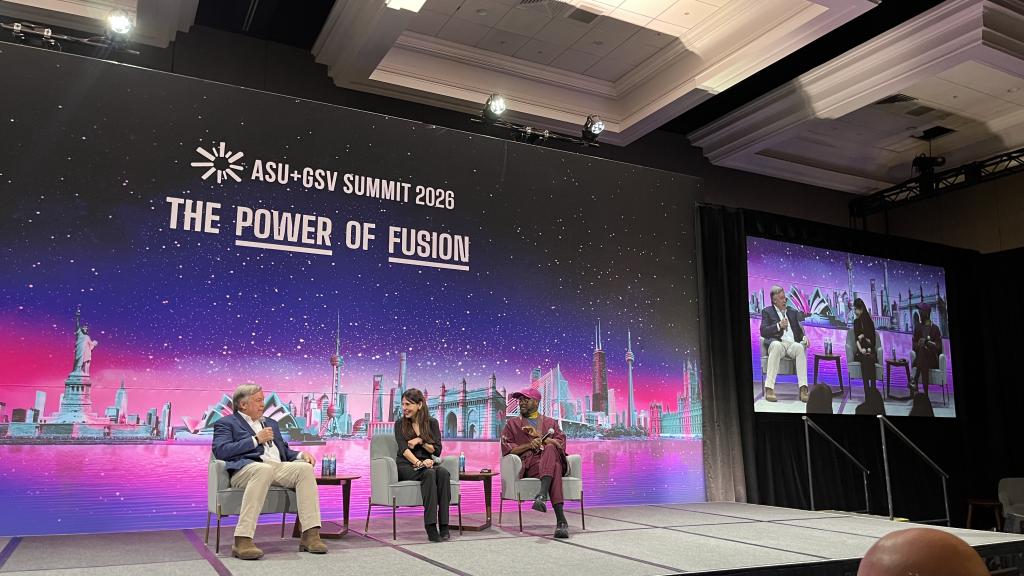
The 2026 ASU+GSV Summit in San Diego may be over, but many of the conversations that emerged from this year’s conference are still unfolding in real time across education, workforce development, and the broader edtech sector. Michigan Virtual joined educators, innovators, and school leaders at this year’s Summit and left with one clear takeaway: the conversation around AI in education is moving much faster than many systems are prepared for.
That reality showed up everywhere in San Diego. Not in the usual “AI is coming” way that has dominated education conferences for the past two years, but in a much more immediate sense. The tools are improving quickly. Expectations around productivity and personalization are shifting alongside them. Meanwhile, many schools are still trying to establish basic guidance for classroom use.
What felt different this year was the tone. Last year, much of the discussion around generative AI centered on experimentation. Educators were exploring tools, testing policies, and trying to understand where AI might fit within existing systems. This year, the conversation had already moved beyond that stage. AI is no longer sitting at the edge of education waiting to be integrated. It is actively reshaping expectations around teaching, learning, assessment, and workforce readiness in real time.
One of the clearest examples of that shift was the growing focus on agentic AI.
Agentic AI is changing the conversation
Much of the conference focused on systems designed to do more than generate content. Agentic AI refers to tools capable of taking action independently, completing multi-step tasks, and operating across platforms with limited human direction.
That distinction matters because it changes the role AI plays inside educational environments.
The first wave of generative AI tools helped users produce content faster. The next wave is being built to manage workflows. A future classroom tool may not simply create a lesson outline from a prompt. It may review student performance trends, reference curriculum standards, personalize instructional materials, upload resources into a learning management system, and draft communication for families before a teacher ever opens the platform.
For developers and startups, that evolution represents a massive opportunity. Conversations around standards like the Model Context Protocol surfaced repeatedly throughout the summit as companies explored how AI systems can securely connect across tools and datasets in real time.
For schools, however, the implications are far more complicated.
Most districts are still navigating foundational questions around AI usage, data privacy, oversight, and acceptable classroom implementation. At the same time, the technology sector is rapidly building systems capable of increasingly autonomous action. That gap between innovation and institutional readiness was impossible to ignore throughout the week.
The concern is not simply whether schools will adopt these tools. It is whether they will have the capacity to implement them thoughtfully before the technology becomes normalized by default.
AI literacy is giving way to agency literacy
Another noticeable shift involved the language used to describe student preparedness.
Over the past year, education conversations have largely focused on AI literacy. Schools wanted students to understand what AI is, how it works, and its limitations. At ASU+GSV, the framing had already started to evolve.
Increasingly, speakers discussed the importance of agency literacy.
The difference may sound subtle, but the implications are significant. AI literacy focuses on understanding technology. Agency literacy focuses on helping students use technology intentionally rather than becoming passive consumers.
Several presenters discussed the idea of the “agentic self,” a future in which individuals use highly personalized AI advisors trained on their goals, experiences, habits, and preferences. These systems could potentially support career planning, learning pathways, or long-term personal development in highly customized ways.
Whether that future develops exactly as described remains uncertain, but the broader point resonated throughout the conference. The students most prepared for an AI-shaped future may not be the ones who can generate the fastest output. They may be the ones who can think critically, exercise discernment, and maintain a strong sense of direction as they use increasingly powerful tools. This cannot be accomplished without the careful guidance of teachers.
At the same time, many conversations acknowledged growing tension among younger generations surrounding AI adoption. Not every student sees these developments optimistically. Concerns around workforce disruption, environmental impact, misinformation, and loss of personal agency surfaced repeatedly throughout the Summit.
That skepticism deserves attention rather than dismissal. Some of the strongest conversations at ASU+GSV focused less on accelerating automation and more on preserving human judgment inside increasingly automated systems.
“AI slop” is forcing a deeper conversation about learning
One of the most grounded conversations at the Summit centered on cognitive offloading and the growing concern that students are outsourcing too much thinking to AI systems before building foundational understanding themselves.
The phrase “AI slop” came up repeatedly throughout the week. It refers to work that appears polished on the surface but lacks originality, depth, or genuine comprehension underneath. Most educators have already encountered examples of it. The formatting looks impressive. The tone sounds confident. Yet the thinking behind the work often feels thin or disconnected.
What made these conversations valuable was that they moved beyond panic.
There was broad recognition that outright AI bans are becoming increasingly unrealistic. In practice, bans often drive usage underground, creating unsupervised “shadow use” that schools have little visibility into. Students continue using the tools anyway, just without guidance or transparency.
Instead, many presenters described what one session called the “messy middle.” The idea acknowledges that schools are navigating an in-between moment in which AI use is inevitable, policies are still developing, and educators are trying to preserve authentic learning in rapidly changing environments.
That reality is pushing schools to reconsider what meaningful assessment actually looks like.
Portfolios gained significant attention throughout the Summit, along with oral defenses, project-based demonstrations, and assignments that emphasize process over final product. In many ways, AI is exposing weaknesses that already existed within traditional assessment models. When a tool can complete an assignment in seconds, educators are being forced to ask whether the assignment was measuring learning in the first place.
That may ultimately become one of the more important long-term outcomes of this moment. AI is not just changing how students complete work. It is forcing education systems to think more carefully about what authentic learning requires.
The workforce conversation is becoming harder to ignore
Another idea that surfaced repeatedly throughout the conference was a framework presenters referred to as the “Bot Sandwich.”
The premise is straightforward. Increasingly, workers are finding themselves in one of two positions: directing AI systems or being directed by them. As automation capabilities improve, many entry-level white-collar roles that traditionally served as career entry points are beginning to thin out.
Whether every prediction around workforce disruption materializes remains uncertain, but the concern itself is becoming difficult to dismiss. The conversation around AI is no longer limited to efficiency or productivity gains. It is increasingly connected to broader questions about economic mobility, career pathways, and which skills remain valuable in a labor market shaped by automation.
Several discussions pointed toward what presenters described as a potential “Grand Bargain” between employers, higher education institutions, and government systems. The focus was not on competing directly against AI, but on strengthening the kinds of capabilities that remain deeply human.
Critical thinking came up constantly. So did communication, ethical reasoning, adaptability, and interpersonal judgment.
For K-12 education, the implications are significant.
Schools are no longer simply preparing students to use digital tools effectively. They are preparing students to navigate systems that may influence hiring, communication, productivity, learning pathways, and decision-making across nearly every industry. That requires a different level of intentionality than many technology conversations in education have demanded in the past.
Google Beam offered a glimpse of where connection may be headed
Among the more memorable demonstrations at the Summit was Google Beam, an AI-first communication platform that uses 3D imaging and light field rendering to create remote interactions that feel surprisingly physical and present.
The technology itself drew attention immediately, but what stood out most was the philosophy behind it.
Even as AI systems automate more administrative work and handle increasingly complex tasks, companies are investing heavily in technologies designed to preserve human presence rather than eliminate it. Beam is built around eye contact, nonverbal communication, spatial awareness, and conversational realism. In other words, it attempts to recreate the human dimension that traditional video conferencing often struggles to capture.
The most compelling visions for AI in education were rarely about replacing educators. Instead, many conversations focused on creating more time and capacity for the kinds of human interaction that matter most in learning environments. Relationship-building, mentorship, trust, collaboration, and communication all become more valuable in a world where routine tasks are increasingly automated.
For educators, that may be one of the most important takeaways from this moment. As technology becomes more capable, the distinctly human aspects of teaching remain relevant. They become more essential.
Education is entering a defining stretch
Conferences like ASU+GSV are often filled with bold predictions, ambitious product launches, and competing visions of the future. Not every idea introduced in San Diego will reshape education. Some technologies will fade. Others will evolve more slowly than expected.
Still, this year’s Summit carried a different kind of urgency.
AI is no longer emerging as a single tool or trend. It is becoming infrastructure. It is influencing how students learn, how teachers work, how companies hire, and how institutions make decisions. The systems being developed today will shape expectations around education and work for years to come.
That reality places enormous responsibility on schools, policymakers, innovators, and education leaders.
The decisions being made right now around governance, privacy, assessment, workforce preparation, and student agency will influence whether AI strengthens human potential or gradually weakens it through overdependence and passive consumption.
There is still time to shape that outcome thoughtfully, but the pace of change is accelerating.
Michigan Virtual remains committed to contributing to those conversations alongside educators, entrepreneurs, and innovators across the state and beyond. That includes supporting school leaders navigating AI adoption through resources like the AI Lab, while also creating space for emerging ideas through initiatives like Michigan Virtual’s annual Pitch Contest.
And for those interested in following where these conversations are headed next, the EdTech Catalyst newsletter continues to explore the ideas shaping the future of education and innovation. From emerging AI developments and edtech trends to startup insights and pitching resources, the newsletter highlights the people, challenges, and opportunities influencing what comes next in learning.

Scott Watkins
Senior Director of Business Strategy
Scott provides the Michigan Virtual team with leadership in market analysis, process improvement, new product development, and strategy development and implementation. He is a proud Spartan, holding bachelor’s degrees in international relations and marketing, and an MBA, from Michigan State University. Prior to joining Michigan Virtual, Scott was involved in several start-ups and was a consultant and executive with Anderson Economic Group.
Related Posts

I Am Iron Man A Teacher: Balancing High-Tech Tools with Human Heart
Why You’re the Hero, and AI is the Armor We’ve all seen the scene: Tony Stark, battered and outmatched, taps his chest. In a flurry of...

Screens Are Not the Solution or the Problem. Design Is.
As schools rethink the role of technology in the classroom, it's tempting to see screens as either the problem or the solution. This article argues that the real difference lies in how learning experiences are designed. Michelle Gierman explores how purposeful, collaborative technology use can strengthen thinking, while passive screen time can undermine it. The result is a practical look at how educators can teach students the discernment they'll need to navigate an AI-powered world.

Understanding How Students and Teachers Think About Responsible AI Use: An Interview with a Researcher
Students and teachers generally understand the risks of AI misuse, but they are less clear about what responsible AI-supported learning should look like in practice. This interview highlights findings from a Michigan Virtual study showing that students need clearer examples, consistent expectations, and practical guidance for using AI transparently and appropriately in schoolwork.
The Environmental Trade-Offs of AI in Michigan Education
As both a Michigan Virtual AI Ambassador and the AI Strategist for Avondale School District, I spend much of my time exploring how...
How Students Really Use AI (with Karle Delo from Michigan Virtual)
In a recent episode of Make It Mindful: Insights for Global Learning, host Seth Fleischauer sits down with Karle Delo, AI Strategist at...
Self-Efficacy, Culture, and the Path to AI Adoption in Schools (with Dr. Nikolas McGehee)
In this episode, Dr. Nikolas McGehee talks about how confidence, curiosity, and a supportive school environment influence the way...