
Screens Are Not the Solution or the Problem. Design Is.

Removal is Not Preparation
In conversations across Michigan, I am hearing a growing concern. Devices feel distracting. AI feels overwhelming. Screen time feels constant. The instinct in many places is to simplify the equation.
If screens are causing problems, remove the screens.
The instinct is understandable. But removal is not preparation.
Our students are growing up in a world shaped by digital platforms, artificial intelligence, collaborative tools, and algorithmic feeds. These environments are not disappearing after graduation. If we eliminate structured opportunities to practice thoughtful use in school, we are not protecting students from screens. We are sending them into a society of complex systems without guidance.
The question is not whether screens belong in school. The question is how they are used and what habits we are cultivating around them.
From Passive Consumption to Active Partnership
The research on technology and learning continues to reinforce a simple truth. Passive, unstructured, recreational screen use is associated with weaker outcomes. Purposeful, guided, active use is often neutral or modestly positive. The difference is not the device. The difference is design.
A student scrolling independently through content is experiencing screen time.
A student using a shared device with a partner to analyze primary sources, debate interpretations, and revise thinking is also experiencing screen time.
Those two experiences are not equivalent.
If screens become digital pacifiers or silent worksheets, they will crowd out discussion, depth, and productive struggle. If screens become tools embedded in conversation, collaboration, and reflection, they can amplify thinking rather than replace it.
The goal is not one-to-one isolation. The goal is structured partnership.
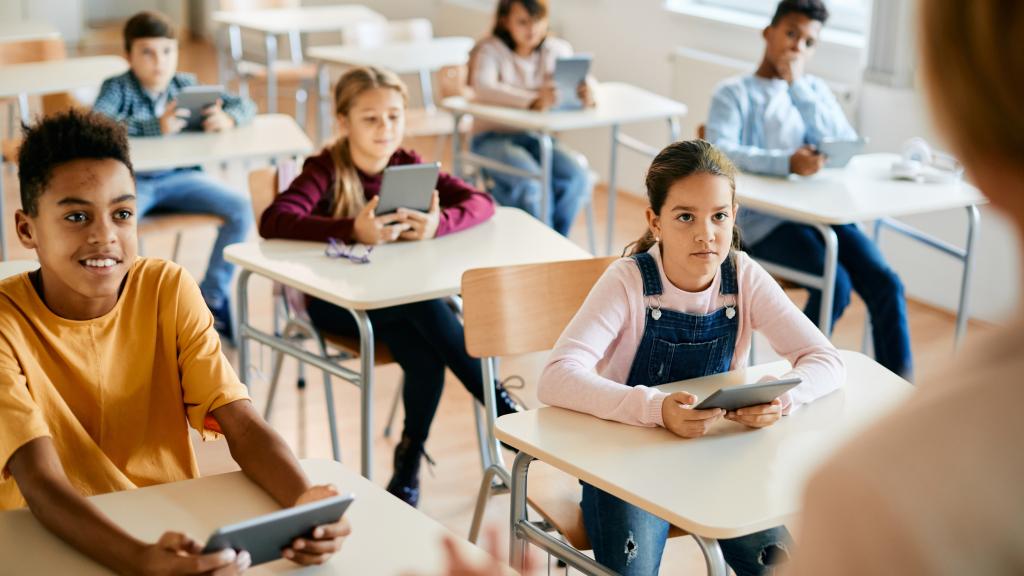
In many classrooms, that means fewer moments where every student is individually immersed in a device and more moments where a screen is part of a shared task. A research team gathered around one Chromebook. A pair of students using AI to generate counterarguments and then debating their validity. A small group projecting a draft and revising it together.
The screen becomes a tool in the room, not the center of the room.
Discernment Must Be Taught
Students do not automatically know how to use powerful tools wisely. Adults struggle with this too. Algorithms are designed to capture attention. AI tools can remove friction instantly. Without guidance, efficiency can quickly turn into dependency.
If we remove screens entirely, we remove the opportunity to explicitly teach discernment.
Discernment sounds like this in practice:
Why are we opening this tool?
What problem are we trying to solve?
Could we do this better without a device?
How will we know when to close it?
What did this tool help us think about?
What did it make too easy?
These are metacognitive moves. They do not develop through restriction alone. They develop through modeling, repetition, and shared language.
As educators, we can narrate our own decision-making as a model for our students. “I am choosing this platform because it will allow us to compare multiple data sets quickly,” or “I am not using AI here because I want you to wrestle with the structure of this paragraph first,” or “We are closing devices now because the next step requires face-to-face dialogue.”
When students hear that reasoning consistently, they begin to internalize it.
Intentional and Efficient
Intentional use means the device is tied directly to a learning goal. It is not open-ended. It is not filler. It is not simply because the devices are available.
Efficient use means it is used for the portion of the task where it adds value, then closed.
A class might spend ten focused minutes using an AI tool to generate feedback on thesis statements, followed by twenty minutes of peer discussion and revision without screens. A science group might use simulation software to visualize a concept that cannot be replicated physically, then transition into hands-on experimentation.
The screen is a phase of the learning cycle, not the entire cycle.
When we allow screens to remain open indefinitely, passive drift becomes almost inevitable. When we structure clear beginning and end points, we reinforce agency.
Collaboration Over Isolation
One of the most powerful shifts schools can make is reducing isolated one-to-one screen immersion and increasing collaborative use.
Partnership changes behavior. Students are more likely to stay focused when accountable to a peer. They verbalize reasoning instead of silently copying. They question outputs together. They negotiate meaning.
A screen in the center of a group can spark dialogue. A screen in every lap can silence it.
This does not mean one-to-one devices have no place. It means we must be deliberate about when independence serves the goal and when collaboration deepens it.
Modeling Healthy Habits
If we want students to develop independence with technology, they must see healthy patterns modeled.
That includes protecting sleep by avoiding late-night assignments that require online submission at midnight. It includes demonstrating when paper is preferable for deep reading. It includes showing that boredom is not an emergency that requires a device.
It also includes honest conversations about distraction.
We can say explicitly, “These platforms are designed to keep you scrolling. Your attention is valuable. Let’s talk about how to protect it.”
Those conversations build awareness. Awareness builds regulation.
Equity and Literacy
Digital literacy and AI literacy are not optional skills. They are emerging competencies. If we remove opportunities to practice these skills in structured environments, we risk widening gaps between students who receive guidance at home and those who do not.
School remains one of the few spaces where adults can slow the process down and teach students to question what they see, analyze outputs, detect bias, and use tools ethically.
That work requires exposure, not avoidance.
Balance Requires Design
None of this suggests unlimited screen use. Sleep matters. Handwriting still supports memory. Face-to-face conversation builds empathy in ways devices cannot replicate.
Balance is not achieved through extremes. It is achieved through thoughtful design.
We can ask ourselves:
Is this use active or passive?
Are students collaborating or isolated?
Is there a clear beginning and end?
Are we naming the purpose aloud?
Are we teaching students how to evaluate the tool itself?
When those questions guide practice, screens become instruments rather than environments.
The Long View
Our goal is not to raise students who comply with restrictions. Our goal is to raise students who can navigate complexity with judgment.
That requires guided practice.
If we want graduates who can use AI without overreliance, who can manage distraction, who can collaborate digitally with integrity, and who can close a laptop when the moment calls for presence, we must create classrooms where those habits are intentionally cultivated.
Screens are powerful. So is modeling. So is conversation. So is partnership.
The answer is not simply removing devices. The answer is designing experiences where technology is purposeful, efficient, collaborative, and always in service of deeper human thinking.
Discernment is not downloaded. It is taught by design.

Michelle Gierman
Michigan Virtual AI Ambassador (Avondale School District)
Related Posts

I Am Iron Man A Teacher: Balancing High-Tech Tools with Human Heart
Why You’re the Hero, and AI is the Armor We’ve all seen the scene: Tony Stark, battered and outmatched, taps his chest. In a flurry of...

What ASU+GSV 2026 Revealed About the Future of AI in Education
What emerged from ASU+GSV 2026 was clear: AI is no longer an emerging trend in education. Michigan Virtual reflects on the conversations shaping the future of teaching, learning, workforce readiness, and student agency in an increasingly AI-driven world.

Understanding How Students and Teachers Think About Responsible AI Use: An Interview with a Researcher
Students and teachers generally understand the risks of AI misuse, but they are less clear about what responsible AI-supported learning should look like in practice. This interview highlights findings from a Michigan Virtual study showing that students need clearer examples, consistent expectations, and practical guidance for using AI transparently and appropriately in schoolwork.

The Environmental Trade-Offs of AI in Michigan Education
As both a Michigan Virtual AI Ambassador and the AI Strategist for Avondale School District, I spend much of my time exploring how...

How Students Really Use AI (with Karle Delo from Michigan Virtual)
In a recent episode of Make It Mindful: Insights for Global Learning, host Seth Fleischauer sits down with Karle Delo, AI Strategist at...
Self-Efficacy, Culture, and the Path to AI Adoption in Schools (with Dr. Nikolas McGehee)
In this episode, Dr. Nikolas McGehee talks about how confidence, curiosity, and a supportive school environment influence the way...