
Introduction
The adage that online learning capitalizes on students’ desire for flexibility through providing learning ‘any time, any place, and at any pace’ is commonly touted as a strength of this modality. However, as highlighted within the Introductory report in this series (‘Any time, any place, any pace: An introduction to the flexibility of K-12 virtual learning’), notable gaps exist in our understanding of how K-12 students engage with this flexibility and its potential relationships with course outcomes. To address this gap, three reports, each focusing on a different aspect of learning at ‘any time, any place, and at any pace,’ were published.
The ‘Any Time, Any Place, Any Pace: How Students Use Time in Online Courses’ report focused on describing the timing of students’ enrollment, course access, and assignment submissions. This report provided a reminder that context matters when examining students’ enrollment and course access behaviors. Delays in enrollment were not always a sign that students were disengaged or falling behind, but rather, a strategic choice based on course offerings.
Using building-reported demographic information and assignment submissions, the ‘Any Time, Any Place, Any Pace: How Students Use Place in Online Courses’ report explored students’ use of ‘place.’ Interestingly, students' assignment submissions were concentrated during weekday school hours, with students who were struggling tending to rely more heavily on this structure.
Finally, the ‘Any Time, Any Place, Any Pace: How Students Use Pace in Online Courses’ report analyzed student assignment submission behaviors to examine pacing across a course. Students who submitted an assignment within the first week of the course had higher final course scores than those who did not. Defining pacing as cumulative progress revealed a significant gap in progress between students who do well in their online courses and those who do not. Finally, pacing as a construct concerned with the order of students' assignment submissions also had important implications for performance; there was a negative relationship between final course score and moving through a course out of order.
Looking at each component in isolation facilitated a deeper appreciation for how students leverage these aspects of online learning, but time, place, and pace are inherently interconnected. For example, a student preparing for a big sporting competition may submit several assignments in close succession one evening from home to free up their schedule for additional practice time. Another student may submit assignments during their study period at school, where they can ask their mentor for help understanding the instructions or content. Taken together, time, place, and pace information can help mentors and instructors support students, but examining their intersection may yield additional meaningful insights to better support them. This final report in the series aims to put all the pieces together.
Scope & Data
For a full review of the data used in this report, please refer to ‘Any Time, Any Place, Any Pace: How Students Use Time in Online Courses’. This report synthesizes the results of the other three reports in this series, along with supplemental analyses that highlight the interconnectedness of time, place, and pace. Specifically, this report will break down performance and progress by assignment type and final course score, and examine differences in performance by first-week submission behavior. As a reminder, students are categorized as failing if they earn less than 60% of course points and as demonstrating content mastery if they earn more than 80% of course points.
Themes Across Time, Place, and Pace
Across the three reports published in this series so far, two prominent themes that comprehensively synthesize the previous reports have emerged. Each will be discussed in the following sections, highlighting previous work and new analyses.
Strategic flexibility: Access versus assignment submissions
Examining students’ relationship with the flexibility to access and submit assignments at any time revealed that while students’ first course access was most likely to occur outside traditional school hours (i.e., before 7 am or after 3 pm on a weekday, or on a weekend), assignment submissions were concentrated during weekday school hours (i.e., between 7 am and 3 pm on a weekday). In fact, we observed that 65% of assignments were submitted during weekday school hours, with Mondays between 8:00 am and 2:00 pm being the most frequent days and times for submissions (Cuccolo & DeBruler, 2026). Using assignment timestamps as a proxy for “place” revealed potential variations in the use of school-based structures by assignment type. Both quizzes and dropbox assignments were more likely to be submitted during weekday school hours than discussions (Cuccolo & DeBruler, 2026b).
Assignment completion distinguishes between student outcomes
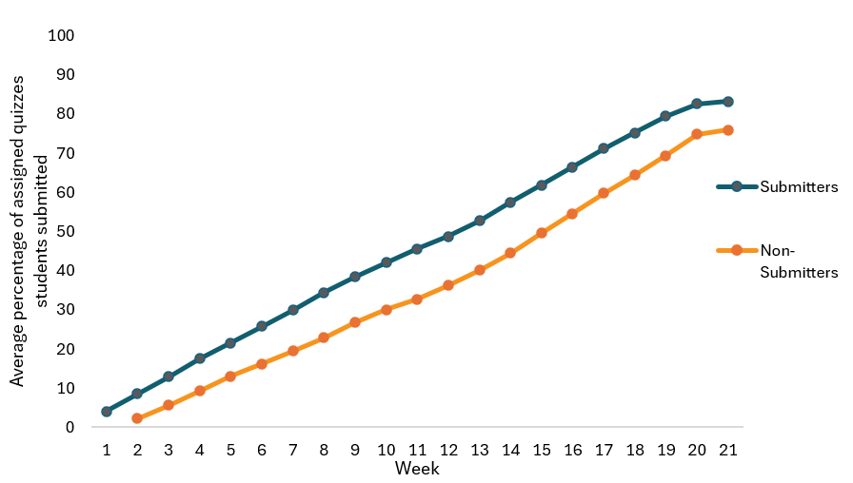
Assignment completion trends may emerge as early as week one, highlighting how the timing of students' first assignment submission may have important implications for their pace throughout the course. In the ‘Any Time, Any Place, Any Pace: How Students Use Pace in Online Courses’ report, we identified that students who submitted an assignment within the first week of their course had final course scores about six points higher than their peers who failed to submit an assignment in that first week. Interestingly, students who failed to submit any type of assignment in the first week of a course had average quiz scores nearly identical (i.e., within 2 percentage points) to those of their peers (except in the first week, when their average was zero as they had not yet submitted any assignments). Thus, as we observed in the pacing report comparing students who demonstrated content mastery and those who failed, performance doesn’t boil down to a quality-of-work issue alone. The next two figures highlight this distinction by showing how well students did on the quizzes they submitted (review Figure 1), and the percentage of quizzes they submitted (review Figure 2).
Figure 1. Average cumulative quiz scores by week based on first week submission status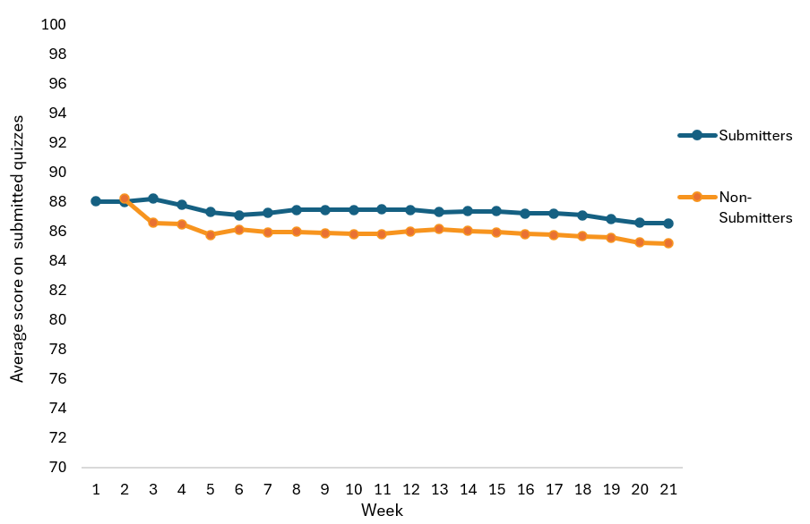 A closer look shows that students who did not submit an assignment in the first week of a course consistently submitted fewer quizzes than their peers, and this gap (i.e., an average of 10 percentage points) persisted throughout the course. In other words, students who failed to submit an assignment in the first week never fully caught up (refer to Figure 2).
Figure 2. Average cumulative percentage of quizzes submitted based on first week submission status
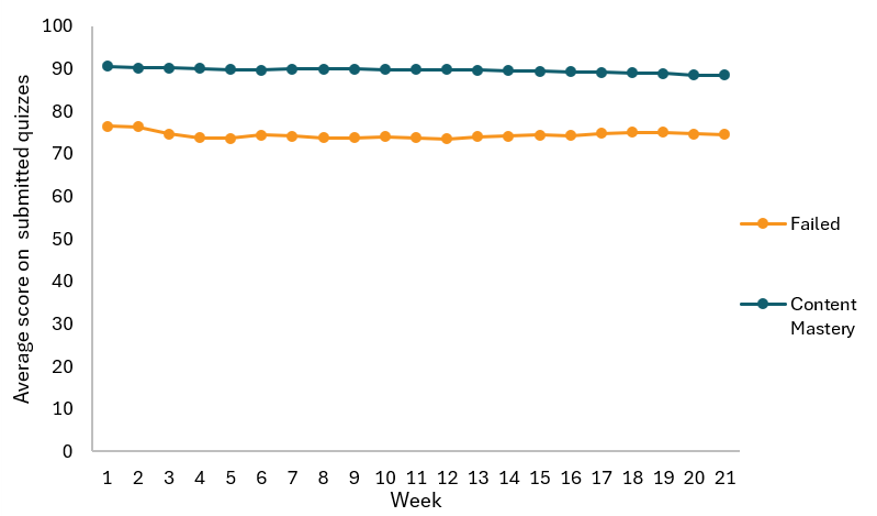
 Looking specifically at students' final course outcomes further highlights the importance of assignment completion, not just work quality. It may be intuitive to assume that students fail because their submitted work is of lower quality than their peers', that is, they submit work but receive failing grades. While a performance gap exists, it is not as large as one might expect and does not fully explain why some students do poorly in their online courses. Figure 3 highlights the quality of work students produced, while Figure 4 shows the trajectory of completed work. Students who failed their courses earned, on average, 75% of available points on their submitted quizzes, and this performance remained relatively stable throughout the course (see Figure 3). Students who demonstrated content mastery earned, on average, 89% of available points. The larger discrepancy was observed in the proportion of quizzes submitted (refer to Figure 4). For example, students who demonstrated content mastery submitted around 50% of course quizzes by Week 12 (just over “halfway” through the course), but students who failed didn’t hit this milestone until Week 19, which is concerning given that most Michigan Virtual courses are approximately 20 weeks in duration. Overall, the performance and progress gaps between students who demonstrated content mastery and those who failed were approximately 15% and 20%, respectively.
Figure 3. Average cumulative submitted quiz scores by week based on course performance
Fairly similar trends were observed when examining dropbox and discussion assignments. A gap in the percentage of cumulative discussions submitted existed between students who failed and those who demonstrated content mastery from Week 1, and remained relatively stable throughout the course. When looking at cumulative Dropbox submissions over a course, students who failed and those who showed content mastery were very similar in Weeks 1 and 2, but diverged as early as Week 3, and the gap widened significantly thereafter.
Figure 4. Average cumulative percentage of quizzes submitted by week based on course performance
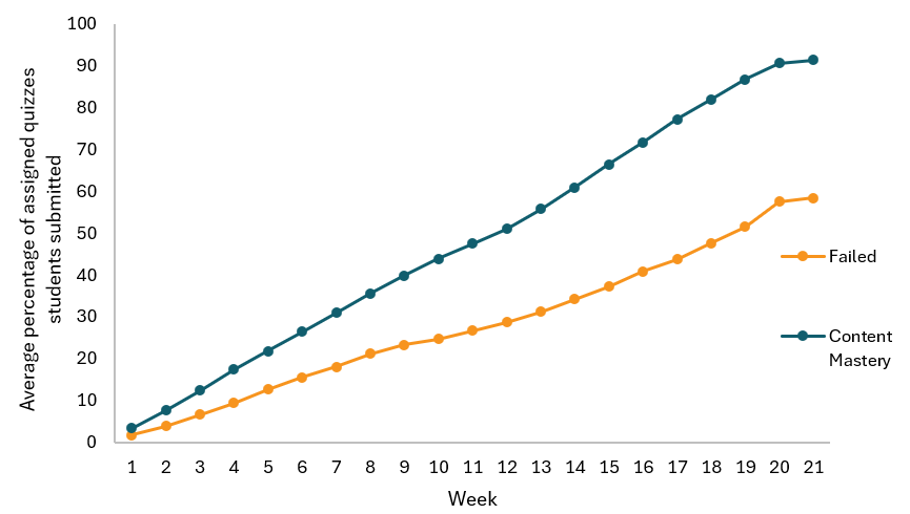 Together, these findings suggest that differences in course outcomes are tied more closely to how much work students complete than to their performance on submitted assignments alone. Because these differences can emerge early and persist throughout the course, the first few weeks may be an important time to identify and support students who are falling behind.
Bringing Time, Place, and Pace Together
Students who performed well showed a distinct pattern—less reliance on school-hours submissions and more consistency in pace. Students who did well (i.e., passed their course, and demonstrated content mastery) tended to rely less on school-based structure when submitting assignments, while their struggling peers concentrated their efforts in the hours when school-based support was more likely to be available. This may suggest that struggling students are leaning on school-based supports more than their peers, whether that be self-motivated or prompted by a mentor or similar school professional.
Relatedly, time and pace showed a relationship that could inform student support practices, as the timing of students' first assignment appeared to relate to their pacing throughout a course. Across all assignment types, a significant gap in progress emerged by week 4 (e.g., an average gap of 15% for quizzes). Students’ performance on their assignments was relatively similar throughout the course (e.g., within 2% for quizzes), regardless of final course score, but by week 4, students who go on to fail their courses are significantly behind their peers in regard to workload. Finally, the order of students’ assignment submissions matters, as the proportion of assignments submitted out of alignment with course pacing guides increases, final scores decrease.
Taken together, these results highlight several pacing patterns associated with students’ course outcomes. Specifically, the amount of work completed over time, the timing of the first submission, and the order of submissions can provide instructors and mentors with important information about students’ course progress and potential need for support.
Implications
In light of the reviewed evidence, understanding how to balance flexibility with structured support may be an ideal path forward for promoting positive student outcomes in digital learning.
Administrators
While students in the courses sampled arguably had unlimited flexibility in when they accessed their courses and submitted their assignments, clear trends emerged from the data. Students were most likely to access their courses outside of traditional school hours, but the opposite pattern emerged for their assignment submissions. Further examining this trend, we observed that lower-achieving students were more likely than their peers to submit during weekday school hours. Thus, students may leverage the flexibility of time and place to submit assignments when they have the most support. This highlights the importance of having building-level support for students taking virtual courses.
Mentors and instructors
Instructors and mentors should also be thoroughly monitoring students’ pace and assignment submissions early in the course, because early-course behaviors (weeks 1-4) can compound over time. Assignment submissions in week 1 are important indicators of potential course outcomes, as students who do not submit an assignment in week 1 are more likely to fail than those who do. Further, by week 4, assignment submission trends generally stabilize (with students who ultimately fail their courses submitting a significantly lower proportion of assignments), suggesting interventions should occur around or before this point. Ultimately, teachers and mentors should ask themselves the following questions about their students by the end of week 3, before these gaps solidify:
Did the student submit anything in week 1? (Submission timing)
Is the student keeping up with the proportion of work expected by this point? (Submission frequency)
Is the student moving through the material as sequenced, or jumping around? (Submission order)
The promise of learning “any time, any place, and at any pace” does not mean that students learn without structure or support. Students accessed their courses at varied times but concentrated much of their assignment activity during weekday school hours, particularly those who struggled. Course outcomes were also distinguished more by how much work students completed than by their performance on submitted assignments alone. These patterns suggest that students use flexibility differently, and that some continue to rely heavily on school-based structures even when learning online.
These findings do not suggest that flexibility should be reduced. Rather, flexibility may be most effective when paired with timely, targeted support. Monitoring whether students submit work during the first week, maintain sufficient progress, and generally follow the intended course sequence can help mentors and instructors identify students who may need assistance before gaps become difficult to overcome. Ultimately, providing flexible learning opportunities and ensuring that students have the structure needed to use them successfully should be viewed as complementary goals.
References
Cuccolo, K. & DeBruler, K. (2026). Any time, any place, any pace: How students use pace in online courses. Michigan Virtual. https://michiganvirtual.org/research/publications/any-time-any-place-any-pace-how-students-use-pace-in-online-courses
Cuccolo, K. & DeBruler, K. (2026). Any time, any place, any pace: How students use place in online courses. Michigan Virtual. https://michiganvirtual.org/research/publications/any-time-any-place-any-pace-how-students-use-place-in-online-courses
Cuccolo, K., & DeBruler, K. (2026). Any time, any place, any pace: How students use time in online courses. Michigan Virtual. https://michiganvirtual.org/research/publications/any-time-any-place-any-pace-how-students-use-time-in-online-courses
Cuccolo, K. & DeBruler, K. (2026). Any time, any place, any pace: An introduction to the flexibility of K-12 virtual learning. Michigan Virtual. https://michiganvirtual.org/research/publications/any-time-any-place-any-pace-an-introduction-to-the-flexibility-of-k-12-virtual-learning