

Book Review: Critical AI in K-12 Classrooms (+ How to Earn SCECHs For Reading!)
 Danielle Peck
It’s become hard to ignore the proliferation of AI in the past few years. It seems like it’s everywhere: from the menu at your local coffee shop, to your online searches, to your medical appointments.
You’ve almost certainly seen it in your school, too. Maybe you’ve noticed your students using it on assignments. Maybe your district has a subscription to a chatbot. Maybe you’re expected to incorporate AI into your practice or teaching in some way.
Honestly, it’s overwhelming. And you, understandably, might be wondering what to do about all of this. If you’re anything like me, you might be wondering:
How can I prepare myself, as an educator, to both understand and use AI toward justice and joy, and in ways that do not harm marginalized and minoritized students?
Luckily, the book Critical AI in K-12 Classrooms: A Practical Guide for Justice and Joy is focused on answering this exact question.
 Authors Stephanie Smith Budhai and Marie K. Heath have written a concise text that informs, inspires, and encourages educators to innovate with inclusion as a priority. Here are three things I loved about the book:
1. The Book Takes AI's Harms Seriously
Over the past few years, I’ve facilitated professional learning on AI across Michigan. In listening to educators, I’ve realized that one reason AI can seem overwhelming is that they recognize the technology causes harm. Researchers, activists, journalists, and others have done amazing work bringing injustices in AI into public consciousness: from environmental harms to racial bias and systemic rejection. Educators have seen and heard about these issues. They have ascertained that these harms are a big deal and should have a real bearing on their practice and use of AI. But they have found that much existing AI training for educators either ignores or glosses over these problems.
Budhai and Heath hear this and argue that the first step in understanding and using AI toward justice and joy is naming and acknowledging existing injustice in AI and schools. To reflect this, they begin the book with a chapter about the harms that AI has done to society at large and to schools in particular: from predatory lending algorithms to algorithmic surveillance of K-12 students. To help readers understand, they detail information on the injustices themselves and how the technology creates them. This provides educators with the knowledge they need to communicate confidently with students and colleagues about these issues.
I appreciate that Budhai and Heath begin the book by offering a clear and realistic view of the current AI landscape. It’s the foundation for the rest of the book, not an afterthought. This is central to what makes the text so effective. As James Baldwin famously said,
“...Nothing can be changed until it is faced.”
The book first allows readers to face the more uncomfortable realities of AI. Then, it equips them with tools to make meaningful changes in their own settings.
2. The Book is Full of Engaging Classroom Activities
Budhai and Heath offer so many concrete ways for educators to “use AI toward justice and joy, and in ways that do not harm marginalized and minoritized students” (12).
Some of these activities encourage educators and students to engage critically with existing technologies.
One activity I particularly liked was an investigation of how generative AI might shape an understanding of community.
First, students make a sound journal of their day, either recording or writing down sounds they hear around them in the community. Then, the class creates a collective sound story that answers the question: “What do the sounds of our community show about who we are?” (Budhai and Heath 116).
After the students have crafted their story, the class asks one or more generative AI models what they might hear in their community. Students compare their human-crafted sound story to what was generated by the LLMs.
This is a great opportunity to unearth and answer students’ questions about the descriptions that the LLMs generate. The activity offers a space to explore the differences between students’ visions of their own community and algorithmically-mediated visions.
If students in a classroom have access to a chatbot, educators could have them use the technology themselves. But the activity works just as well if the teacher generates the LLM response for the class to go over together. This offers so much flexibility: the activity can be done in classrooms where students don’t have access to AI due to their age or school policy. By generating a single answer, educators can also minimize LLM use and avoid putting students in a position where they’re compelled to use the technology.
Other activities in the text offer ways to resist in order to work towards more just technological futures.
One very easily actionable step that Buhai and Heath suggest is to review the default settings of AI technologies with students.
Educators can teach students how to navigate to settings and review each setting together as a class. “Invite students to turn off settings which collect, surveil, or force default to choices which benefit the company, not the child” (Budhai and Heath 143).
This seems like such an obvious thing to do. Yet, I can confidently say that I never did it in my classroom - in fact, I never even looked into the settings of ed tech tools for my own use!
It’s a powerful way to engage everyone in a classroom community in a simple, meaningful act of resistance against harmful aspects of technology. And it’s a reminder that we have agency. Small actions like these can lead to more inquiry, discussion, and further action towards creating more just technological futures.
3. The Activities are Really Effective in Practice
The book’s subtitle is A Practical Guide for Cultivating Justice and Joy, and it’s true: educators can easily incorporate ideas and activities from the book into the work they do every day.
How do I know? I’ve tried some of the activities out with educators, and they were a hit!
Thinking Critically About AI-Generated Images
One of my experiences applying the ideas from the book was a professional development session that I led for educators from across Michigan. I decided to try an abbreviated version of another activity from the book:
“Invite students to ask AI to generate images of a well-known historical figure of color, such as Ella Baker… Ask students to compare this image to historical photographs. Guiding questions could be:
Do you believe that the image is accurate? Why or why not?
What do you notice about the image?
What do you wonder about what the AI chose to highlight and conceal? What do historical photos show?”
(Budhai and Heath 131)
I asked ChatGPT, Claude, and SchoolAI to generate an image of Ella Baker. I compiled a printed packet with the three generations, plus a collage of real historical photographs of Baker (here’s access to a digital version of the packet; navigate using the tabs on the left).
At the presentation, I first gave a short lecture-burst about Baker to remind the audience of her historical impact. Each session attendee then received one of the printed packets, which they first explored and annotated on their own. Next, attendees spoke with one another about what they had observed. Finally, we had a whole-group discussion.
Some highlights from our discussion:
Both ChatGPT and SchoolAI’s generations created faces that don’t even look like Ella Baker’s real face. They also got her hair and personal style wrong. Dr. Buolamwini has shown that AI facial recognition systems fail to “see” famous Black women correctly; in this example, we see generative AI fail to render another famous Black woman accurately.
Baker is very animated in many of the real historical photographs, often speaking emphatically in front of a microphone. Participants said she looked powerful in the historical images, but more reserved and calm in the AI-generated images. Generative AI demonstrates bias in favor of white and Western standards of “respectability,” and the images appear to reflect this in practice.
The AI generations appear to lighten Baker’s skin tone. We also noted that the photographers and/or publications that prepared her earlier historical photographs (from approximately the 1940s) lightened her skin, as well. Generative AI demonstrates bias in favor of white and Western standards of “beauty,” and the images also seem to show this in practice.
Claude AI stated, ”I can't generate an image of a real person, but I can find existing photographs of her.” Given what ChatGPT and SchoolAI generated, this seemed like a reasonable policy. We did notice that Claude’s generation included two human-made artistic depictions of Baker, but Claude referred to them as photographs. After I asked Claude about this, the program responded that this is because it only had the titles and sources of the results, not the images themselves.
The session participants were really engaged, and it felt communal for all of us to focus on a set of shared images. It was frustrating to see how inaccurately a powerful freedom fighter of the Civil Rights movement was portrayed. We discussed how many of us in the room technically knew that generative AI can create racially biased responses. But actually seeing the images elicited visceral responses that led to deeper ways of understanding this bias.
Importantly, it was also joyful to take the time to learn about Ella Baker. It felt energizing to study the real historical photos closely and strive earnestly to see her as who she actually was. The activity was a reminder that we have agency to challenge and push back on AI bias.
Many participants in my session left eager to pick up Critical AI in K-12 Classrooms. Maybe you’re interested in checking it out, too. If so, you can…
Earn SCECHs For Exploring The Book
If you’re a Michigan educator looking to complete continuing education hours (SCECHs), you can do so with Budhai and Heath’s book.
Once you have a copy of Critical AI in K-12 Classrooms in your hands (tip: you can request it at your local library!), you can sign up for a course we created: Read, Reflect, Grow: Critical AI in K-12 Classrooms Book Study.
The course is simple: all you need to do is explore the book and provide a short reflection about how you’ll use what you learned in your own practice. It’s self-paced and unfacilitated, so once you’re finished, you’ll immediately earn 2 SCECHs.
If you spend more than two hours exploring the text and putting its ideas into practice, you can earn more SCECHs by taking MyPD 6 or MyPD 10. In those courses, you’ll document your independent learning, get feedback from a Michigan Virtual Professional Learning Specialist, and earn 6 or 10 SCECHs.
Happy reading! We look forward to hearing your insights about the book in our courses.
Citation
Budhai, Stephanie Smith, and Marie K. Heath. Critical AI in K-12 Classrooms: A Practical Guide for Cultivating Justice and Joy. Harvard Education Press, 2026.

Danielle Peck
Senior Professional Learning Specialist
Danielle comes to Michigan Virtual’s professional learning services team with over a decade of experience teaching in the classroom. She is passionate about collaborating with educators to create and implement instructional practices that are transformative and liberating. Danielle is a graduate of Michigan State University with a bachelor’s degree in English and history and a master’s degree in curriculum and instruction. In her free time, she enjoys reading, acting, crafting, and spending time with her family.
Related Posts

Square One helps teachers put STEM learning in motion
See how Square One Education Network brought educators together at Michigan Virtual’s Innovation Design Studio for hands-on autonomous vehicle training, helping teachers build new skills and bring STEM learning opportunities to their students.

Start Strong, Stay Connected: 3 Practices for Building Classroom Community
Most teachers pour energy into building classroom community during the first week of school, then gradually shift focus as the year picks up. The relationships students need to thrive, though, do not build themselves after August. Here are three practices to help you start strong and stay intentionally connected all year long.
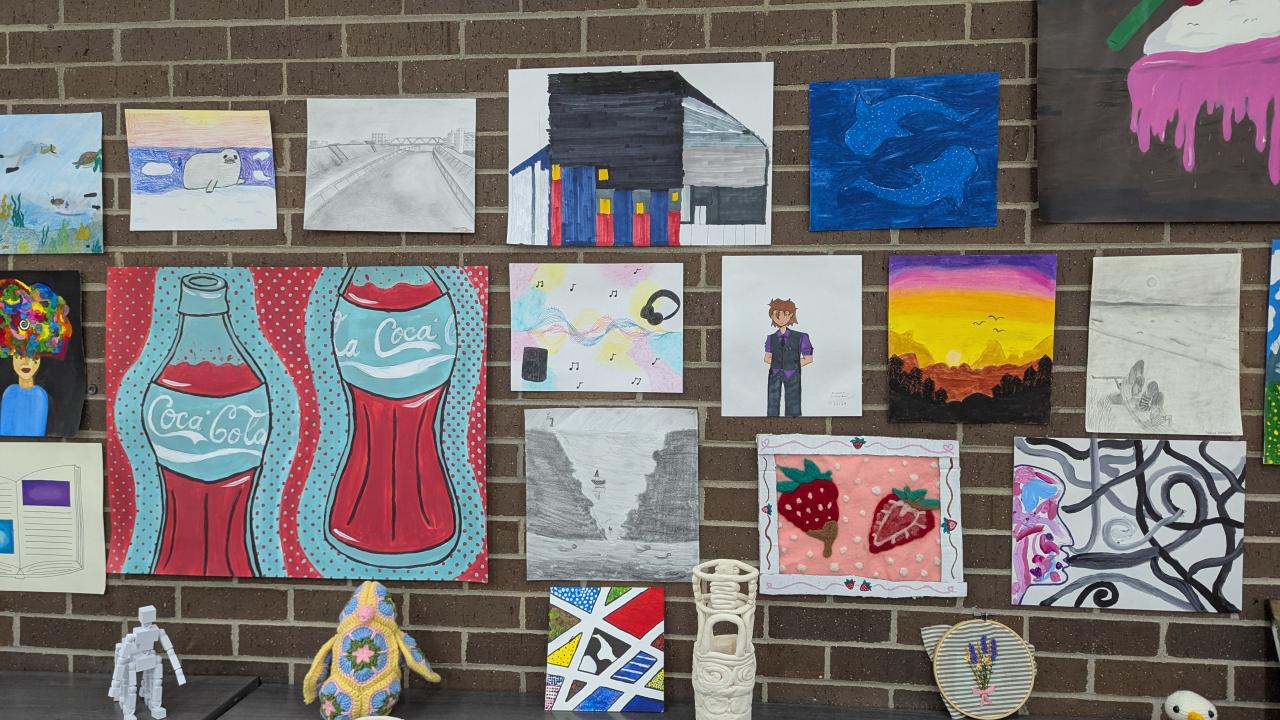
From Simple Squares to Sweaters: How One Teacher Uses Crochet to Build Confidence
When Erica Gorzen’s students pick up a crochet hook, they choose their own path. Some make simple squares. Others create sweaters and stuffed toys. As the 2026-2027 Regional Teacher of the Year, this Portland High School art teacher shares how choice-based lessons help her students build confidence, independence, and a love of learning that lasts well beyond the classroom.

Build Trust, Boost Autonomy, & Design Smarter Check-Ins With Students
Strong student relationships don't happen by chance. They happen by design. Discover how structured check-ins can build trust, strengthen student autonomy, and help you create more student-centered learning experiences. Plus, access a free template or earn a SCECH while creating a check-in routine for your classroom.

Revisiting the 5:1 Ratio: Reflecting on a "Magic" Ratio Just Too Tidy to be True
A popular idea in education holds that teachers should aim for five positive interactions for every one corrective one. It spread quickly, cited widely, and seemed to just make sense. There was only one problem: the research behind it was never really about teaching at all.

I Am Iron Man A Teacher: Balancing High-Tech Tools with Human Heart
Why You’re the Hero, and AI is the Armor We’ve all seen the scene: Tony Stark, battered and outmatched, taps his chest. In a flurry of...