

Beyond Resistance: Understanding & Using Change Sets to Support Transformation

Transformation is worth examining in any environment and at any stage of life. I have spent substantial time trying to understand what change is, how transformation differs from change, and how people and systems can learn and grow through both. Some inquiries developed independently as I explored mindset, systems, skills, tools, and coaching in depth. Other insights emerged together, with one concept shaping another. While reading Brené Brown's Strong Ground (2025), I began organizing these topics into sets. Brown's language around mindsets and skill sets gave me a clearer way to name and connect ideas I had been studying and practicing for years.
In mathematics, a set is a collection of distinct elements considered as a whole (Cantor, 1955). I intentionally use the word “set” rather than category because sets invite us to think relationally rather than hierarchically. Additionally, each set consists of many subsets. Elements in these sets belong together, overlap, and interact. One element may belong to more than one set. These boundaries help organize our thinking without pretending reality is neatly divided.
Through this lens, I see five change sets that support transformation: mindset, skill set, tool set, coaching set, and system set. These are not the only elements that matter, and they are not in sequence. They are practical lenses for assessing readiness, locating barriers, and choosing more intentional responses.
Leaders often assume people resist change. I increasingly believe they may simply be struggling in a different change set.
Figure 1. Change Sets for Transformation. Graphic and interpretation by Dr. Tovah Sheldon
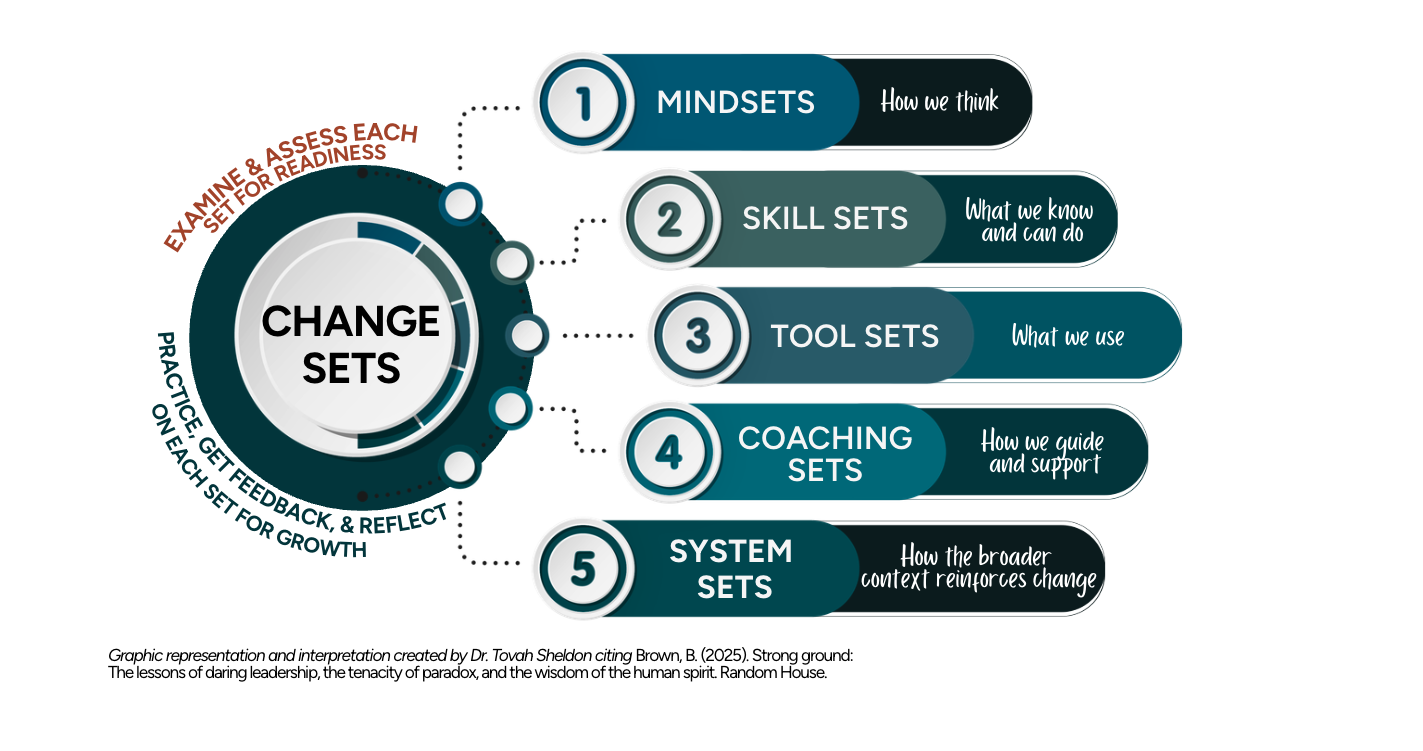
Change Sets: A Framework for Transformation
The sets are presented separately for clarity, but they operate together. The visual may appear to shift from the individual to the collective, or from the internal to the external. That is not the intent. Individuals, teams, and organizations may begin with any set depending on context, need, and readiness. Mindset often shapes interpretation and action, but it is not always the first or only place to begin.
Building on Costa and Garmston's (2015) framing, I view transformation through the lens of holonomy. Koestler (1967) used the term "holon" to describe something that is both a whole and a part. People simultaneously function as autonomous individuals and as interdependent members of teams, organizations, communities, and broader systems. Implementation research offers a related lesson. Sustainable implementation requires aligned attention to competency, organizational, and leadership conditions, not a single intervention (Fixsen et al., 2005). Keep that whole-part relationship in mind as we examine each set.
A note about the framework:
Use the sets as nonlinear lenses for inquiry and assessment. Start where the context indicates, then keep looking across the whole. The goal is not to reduce complexity to isolated pieces. The goal is to make complexity more usable.
Table 1. Core Questions & Primary Focuses of Change Sets
Change Set | Core Question | Primary Focus |
|---|---|---|
Mindset | How do we think? | Beliefs, assumptions, perspectives, and interpretations |
Skill Set | What do we know and can we do? | Competence, practice, behavior, and application |
Tool Set | What do we use? | Resources, workflows, processes, and protocols |
Coaching Set | How are we guided and supported? | Listening, questioning, feedback, perspective taking, and accountability |
System Set | What does the broader context reinforce? | Culture, policies, structures, incentives, power, and history |
1. Mindset: How We Think
Why It Matters
Mindset drives attention, interpretation, and behavior. It shapes what people notice, what they believe is possible, and how they respond to uncertainty. Mindset is a person's established set of attitudes, beliefs, and assumptions about the world and themselves. Research on growth mindset emphasizes that beliefs about whether human capacities can develop can influence motivation and behavior. It also reminds us that context and implementation matter (Dweck & Yeager, 2019). No one arrives at the right mindset and moves on. It is not something we simply have, and it is not a light switch that turns on or off. Mindset is closer to a daily practice. Experience, information, emotion, and context continue to shape it. We can notice it, question it, and strengthen it. When people encounter change, they make meaning before they make a move. A change-ready mindset does not require constant optimism. It requires enough curiosity, courage, and openness to examine assumptions, receive feedback, and learn. Psychological safety also matters. People are more likely to ask questions, admit mistakes, and test new approaches when the environment feels safe enough to take interpersonal risks (Edmondson, 1999). Mindset work cannot be separated from the conditions around it.
Mindset Assessments
Self-reflection: Invite individuals to identify their current beliefs and attitudes about change, challenge, and uncertainty. Questions might include:
"Am I asking learner questions or judge questions?" (Adams, 2022)
"How am I showing up?"
"Am I choosing curiosity over armor?"
Team pulse checks: Use brief surveys, interviews, and open discussions to identify prevailing patterns such as fixed thinking, growth thinking, resistance, possibility, fear, or readiness.
Mindset mapping: Identify armor behaviors such as perfectionism, cynicism, defensiveness, blame, or avoidance. Name what those behaviors may be protecting.
Evidence review: Compare stated beliefs with actual decisions and behaviors. Notice where words and actions align and where they do not.
Mindset Strategies
Clarify the why: Connect the purpose of the change to the daily work, the people affected, and the outcomes that matter. A compelling vision needs repeated, concrete communication (Kotter, 1995).
Normalize discomfort: Name emotions and uncertainty so people can work with them rather than hide or perform around them.
Treat mistakes as information: Reframe failures and missed attempts as data for learning, not as endpoints or proof that growth is impossible.
Model learning: Leaders should visibly ask questions, seek feedback, acknowledge errors, and adjust their own thinking. When leaders do this, they give 'permission' for others to do the same. People do as you do, not do as you say.
Create space for voice: Build routines that make questions, dissent, and feedback expected parts of the work.
2. Skill Sets: What We Know and Can Do
Why It Matters
Skill sets are the capabilities people need to perform tasks, use new practices, and navigate change. Skills are learnable, repeatable behaviors that support an intended outcome when practiced and sequenced effectively. Brown (2025) challenges the quick conclusion that people are resistant. Sometimes people are willing but unprepared, or they have not yet developed the skills the work requires. Adaptive challenges are especially demanding because technical knowledge alone cannot solve them. They require people to learn new roles, relationships, priorities, and ways of working (Heifetz et al., 2009). In education, relevant skills may include communication, difficult conversations, navigating uncertainty and conflict, receiving feedback, perspective taking, and using different kinds of thinking. These capacities may draw on cognitive, emotional, social, cultural, and resilience-related strengths. Expectations without skill development create frustration and mislabeling. A clear vision does not create competence by itself. People need opportunities to learn, practice, receive feedback, and try again.
Skill Set Assessments
Skill awareness exercise: Individually and collectively list the top five to ten skills needed to complete a known task or reach a defined outcome. Break large competencies into observable behaviors.
Skill gap analysis: Compare the skills required in the desired future state with the skills currently demonstrated by individuals and teams.
Performance evidence: Use observation, work samples, and relevant performance indicators to understand what people can do, not only what they report knowing.
Readiness analysis: Identify whether the gap involves knowledge, skill, confidence, opportunities to practice, or another condition.
Skill Set Strategies
Target learning: Design workshops, courses, demonstrations, and practical exercises around identified gaps rather than offering broad training that may not match the need.
Use deliberate practice: Provide focused practice on specific aspects of performance, paired with timely feedback and repeated opportunities to improve. Deliberate practice is more than repetition. It is structured improvement work (Ericsson et al., 1993).
Create safe application opportunities: Use simulations, rehearsals, pilot projects, and low-risk trials before expecting full implementation.
Build observation and mentorship: Pair experienced individuals with those developing a skill. Make modeling, observation, feedback, and reflection part of the learning process.
Connect training to coaching and performance assessment: Implementation research shows that training alone is rarely enough. Competency development is stronger when training, coaching, and performance feedback work together (Fixsen et al., 2005).
3. Tool Sets: What We Use
Why It Matters
Tool sets include resources, technologies, processes, procedures, protocols, templates, and operational systems that help people work with greater clarity and effectiveness. A tool can be physical, digital, relational, or procedural. A common language, a meeting protocol, a decision rule, and a technology platform can all function as tools. Brown (2025) raises three important cautions. Organizations often adopt tools without addressing the mindsets and skills needed to use them. Tools should reduce ambiguity rather than add to it. Tools also cannot compensate for low psychological safety. New tools are often visible, so leaders may reach for them first. Tools often amplify the conditions around them. A strong tool used without access, training, purpose, or trust can create noise, overload, and superficial compliance.
Tool Set Assessments
Tool and workflow audit: Evaluate whether current tools support the intended process. Ask whether they reduce or create noise, whether people have access and training, and whether the tool solves a clearly named problem.
Visibility check: When a tool is not a physical item or technology, determine how it is made visible, tangible, shared, and taught. This may include a shared protocol, common language, or clear workflow.
Usability feedback: Collect feedback from users on a consistent cycle. Examine effectiveness, ease of use, pain points, workarounds, and unintended burdens.
Access and equity review: Identify who can use the tool easily and who cannot. Examine how time, technology, language, authority, or support may affect access.
Integration and redundancy review: Determine whether the tool fits existing workflows or adds another layer that duplicates work.
Tool Set Strategies
Provide necessary resources: Ensure access to technologies, platforms, materials, and time that support the new way of working.
Integrate tools with mindset and skill development: Pair a new tool with purpose, training, practice, and support so it is used with intention rather than simply introduced.
Simplify processes: Design workflows to be as clear and intuitive as possible. Reduce unnecessary steps and mental demand, especially while people are learning a new practice (Sweller, 1988).
Balance individual innovation with collective coherence: Pay attention to individuals who surface useful tools while also protecting the efficiency of shared tools and common language.
Plan for breakdowns: Make the response clear when a tool or process is not working. It isn't a matter of whether a tool won't work or whether a person will have conflict, but of when, so plan ahead of time for what to do. Establish a "Good Catch" culture in which people can identify problems early without blame.
Retire what no longer serves the work: Do not keep adding tools without removing outdated, redundant, or low-value practices.
4. Coaching Sets: How We Guide & Support
Why It Matters
Coaching provides personalized support as people navigate the emotional and practical aspects of change. It connects individual learning with collective and system improvement. Authentic relationships and intentional relational scaffolding are fundamental to sustaining change. Most coaching models combine active listening, powerful questions, perspective taking, feedback, boundary work, and accountability rooted in dignity. Coaching should never be a punishment or a last-ditch effort. It is stronger when it is embedded, expected, and available throughout the change process. Research on workplace coaching finds positive effects on learning and performance outcomes (Jones et al., 2016). In education, a meta-analysis of 60 causal studies found positive effects on instructional practice and student achievement. It also identified challenges in expanding coaching programs at scale (Kraft et al., 2018). Information alone rarely transfers learning into practice. Coaching creates space to think, test, receive feedback, build confidence, and strengthen accountability.
Coaching Set Assessments
Coaching analysis: Identify the forms of coaching needed for the change at hand. Review past coaching efforts to understand what worked, what did not, and why.
Coaching model selection: Research and select models that fit the purpose, people, and context. Possible approaches include Leadership Coaching for Innovation, Cognitive Coaching, instructional coaching, peer coaching, and executive coaching.
Feedback on support: Use surveys, interviews, and focus groups to understand whether people feel adequately supported and guided during the transition.
Coach and leader readiness: Assess the ability of leaders, managers, and other potential coaches to listen, question, build trust, offer useful feedback, and support accountability.
Access and fit: Examine who receives coaching, how often, under what conditions, and whether the approach respects differences in role, identity, experience, and need.
Coaching Set Strategies
Develop a coaching culture: Build coaching skills across roles. Encourage leaders and colleagues to use active listening, thoughtful questions, feedback, and reflection as normal practices.
Integrate coaching transparently: Define how coaching fits into each phase of the change process, from awareness and learning through application and reinforcement.
Provide tailored support: Match coaching to the needs of individuals and teams. No single coaching model fits every change, person, or system.
Protect trust and dignity: Clarify confidentiality, purpose, roles, and boundaries. Coaching cannot function as support if people experience it as surveillance or punishment.
Look beyond formal titles: Identify people who can coach effectively because of trust, experience, skill, perspective, or proximity to the work.
5. System Sets: What the Broader Context Reinforces
Why It Matters
System sets include organizational structures, culture, policies, incentives, resource decisions, power relationships, and formal mechanisms that reinforce or constrain change. Life does not happen in a vacuum. We are part of multiple systems, and those systems influence us as we influence them. Systems can be difficult to grasp because they operate at different grain sizes. Grain size refers to the level being examined, such as an individual, classroom, team, school, district, community, state, or broader network. Power and history also shape how systems respond to change. Systems thinking asks us to study relationships, patterns, feedback loops, delays, and unintended consequences, not only isolated events (Senge, 2006). Improvement science makes a related point in education. We have to understand the system that produces current outcomes if we want to improve them at scale (Bryk et al., 2015). Systems must reward and reinforce new behaviors, or established culture and routines will pull people back. Culture is reinforced through shared assumptions and through what leaders consistently pay attention to, model, reward, and embed in organizational routines (Schein & Schein, 2017). Brown (2025) similarly emphasizes that strong mindsets and skills are not enough when systems remain unchanged. When leaders locate every problem in the individual, they miss structural barriers. People may be motivated, skilled, coached, and equipped, yet still be blocked by schedules, policies, incentives, workload, decision rights, resource allocation, or power.
System Set Assessments
System and environmental scans: Look inside and outside the organization to name established and connected systems. Identify external factors and emerging conditions that may affect internal work.
Culture assessment: Evaluate whether the current culture supports the desired change. Ask what the organization rewards, celebrates, teaches, ignores, and tolerates.
Two-way values and behavior mapping: Name key values and map the expected and observed behaviors that support them. Then work in reverse by examining recent behaviors and identifying the values those behaviors communicate.
Policy and incentive review: Examine policies, schedules, structures, evaluation practices, and reward systems to determine whether they reinforce the new direction or protect the old one.
Power and history review: Identify whose voices shape decisions, whose experience is missing, and how past events affect trust, risk, and readiness.
Feedback loop analysis: Study how information moves, where decisions are made, how quickly the system responds, and where delays or unintended consequences appear.
System Set Strategies
Build a supportive culture: Foster psychological safety so people can experiment, voice concerns, question assumptions, and learn from mistakes.
Align policies, resources, and incentives: Make sure the formal system supports the behaviors leaders say they want. Remove barriers that make the desired practice difficult or costly.
Establish measures and feedback loops: Define useful indicators, monitor progress, and use regular feedback to make adjustments. Avoid measuring only what is easiest to count.
Institutionalize new approaches: Formalize effective practices through policy, structure, communication, onboarding, leadership routines, and resource decisions so the work does not depend on one person.
Examine underlying assumptions: Do not stop at correcting a behavior or result. Ask which rules, beliefs, and routines produced it. This reflects Argyris and Schön's (1978) work on organizational learning.
Include the people closest to the work: Engage those most affected by the change in understanding problems, designing responses, and interpreting evidence.
Monitor unintended consequences: Pay attention to how a change in one part of the system affects workload, access, relationships, outcomes, and other parts of the whole.
Putting the Change Sets Into Practice
The Change Sets framework is a guide for inquiry, not a checklist. Start with a specific change and a specific outcome. Then use the core question for each set to examine readiness, barriers, and possible leverage points.
Define the change and the desired outcome. Be clear about what is changing, for whom, why it matters, and what evidence would show meaningful progress.
Assess all five sets. Look for strengths, gaps, contradictions, and connections across mindset, skills, tools, coaching, and systems.
Choose a practical leverage point. Begin with the set that is most likely to unlock movement in the current context. Do not assume the same starting point for every person or group.
Practice, get feedback, and reflect. Use evidence to adjust the response. Then examine the whole again because growth in one set may reveal a new need in another.
Table 2. Common Patterns & Possible Responses
Observed Pattern | Likely Set to Examine | Possible Response |
|---|---|---|
High commitment, low skill | Skill set | Provide targeted learning, deliberate practice, modeling, and feedback. |
Strong skills, weak system support | System set | Address policies, schedules, incentives, resources, decision rights, or workload. |
New tools, low trust, or unclear purpose | Mindset and system sets | Clarify the why, strengthen psychological safety, and simplify the tool environment. |
Strong expectations, limited support | Coaching set | Embed coaching, feedback, and reflection throughout implementation. |
Positive mindset, unclear workflow | Tool set | Make processes, protocols, roles, and decision paths visible and usable. |
Do not oversimplify the complexity. Do not wait for perfect readiness either. Start where you can, learn from what happens, and keep examining the whole.
Conclusion
Transformation is not a single decision or a linear sequence. It is an ongoing process of aligning how we think, what we know and can do, what we use, how we are supported, and what the broader context reinforces.
The Change Sets framework gives us a way to name that complexity without pretending it is simple. It helps us ask better questions before we label people as resistant, add another tool, or assume one training session will create lasting change. It also reminds us that change can begin in more than one place.
Examine and assess each set for readiness. Practice in one set at a time, like a science experiment with a control group. Get feedback. Reflect. Then look again at the whole.
Endnote: Framework Limitations & Development
These are not the only sets that influence transformation. They reflect the areas that I have most challenged, supported, and sometimes limited transformation in my lived experience, research, practice, and discussions with others. This is a working framework that will continue to evolve past the publication date. I expect it to develop as it is tested across contexts, and I welcome feedback, pushback, and insights from all readers.
During refinement, I used ChatGPT, Gemini, and Microsoft Copilot for technical editing and small enhancements. I reviewed and revised all content and take responsibility for the final work.
Citations
Adams, M. G. (2022). Change your questions, change your life: 12 powerful tools for leadership, coaching, and results (4th ed.). Berrett-Koehler Publishers.
Argyris, C., & Schön, D. A. (1978). Organizational learning: A theory of action perspective. Addison-Wesley.
Brown, B. (2025). Strong ground: The lessons of daring leadership, the tenacity of paradox, and the wisdom of the human spirit. Random House.
Bryk, A. S., Gomez, L. M., Grunow, A., & LeMahieu, P. G. (2015). Learning to improve: How America's schools can get better at getting better. Harvard Education Press.
Cantor, G. (1955). Contributions to the founding of the theory of transfinite numbers (P. E. B. Jourdain, Trans.). Dover Publications. (Original work published 1915)
Costa, A. L., & Garmston, R. J. (2015). Cognitive coaching: Developing self-directed leaders and learners (3rd ed.). Rowman & Littlefield.
Dweck, C. S., & Yeager, D. S. (2019). Mindsets: A view from two eras. Perspectives on Psychological Science, 14(3), 481-496. https://doi.org/10.1177/1745691618804166
Edmondson, A. C. (1999). Psychological safety and learning behavior in work teams. Administrative Science Quarterly, 44(2), 350-383. https://doi.org/10.2307/2666999
Ericsson, K. A., Krampe, R. T., & Tesch-Römer, C. (1993). The role of deliberate practice in the acquisition of expert performance. Psychological Review, 100(3), 363-406. https://doi.org/10.1037/0033-295X.100.3.363
Fixsen, D. L., Naoom, S. F., Blase, K. A., Friedman, R. M., & Wallace, F. (2005). Implementation research: A synthesis of the literature. University of South Florida, Louis de la Parte Florida Mental Health Institute, National Implementation Research Network.
Heifetz, R. A., Grashow, A., & Linsky, M. (2009). The practice of adaptive leadership: Tools and tactics for changing your organization and the world. Harvard Business Press.
Jones, R. J., Woods, S. A., & Guillaume, Y. R. F. (2016). The effectiveness of workplace coaching: A meta-analysis of learning and performance outcomes from coaching. Journal of Occupational and Organizational Psychology, 89(2), 249-277. https://doi.org/10.1111/joop.12119
Koestler, A. (1967). The ghost in the machine. Hutchinson.
Kotter, J. P. (1995). Leading change: Why transformation efforts fail. Harvard Business Review, 73(2), 59-67.
Kraft, M. A., Blazar, D., & Hogan, D. (2018). The effect of teacher coaching on instruction and achievement: A meta-analysis of the causal evidence. Review of Educational Research, 88(4), 547-588. https://doi.org/10.3102/0034654318759268
Schein, E. H., & Schein, P. A. (2017). Organizational culture and leadership (5th ed.). Wiley.
Senge, P. M. (2006). The fifth discipline: The art and practice of the learning organization (Rev. ed.). Currency.
Sweller, J. (1988). Cognitive load during problem solving: Effects on learning. Cognitive Science, 12(2), 257-285. https://doi.org/10.1016/0364-0213(88)90023-7

Tovah Sheldon
School Design Strategist
Dr. Tovah Sheldon is a School Design Strategist for Michigan Virtual. For 20+ years, Dr. Sheldon has served pK-12 and higher education as a dynamic leader and educator driving positive change. Her expertise ranges from instruction to capacity building to systems change. She has a passion to cultivate relationships, bring innovation to spaces managing complex change, and promote equity and opportunities for ALL. Additionally, Dr. Sheldon serves on various boards while enjoying time with her family and going on adventures.
Related Posts

Choosing Your Next Right Move: How Metaphors Help District Leaders Build Alignment and Coherence in Their Complex Systems
Many districts are doing ambitious transformation work, yet one of the most common risks is not lack of effort. It is fragmentation. This article explores how alignment and coherence, brought to life through seven powerful metaphors, can help leaders see their systems more clearly and make better decisions about what to do next.

Portrait of a Graduate 201 Article 3
Many districts have already done the work of approving a Portrait of a Graduate, naming what they want students to know, do, and become. The harder question now is how that vision moves from approval into everyday practice.

Portrait of a Graduate 201 Article 2
Many districts have already done the work of approving a Portrait of a Graduate, naming what they want students to know, do, and become. The harder question now is how that vision moves from approval into everyday practice.

Portrait of a Graduate 201 Article 1
Many districts have already done the work of approving a Portrait of a Graduate, naming what they want students to know, do, and become. The harder question now is how that vision moves from approval into everyday practice.

Kinds of Thinking
We all have a default way of thinking and most of the time, we don’t even notice it. In a complex, fast-changing world, how we think matters just as much as what we think. Overusing one kind of thinking can quietly limit our decisions, our leadership, and our growth. Becoming more intentional about how we think is one of the most important shifts we can make.

Leadership Coaching for Innovation Part 3
At Michigan Virtual, innovation is not a one-time initiative, it is an ongoing, human-centered process. Through the Innovator’s Journeys framework and Leadership Coaching for Innovation, leaders are supported in navigating complexity and driving meaningful, lasting change.