

Portrait of a Graduate 201 Article 2

Article 2: What's Working? Why, Where, and How?
By: Dr. Tovah Sheldon & Guest Writers
In Article 1, we defined and made visible the components of implementation through examining both Design Thinking and Implementation Science as strategic approaches for integrating, iterating, and evolving a district’s Portrait of a Graduate. We know schools are doing this work! There are many great practitioners, leaders, and systems making this work meaningful, and we all want to get better. In this article, you will hear from various leaders/districts about their implementation journeys. Each is in a different place, figuratively and literally!
As you read about the 3 journeys below consider:
How are your current context, resources, or histories similar or different from theirs.
What design thinking and implementation science practices did they try?
What small and large moves did those leaders make to 'do the work' not just talk about doing the work?
And, you might notice some practices don’t sit in one category or the other; they aren’t deemed ‘research-based’ or ‘evidence-based’, they were just an idea that came forward at the right time and made a difference. We want their stories to both capture what really happened and illuminate your options, knowing one article really couldn’t robustly explain the whole journey.
Dexter's Journey Implementing "The Helm"
By: Superintendent Ryan Bruder at Dexter Community Schools
At Dexter Community Schools, we believe that preparing students for their future requires more than academic achievement alone. Several years ago, we embarked on a district-wide effort to define the knowledge, skills, and dispositions we believe every graduate should possess. That work resulted in our Profile of a Learner, known as the Helm. The Helm was not created in isolation. We engaged staff, students, families, community members, and alumni in a collaborative process to identify the competencies that matter most for success in school, career, and life. Through conversations, surveys, and feedback sessions, we developed nine competencies that reflect our shared aspirations for every learner who passes through our schools.
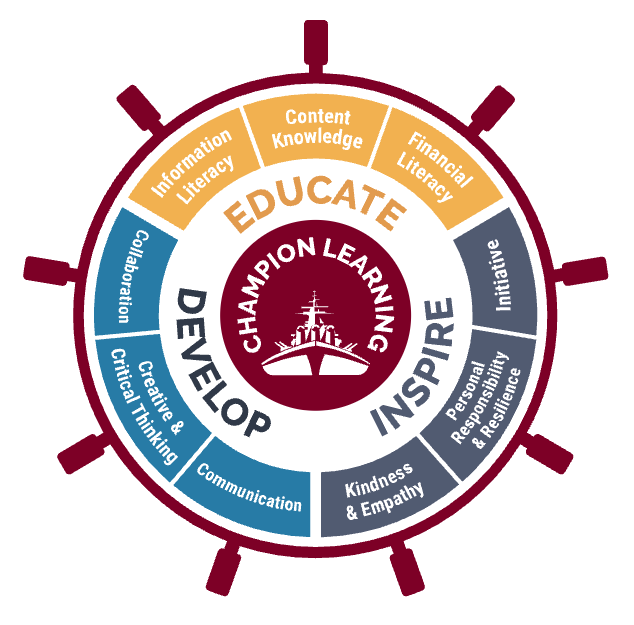 Once the competencies were identified, teams of teachers and administrators worked to create a Learning Continuum that defined each competency across a developmental progression from 0 to 8. This implementation science strategy provided a common language and clear indicators of growth, helping us articulate what each competency looks like as students develop over time. On paper, both the Helm and the Learning Continuum were thoughtfully designed and represented significant accomplishments for our district. Yet, as many educators know, creating a framework is only the beginning. Implementation proved to be far more complex than development.
In these early years, we found ourselves asking an important question: How could we expect students to develop and demonstrate these competencies if they, and even some of our staff, did not yet have a deep understanding of what the competencies truly meant? We realized that before we could measure growth or redesign learning experiences, we needed to build shared understanding. We now know more and see that our natural, authentic inquiries are part of Design Thinking approaches that have really made a difference.
Over the next two years, we intentionally slowed down. Rather than rushing toward implementation, we invested time in unpacking each competency. Staff engaged in meaningful conversations about the language, purpose, and implications of the Helm. Together, we thought critically about what the competencies looked like in classrooms, hallways, extracurricular activities, and the broader school experience. We explored examples, discussed misconceptions, and worked to create a common understanding across grade levels and buildings.
Most importantly, we began helping students understand the competencies as well. We wanted the Helm to be more than a poster on a wall or a graphic on a website. We wanted students to recognize these competencies in themselves, understand why they matter, and develop the ability to reflect on their own growth. As familiarity increased among both staff and students, the Helm became part of our shared language and culture. Interestingly, hindsight has shown us that, just as we wanted students to recognize these competencies in themselves, we, as educators and leaders, needed to see them and grow them in ourselves, too. This concurrent foreground and background work has made what we do rich in complexity, but more than that, it is rich in meaning, significance, and purpose for all of Dexter Community Schools.
Five plus years into this work, we find ourselves in a new phase of the journey. With a stronger understanding and growing confidence, we are now focusing on where and how students can develop and demonstrate each competency. We are examining learning experiences across classrooms, grade levels, and disciplines to identify authentic opportunities for growth. We are asking important design thinking questions: Where are students practicing collaboration? How are they developing agency and resilience? When are they demonstrating critical thinking, communication, or other Helm competencies?
This work has also led us to think more intentionally about alignment. We are striving to create vertical alignment of content, concepts, and competencies so that students experience a coherent progression from kindergarten through graduation. We want each year of learning to build upon the last, ensuring that competency development is purposeful rather than accidental.
While we are proud of the progress we have made, we recognize that this work is far from complete. Implementing “the Helm” is not a checklist to us; it is an ongoing process of reflection, refinement, and growth. As our understanding deepens, so too will our approaches to experience, teaching, learning, and assessment.
The story of the Helm at Dexter Community Schools is ultimately a story of continuous improvement. Whether our strategies for implementation were more implementation science-based (like the learning progressions) or design thinking-based (through our intentional questioning, noticing, designing, testing, and sharing), it is our unique and intentional approach for Dexter that has really made an impact. We have learned that meaningful implementation requires patience, shared understanding, and a commitment to learning alongside our students. The journey continues, and we are excited about the opportunities ahead as we work to ensure that every student develops the competencies needed to thrive in an ever-changing world.
Portrait of a Graduate in Action: The Muskegon Area CTC Journey
By: Bernard Brown, Heidi Vissia, and the Muskegon Area Career Tech Center (MACTC) Implementation Team
At the Muskegon Area Career Tech Center (MACTC), our mission is to prepare students for immediate and long-term success in highly competitive, rapidly evolving technical fields. When we sought to define what success looks like beyond technical skill proficiency, we adopted the Michigan Career Ready Practices as our official "Portrait of a CTE Learner."
However, we quickly realized that our Portrait of a CTE Learner could easily become a passive "poster on the wall" if it is not explicitly integrated into our daily systems. We also realized that if we wanted to graduate students from our programs with authentic Portrait Profiles, we needed to teach and assess those competencies, not just meet the standards to which most systems fall prey. To achieve true systemic change, we looked at how our work could intentionally balance human-centered design with disciplined execution. We found our answer by blending two distinct, powerful lenses: Design Thinking, which ensures we co-design for a deep, empathetic contextual fit (Cf) with our unique community, and Implementation Science, which provides the structures needed to run our systems with high implementation fidelity (Fi).
By treating these two forces as multiplicative partners rather than competing strategies, we anchored our work in a simple, guiding equation:
System Efficacy (Es) = Contextual Fit (Cf) x Implementation Fidelity (Fi)
Here are the four explicit, human-centered implementation strategies we deployed to move our Portrait from a static framework to a living classroom reality.
 Strategy 1: Shifting from Standards-Based to Competency-Based
Our initial discovery phase, heavily influenced by Anthony Reibel’s work on Evidence-Based Grading, helped us identify a crucial systemic trap: we were treating our Career Ready Practices like a traditional, standards-based checklist. Teachers were falling prey to teaching and assessing knowledge and skills rather than competencies. They were also marking whether a student completed a task, rather than assessing their growth over time.
To shift to a growth-over-time approach, we co-designed learning progressions for our building-wide expectations. Instead of constantly rewriting rubrics, we designed them so the "Proficient" (or ideal) state remains constant. This stable anchor allows teachers and students to accurately measure a learner's development along a clear, year-long continuum rather than aiming at a moving target.
Strategy 2: Activating Student Ownership with Goal Calendars
It is not enough for teachers to understand the learning progressions; the students must own them. To make our Portrait student-facing, we integrated Goal Calendars directly into our classroom routines.
The goal calendar, derived from the Scales of Progress article, is a visual mapping tool that helps students locate themselves on the learning progressions in our rubrics. By using this tool, students take the driver's seat: they look at where they currently stand, identify the next level on the continuum, and explicitly plan how they will demonstrate that growth in their CTE labs. This simple, low-burden ritual successfully shifted our grading culture from compliance (completing assignments for a grade) to agency (tracking personal developmental growth).
Strategy 3: AI-Powered Curricular Auditing
One of the loudest anxieties we heard from our instructors was: "How am I supposed to teach these Career Ready Practices on top of my existing, dense technical curriculum?"
The next step in our work is to learn from staff who, on their own, have worked with generative AI to support themselves in managing this workload. Our goal is to have the AI identify the exact moments in their existing curricula where the Career Ready Practices naturally intersect with technical tasks, showing how to assess competencies versus standards. With CTE programs in one of our local high schools, our CTE Curriculum and Instructional Coordinator has utilized generative AI (specifically NotebookLM and custom LLM prompts) as an administrative copilot. Teachers uploaded their course competencies, Portrait definitions, and learning progressions to create lesson plans. The AI-created lesson plans teach and assess the Portrait Competencies, using the content as the vehicle. This has become a game-changer in true competency-based learning.
As we look ahead, we have lessons learned on how to use generative AI to support our teachers' workloads. AI allows us to treat our existing technical content as the vehicle for delivering our Portrait competencies. This will provide insight into our assessment of competencies over time, ensuring we stay true to the content standards, which serve as the vehicle for the transferable competencies within our Portrait.
Strategy 4: Securing the System via New-Hire Mentorship
We recognize that the ultimate threat to any systemic initiative is organizational turnover. To prevent our Portrait of a CTE Learner from fading as staff change, we are building a dedicated New-Hire onboarding program.
Our veteran implementation cohort is actively designing an onboarding system that supports every new instructor with the implementation team. This team will guide new hires through our Practice Profiles, smart rubrics, and AI-assisted mapping workflows from day one. By investing deeply in our people and formalizing our knowledge management, we ensure that our Portrait culture outlasts leadership transitions and becomes a permanent expectation within the organization.
The Road Ahead
Our journey at MACTC has taught us that real implementation is a process of disciplined, patient iteration. We have not arrived at a perfect destination, nor do we intend to. Through Systemic Efficacy, we hope to continue to keep the user experience at the forefront while following quality implementation science practices so that the Michigan Career Ready Practices become the habits our students carry into their futures.
More Than a Metric: How FlexTech High School Brighton Lives Its Portrait of a Graduate Every Day
By: Principal & Superintendent Jason Riggs at Brighton FlexTech High School
 When competencies are taught, assessed, and celebrated — not just listed — students graduate ready for what comes next.
In many high schools, a Portrait of a Graduate sometimes exists as a wall graphic or a paragraph in a strategic plan. At FlexTech High School, a public school academy in Brighton, Michigan, it is the architecture of the school day itself — taught explicitly, measured with rubrics, feedback centered, and celebrated publicly from ninth grade through graduation.
That distinction matters. FlexTech serves approximately 100 in-person and 100 fully online high school students in a 50(d)-designated blended and hybrid learning environment. The school operates without a traditional A/B bell schedule with a lot of flexibility for adaptive support and celebrating our students. What it does have, every single day, is a 115-minute combined Advisory and Seminar block — structured around lunch, designed for depth, and entirely dedicated to the work of becoming.
What Advisory Actually Does
Advisory at FlexTech is not a homeroom. It is a 70-minute, credit-bearing, mentor-driven course — paired daily with a 45-minute Seminar period — forming a 115-minute flexible block anchored by lunch and built for the full range of what adolescent development actually requires. Every student works with a looping teacher-mentor across all four years of high school, engaging weekly in structured lessons tied directly to FlexTech's five Portrait of a Graduate competencies and Advisory competencies: Global Citizen, Problem Solver, Empathy, Passionate, and Growth Mindset.
The lessons are not generic character education. They are designed around competency-specific scales that give students and mentors a shared language for growth. Students set weekly goals, journal about what they are learning from both success and adversity, and reflect on how their actions affect the people around them — in the classroom, in the school, and in the broader community.
Within that 115-minute window, the structure is flexible by design. On any given day, the block might include one-on-one mentoring between a student and their looping advisor, community action project planning in groups or as individuals, student leadership meetings, intervention and support time, collaborative project work in the Maker's Space, or club and enrichment activities. Fridays extend that support further: three hours of morning availability for online learners and any student who needs additional time with teaching or support staff — a built-in weekly safety net that most schools do not have.
We teach what used to be called soft skills directly, weekly, from ninth through twelfth grade. The adviser helps students understand the power of goal setting, the power of journaling, the power of recognizing your role in the community — not just inside our walls, but in the world beyond them.
"Zero major disciplinary incidents in a full school year - across 200 students. That is not a coincidence. It is the result of students trusting the adults in the building, and that trust is built through four years of daily advisory."
The Chronicle: A Four-Year Growth Document
One of the most distinctive features of the FlexTech model is the Chronicle — a longitudinal portfolio that every student builds across all four years of high school, not just as seniors. Students document skills they have developed, experiences they are proud of, skills they have learned - entries they could translate to a résumé, and honest reflections on what they learned from conflict, failure, success, and the experience of showing up for others.
The Chronicle is not a requirement that lives in a folder. It surfaces publicly at Project Showcases, where students present their learning to community members, alumni judges, and invited partners twice a year. It becomes the foundation for the Exemplar Interview — a recorded, teacher-to-student conversation at the end of each quarter that documents growth in measurable terms by subject or Portrait of a Graduate theme.
This approach connects directly to what Michigan's Portrait of a Graduate framework identifies as meaningful and actionable signals of student learning. At FlexTech, those signals are observable, community-validated, and grounded in four years of documented evidence rather than a single performance moment.
Purposeful Action: Where Competencies Meet Community
FlexTech's Portrait of a Graduate includes an expectation that students engage in purposeful action projects — work that makes a visible difference in a real community context. This year, multiple graduating seniors took on independent projects: one organized a supply drive for a local humane society, another led a cleanup effort along the road leading to the school, and others coordinated donation campaigns for domestic violence shelters and community resource centers. Others spent time in the community garden project and building beautification projects.
These projects are not assigned. They emerge from student interest, shaped by four years of advisory conversations about identity, values, and the question of what kind of person each student wants to become. National Honor Society, JMG-connected service opportunities, Student Government leaders, and community partner relationships all provide infrastructure for students who are ready to act. We believe when a student follows a passion, and that passion is celebrated — they become civically minded, community-oriented people. That is what we want every FlexTech graduate to be.
Recognition That Reinforces the Culture
FlexTech formally recognizes students as Portrait of a Graduate exemplars each quarter and at graduation — publicly naming which competencies each student demonstrated and how. This is not an honor roll. It is a competency-based acknowledgment system grounded in the same rubrics mentors use for feedback throughout the year.
The effect on school culture is measurable. FlexTech recorded zero major disciplinary incidents during the most recent school year across its full enrollment of in-person and online students. We attribute this directly to the relational infrastructure built through Advisory: students know their mentors, their mentors know them, and the school's response to conflict is restorative rather than punitive by design.
We are a comprehensive high school, but our flexibility to create a plan with any incoming student, we do draw some students with credit deficiencies from other schools. This is not an alternative school, but we have numerous students who may not have graduated from a traditional high school and we have numerous students who take advantage of dual enrollment and CTE programs throughout our county. Bottom line, I have seen advisory-style courses in other schools. I have never seen anything like what I have witnessed at FlexTech in the last two years. It truly aligns with the mission of who we are as a school.
Beyond Graduation: The JMG Partnership
FlexTech's commitment to its Portrait of a Graduate does not end at the diploma. Through its partnership with Jobs for Michigan Graduates and Youth Solutions over this past school year, the school maintains contact with graduates for one full year post-exit — providing continued support, connection to resources, and accountability for the pathways students mapped in their four years of advisory.
This follow-through reflects something essential about the FlexTech model: the Portrait of a Graduate is not a checklist to complete before graduation. It is a framework for becoming — one that the school builds with each student, documents over four years, celebrates in public, and continues to support after the cap and gown come off.
FlexTech High School - Portrait of a Graduate at a Glance |
|---|
|
|
|
|
|
|
|
|
|
|
|
|
|
|
|
Conclusion
Across these three stories, one thing becomes clear: there is no single path to bringing a Portrait of a Graduate to life. Dexter reminds us that deep implementation often begins with patience, shared language, and the courage to slow down before moving forward. MACTC shows how intentional systems, student ownership, and thoughtful use of tools can move a portrait from aspiration to daily practice. FlexTech demonstrates what becomes possible when competencies are woven into the structure, relationships, celebrations, and rhythms of school life.
Different communities. Different starting points. Different strategies. Yet each story points to the same essential truth: a Portrait of a Graduate is not powerful because it is written well, designed beautifully, or displayed prominently. It becomes powerful when people collectively and intentionally live it—when educators, students, families, and communities use it to shape decisions, create learning experiences, measure growth, and name what matters most for young people’s futures.
Your district’s journey may look very different from the ones shared here. It should. Context matters. History matters. People matter. But your story matters, too. Whether your team is just beginning, refining what already exists, or working through the messy middle of implementation, there are lessons in your experience that can help others. The more we share what is working, what is challenging, and what we are learning along the way, the stronger this work becomes across schools, districts, and communities.
In Article 3, we will look more closely at the common “breakdowns” that can emerge when implementing a Portrait of a Graduate—and the small but meaningful “buildups” that can help restore momentum, strengthen alignment, and keep the work moving forward. Naming these tensions does not weaken the work; it makes the work more honest, more sustainable, and more likely to improve outcomes for students, schools, and communities. As you read, reflect, and lead, we invite you to share your own story so others can learn from your journey, too.
Citations
Anaissie, T., Cary, V., Clifford, D., Malarkey, T., & Wise, S. (2021). Liberatory design. https://www.liberatorydesign.com
Benedetto, A., & Erickson, K. (2026, April 27). From understanding to ownership: When students tell their story through the Portrait of a Graduate. Getting Smart. https://www.gettingsmart.com/2026/04/27/from-understanding-to-ownership-when-students-tell-their-story-through-the-portrait-of-a-graduate/
Brown, B. (2025). Strong ground: The lessons of daring leadership, the tenacity of paradox, and the wisdom of the human spirit. Random House.
Bryk, A. S. (2020). Improvement in action: Advancing quality in America's schools. Harvard Education Press.
Bryk, A. S., Gomez, L. M., Grunow, A., & LeMahieu, P. G. (2015). Learning to improve: How America's schools can get better at getting better. Harvard Education Press.
Collaborative for Academic, Social, and Emotional Learning. (2026, February). From vision to action: How Portraits of a Graduate align social and emotional competencies and future readiness. https://casel.s3.us-east-2.amazonaws.com/CASEL-From-Vision-to-Action-Portraits-of-a-Graduate-report.pdf
Fixsen, D. L., Naoom, S. F., Blase, K. A., Friedman, R. M., & Wallace, F. (2005). Implementation research: A synthesis of the literature. FPG Child Development Institute, University of North Carolina at Chapel Hill. https://implementation.fpg.unc.edu/wp-content/uploads/Active-Implementation-Overview-M1.pdf
Hasso Plattner Institute of Design at Stanford University. (2018). Design thinking bootleg. https://dschool.stanford.edu/tools/design-thinking-bootleg
IDEO. (2012). Design thinking for educators (2nd ed.). https://designthinkingforeducators.com/toolkit/
Langley, G. J., Moen, R. D., Nolan, K. M., Nolan, T. W., Norman, C. L., & Provost, L. P. (2009). The improvement guide: A practical approach to enhancing organizational performance (2nd ed.). Jossey-Bass.
Lyon, A. R. (2017, July). Implementation science and practice in the education sector. Substance Abuse and Mental Health Services Administration. https://education.uw.edu/sites/default/files/Implementation%20Science%20Issue%20Brief%20072617.pdf
Ma, X., Shen, J., & Reeves, P. (2023). Measuring integrity and fidelity of program implementation: Validating an instrument designed for school renewal. Evaluation and Program Planning, 100, Article 102341. https://doi.org/10.1016/j.evalprogplan.2023.102341
Michigan Department of Education. (2024). MICIP process guide: Fall 2024 update. https://www.michigan.gov/mde/-/media/Project/Websites/mde/MICIP/Resources/MICIP_Process_Guide.pdf
Moen, R. D., & Norman, C. L. (2010). Circling back: Clearing up myths about the Deming cycle and seeing how it keeps evolving. Quality Progress, 43(11), 22-28. https://deming.org/wp-content/uploads/2020/06/circling-back.pdf
National Implementation Research Network. (2015). Active implementation frameworks. FPG Child Development Institute, University of North Carolina at Chapel Hill. https://implementation.fpg.unc.edu/wp-content/uploads/Active-Implementation-Overview-M1.pdf
Panke, S. (2019). Design thinking in education: Benefits and challenges. In Teachers as designers: Creative solutions for complex challenges (pp. 1-15). Cast Publishing. https://edtechbooks.org/teachers-as-designers/kttnynptiw
Penuel, W. R., Fishman, B. J., Haugan Cheng, B., & Sabelli, N. (2011). Organizing research and development at the intersection of learning, implementation, and design. Educational Researcher, 40(7), 331-337. https://doi.org/10.3102/0013189X11421826
Peterson, B. E. (2022). Using design thinking as an instrument for school improvement and innovation in public schools [Doctoral dissertation, Murray State University]. Murray State Theses and Dissertations, 253. https://digitalcommons.murraystate.edu/etd/253/
Schell, J. (2018). Design thinking has a pedagogy problem... and a way forward. https://designcreativetech.utexas.edu/design-thinking-has-pedagogy-problem-way-forward
VanGronigen, B. A., Bailes, L. P., & Saylor, M. L. (2023). Stuck in this wheel: The use of design thinking for change in educational organizations. Journal of Educational Change, 24(3), 401-423. https://doi.org/10.1007/s10833-022-09462-6
Wise, S. (2022). Design for belonging: How to build inclusion and collaboration in your communities. Ten Speed Press.
Wolfe, R. E. (2026, January). Can't get there from here: A framework for the start, spread, and scale of bottom-up innovation in education. Hoover Institution. https://www.hoover.org/sites/default/files/research/docs/Wolfe_Can%E2%80%99t%20Get%20There%20From%20Here_web-260116.pdf

Tovah Sheldon
School Design Strategist
Dr. Tovah Sheldon is a School Design Strategist for Michigan Virtual. For 20+ years, Dr. Sheldon has served pK-12 and higher education as a dynamic leader and educator driving positive change. Her expertise ranges from instruction to capacity building to systems change. She has a passion to cultivate relationships, bring innovation to spaces managing complex change, and promote equity and opportunities for ALL. Additionally, Dr. Sheldon serves on various boards while enjoying time with her family and going on adventures.
Related Posts
Choosing Your Next Right Move: How Metaphors Help District Leaders Build Alignment and Coherence in Their Complex Systems
Many districts are doing ambitious transformation work, yet one of the most common risks is not lack of effort. It is fragmentation. This article explores how alignment and coherence, brought to life through seven powerful metaphors, can help leaders see their systems more clearly and make better decisions about what to do next.

Beyond Resistance: Understanding & Using Change Sets to Support Transformation
Leading meaningful change requires more than the right mindset. It takes the right combination of skills, tools, coaching, and systems. Explore the Change Sets framework to uncover why transformation stalls, identify what people truly need to move forward, and lead change with greater clarity and purpose.

Portrait of a Graduate 201 Article 3
Many districts have already done the work of approving a Portrait of a Graduate, naming what they want students to know, do, and become. The harder question now is how that vision moves from approval into everyday practice.
Portrait of a Graduate 201 Article 1
Many districts have already done the work of approving a Portrait of a Graduate, naming what they want students to know, do, and become. The harder question now is how that vision moves from approval into everyday practice.

Kinds of Thinking
We all have a default way of thinking and most of the time, we don’t even notice it. In a complex, fast-changing world, how we think matters just as much as what we think. Overusing one kind of thinking can quietly limit our decisions, our leadership, and our growth. Becoming more intentional about how we think is one of the most important shifts we can make.

Leadership Coaching for Innovation Part 3
At Michigan Virtual, innovation is not a one-time initiative, it is an ongoing, human-centered process. Through the Innovator’s Journeys framework and Leadership Coaching for Innovation, leaders are supported in navigating complexity and driving meaningful, lasting change.