

Portrait of a Graduate 201 Article 3

From Paradoxes & Breakdowns ... to Solutions & Buildups
By Dr. Tovah Sheldon
In Article 1, we defined and made visible your Portrait from poster to practice. With our two useful lenses, Design Thinking and Implementation Science, we provided a multitude of strategies for consideration so you could intentionally bring your Portrait to life. In Article 2, we provided three unique districts’ journeys. Their insights and actions help others see just how powerful this work can be when done in an intentionally integrated way!
In this final article, we'll explore four tensions nearly every district encounters during implementation. By naming them, you can see it coming, prepare, pivot, and progress. We'll also examine five common breakdowns that often emerge, what leaders are likely to notice, and practical leadership moves that can help districts regain momentum and strengthen ownership. In the end, we go back to the beginning where we uncovered that the approval of the Portrait was never the destination, nor will implementation ever really be finished. That’s just an arrival fallacy. Instead, it is the journeys, done with others, where meaning, purpose, and significance all intersect. As you read this article, consider the following questions:
Which of these 4 tensions already exists in your district or for you? Are you rushing to ‘fix’ your discomfort or might you see an opportunity to lean into the complex work?
Which of the 5 breakdowns feels most familiar? Where might a perceived constraint be reframed as an advantage or opportunity for creative solutioning (especially if your Portrait names an attribute or competency of creativity, curiosity, innovative, etc.-- are you practicing what you expect of others)? And, who might be a trusted person(s) that you can go to to get a real pulse on your portrait work?
What small leadership move could you make next week to create greater ownership? How might you adapt a given “build up” or strategy so that it better fits your context? What further reading, conversations, or learning might you need to go from reflection and connection to action and collective shift? Do you need to go back to prior sources or seek something new or someone new, or both? What’s next for you – because when you know better, you do better.
If we can anticipate the paradoxes, recognize the breakdowns, and respond with intentional leadership moves, we are far more likely to build a Portrait that becomes part of the culture rather than another initiative. Let's begin with the tensions nearly every district encounters.
When Implementation & Iteration Gets Real, Expect Paradoxes & Tensions
Portrait implementation often becomes difficult because leaders are managing real tensions rather than simple technical problems. This is where design thinking and implementation science become useful together. Design thinking helps leaders stay close to the lived experience of students, educators, families, and community partners. Implementation science helps leaders build the structures, routines, and supports needed for the work to last. One keeps the work human. The other helps it become dependable.
The challenge is that districts rarely struggle because they lack commitment. More often, they struggle because the work gets caught between important pressures that are all true at the same time. Naming those tensions can reduce frustration and make the work more coherent.
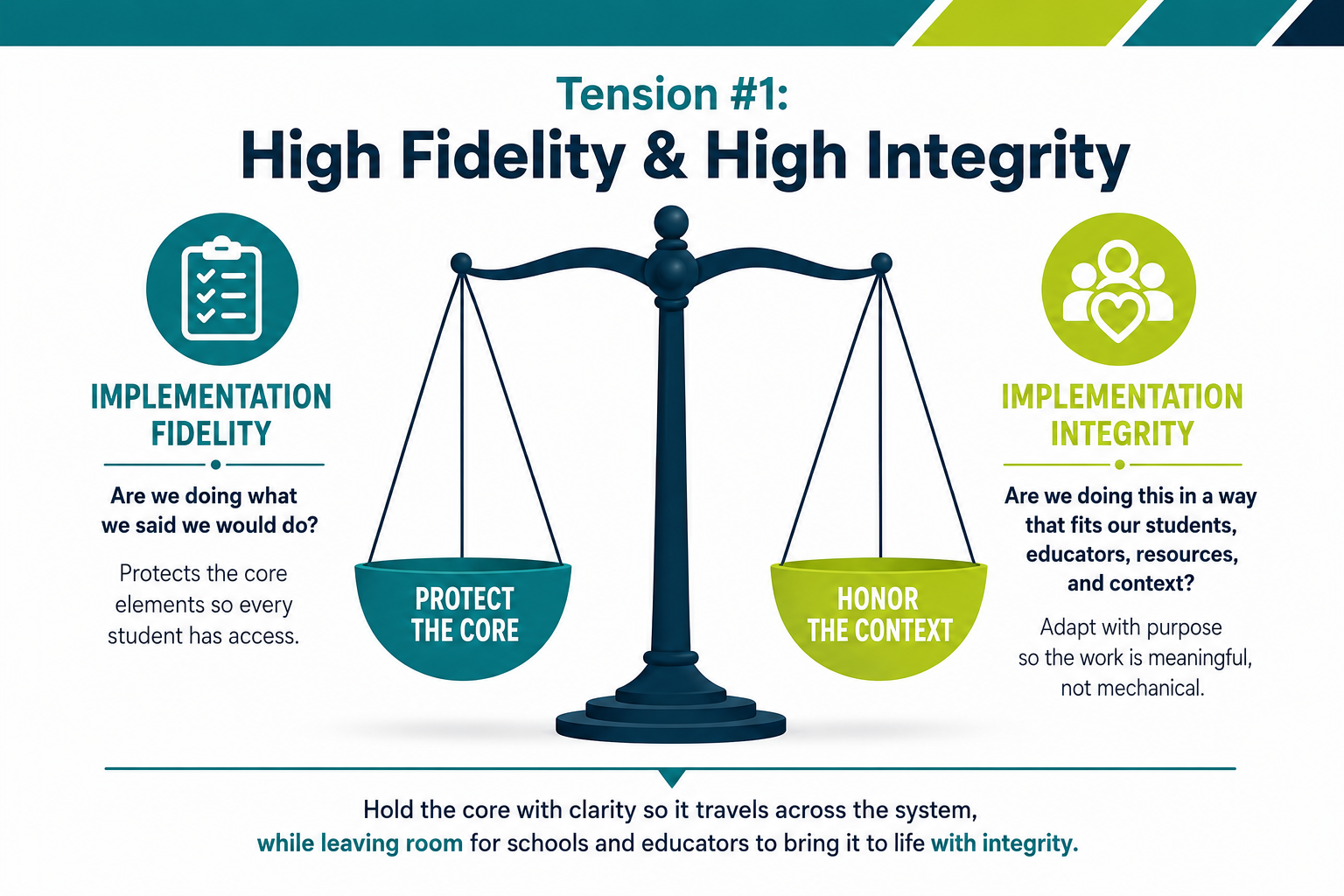
Tension #1: High Fidelity and High Integrity
One of the first tensions districts encounter is the relationship between fidelity and integrity.
Implementation fidelity asks: Are we doing what we said we would do? Are we holding to the Portrait's critical features and the practices connected to it? Are we using shared language, clear expectations, and real-time evidence to understand whether the work is happening? Implementation fidelity refers to the parts of the model that are non-negotiable for it to work or achieve the initiative's intended outcomes.
Implementation integrity asks: Are we doing this in a way that fits our students, educators, resources, and context? Are we using collaborative processes, such as professional learning communities, learning walks, student feedback, and educator co-design, to make the work meaningful rather than mechanical? Just because an initiative or program works in one place doesn’t mean it works in your space. Implementation integrity honors the context without using it as a copout. It is intentional flexibility to enhance effectiveness, not lose it.
In practice, this tension can show up quickly. A district may define “collaboration” as a Portrait competency and create a common rubric. Implementation fidelity matters because every student deserves access to the competency, not only students in a classroom where one teacher happens to value collaboration. Yet implementation integrity also matters because collaboration may look different in a kindergarten classroom, a high school engineering course, a special education setting, a performing arts rehearsal, or a work-based learning experience.
Design thinking tends to lean toward adaptation. If a prototype does not fit the people using it, the team changes the prototype. It asks whether the practice feels usable, meaningful, and worth continuing.
Implementation science tends to protect the core. It asks whether the district is preserving the essential features needed to produce the intended outcomes.
Portrait work needs both. If everything is adapted, the Portrait can lose its shared meaning. If nothing is adapted, the Portrait can become a compliance exercise. The work is to hold the core with enough clarity that it travels across the system, while leaving enough room for schools and educators to bring it to life with integrity.
 Tension #2: Time and the Speed of Learning
A second tension is time. This is one of our oldest and most common tensions or paradoxes in the field of education.
Portrait work often begins with energy. The board approves the Portrait. The community is excited. Leaders want momentum. The staff wants to know what comes next. It is natural to want visible action.
Yet the work asks adults and students to learn new language, new routines, new forms of evidence, and new ways of seeing student growth. That learning cannot be rushed without cost.
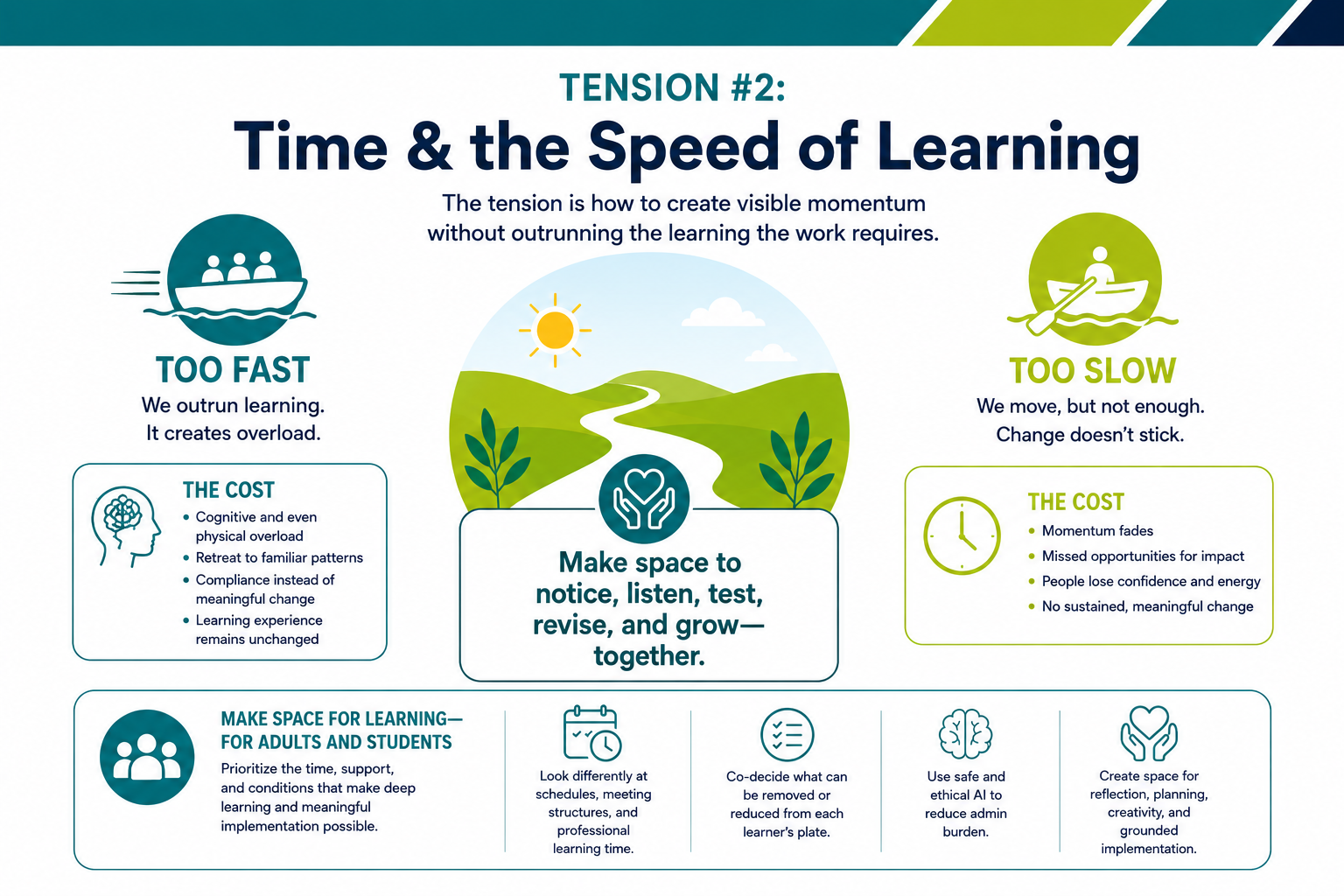
Design thinking, in particular, requires time to slow down, notice, listen, test, and revise. When educators are given a complex design challenge with insufficient time or support, the work can lead to cognitive, and even physical, overload. Instead of becoming creative and curious, people may retreat into familiar patterns. They may comply with the language while leaving the learning experience unchanged.
This can happen when a district launches too much at once: new rubrics, portfolios, reflection prompts, professional learning expectations, reporting structures, and communication materials. Even strong ideas can become too heavy when piled on top of an already crowded system.
For adults, this matters as much as it does for students. Educators need room to breathe, try, talk, revise, and make sense of what the Portrait means in their daily work. Leaders may need to look differently at schedules, meeting structures, professional learning time, and what can come off people’s plates. Safe and ethical uses of AI may help reduce administrative burden, but the time saved should not simply be spent on another task. It can create needed space for reflection, planning, creativity, and grounded implementation.
The tension is not about moving quickly or slowly. The tension is how to create visible momentum without outrunning the learning the work requires.
 Tension #3: Speed of Change and Leadership Transitions
A third tension is the speed of change inside schools and districts.
Portrait implementation often depends on leadership energy. A superintendent, assistant superintendent, principal, teacher leader, board member, or community partner may carry the early vision and keep the work moving. That kind of leadership matters. It helps people understand why the Portrait exists and why it should shape the student experience.
The risk is that the work becomes tied too closely to a single person, role, or department.
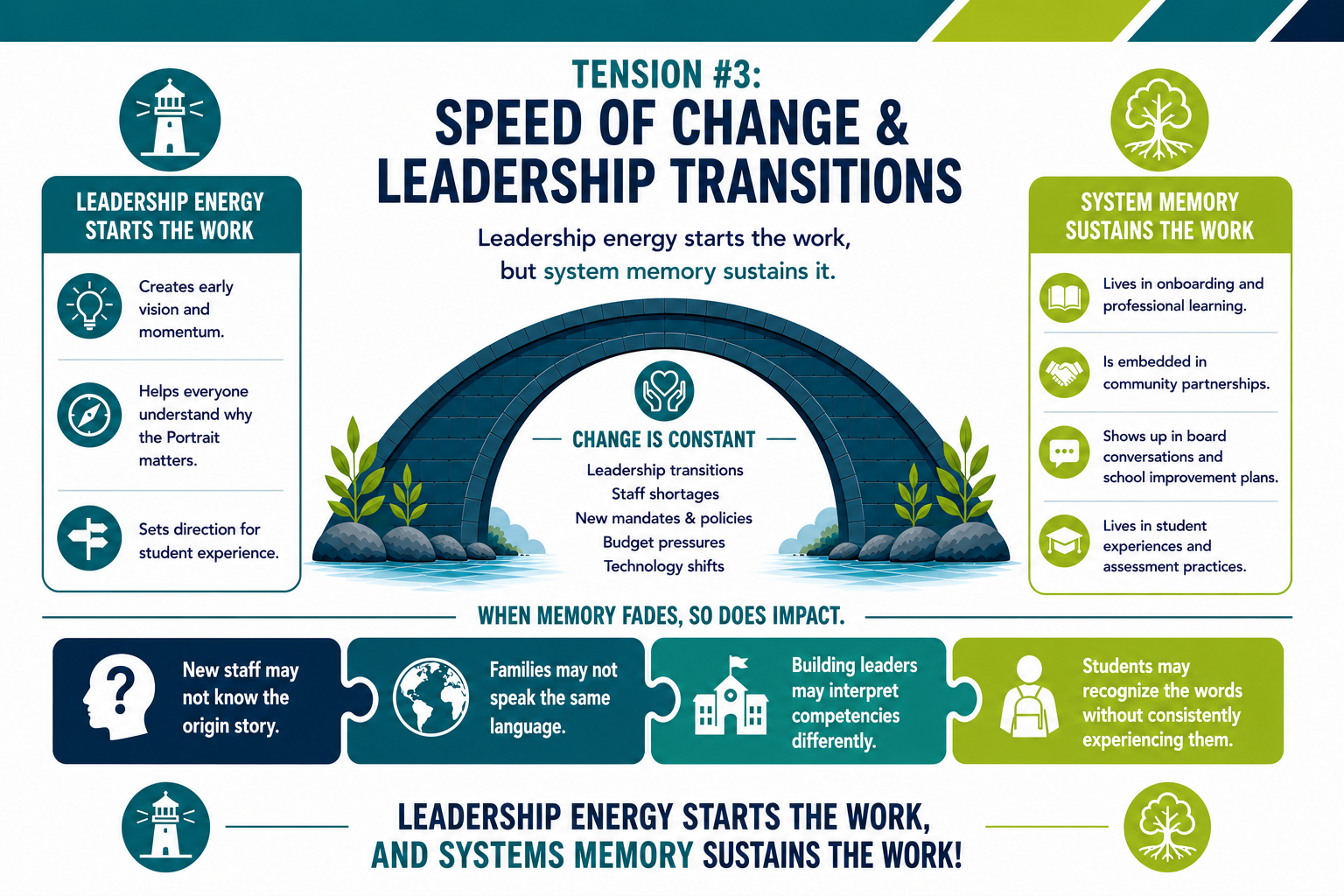
When a champion leader leaves, a grant ends, a central office role is reorganized, or a large group of veteran staff retires, the Portrait can lose traction. The poster may remain on the wall, but the shared memory of the work begins to fade. New staff may not know the origin story. Families may not speak the same language. Building leaders may interpret the competencies differently. Students may recognize the words without consistently experiencing them.
This is especially important because school systems are always changing. Leadership transitions, staffing shortages, new mandates, budget pressures, technology shifts, and community needs can all pull attention away from long-term work.
For the Portrait to last, it has to become part of the system’s memory. That means it must live in onboarding, professional learning, board conversations, school improvement plans, student experiences, community partnerships, assessment practices, and communication routines. It cannot live on the passion of only a few people who were there at the beginning.
The tension is that leadership energy starts the work, but system memory and a larger approach to knowledge management sustain it.
 Tension #4: Top-Down Mandates and Bottom-Up Energy
A fourth tension is the relationship between district direction and local ownership.
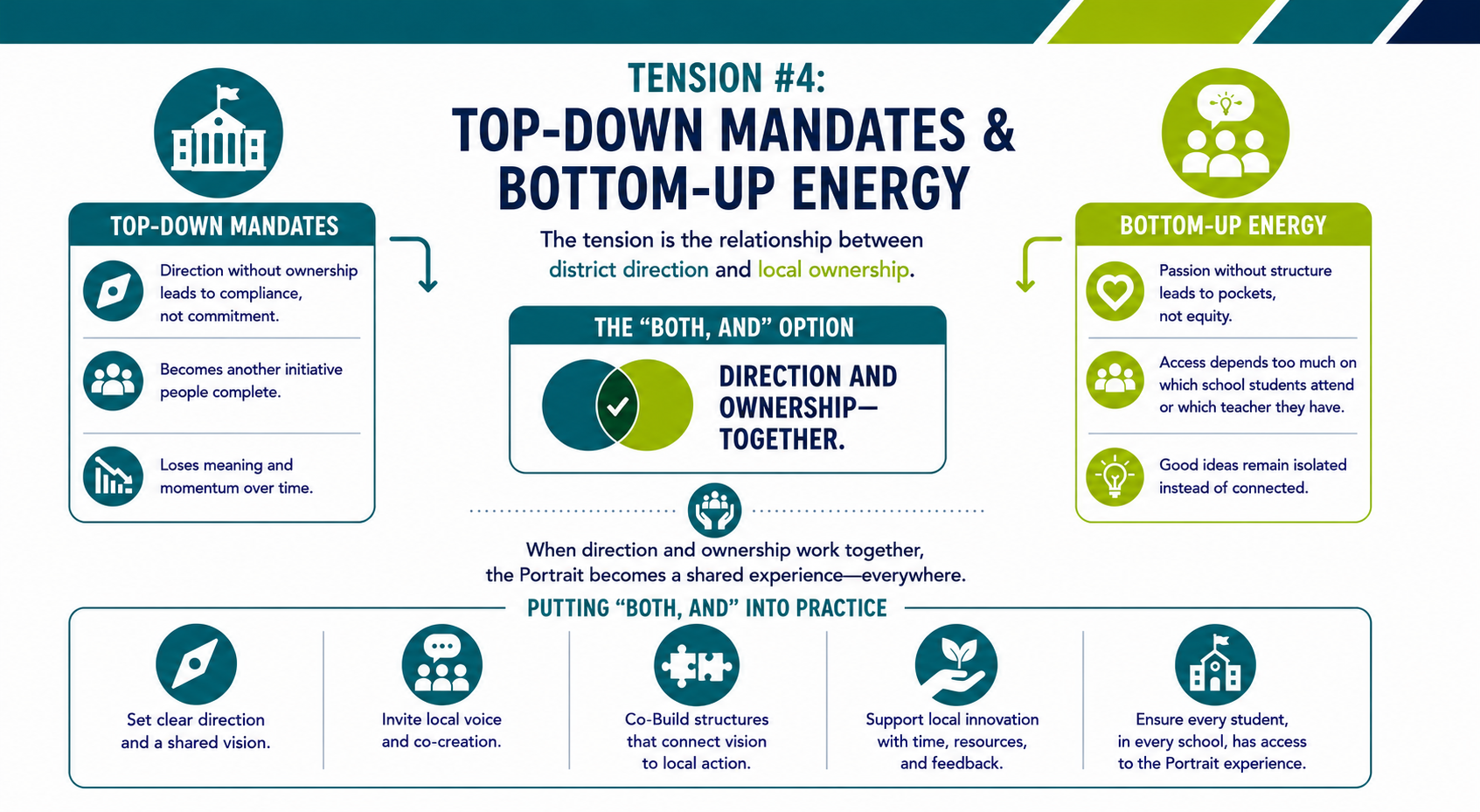
A Portrait of a Graduate cannot thrive as a top-down mandate. If the Central Office simply tells schools, staff, and students what to do, what language to use, which rubric to adopt, and which artifacts to collect, the Portrait can become another initiative people complete rather than a shared vision they believe in.
At the same time, Portrait implementation cannot depend only on bottom-up energy. If the work is left to emerge organically, it may grow in pockets. One building may create powerful student exhibitions. Another may connect the Portrait to a class like Advisory. A few teachers may build strong reflection routines. These examples matter, but without a larger structure, they can remain isolated. Students’ access to the Portrait then depends too much on which school they attend or which teacher they have.
The tension is not resolved by choosing between top-down and bottom-up. It is managed by building a structure that allows direction and ownership to strengthen one another.
 Working the Paradoxes: Tight/Loose Ecosystems
Of course, the tensions above do not resolve neatly. That is the point of a paradox. Both truths remain, and districts do not need to rush toward a single fixed answer.
However, a realistic next move is to design a Tight/Loose Ecosystem for Portrait implementation. The “tight” parts protect coherence across the district: the non-negotiable Portrait competencies, shared language, common expectations, and clear descriptions of what those competencies look like in practice. Tools such as NIRN Practice Profiles can help districts define those competencies behaviorally, so they move from broad aspiration to observable action.
The “loose” parts protect ownership, context, and creativity. Rather than requiring every classroom or building to use the same lesson, rubric, or routine, districts can invite school-based co-design teams to prototype the practices that make the Portrait real in their setting. These teams may include educators, students, leaders, families, and community partners. They might design classroom rituals, student leadership roles, advisory routines, reflection tools, learning exhibitions, or physical spaces that help students practice and recognize the competencies. In this way, the district holds the shared promise of the Portrait while honoring the professional judgment and lived experience of the people closest to students.
Rebecca Wolfe’s (2026) work on bottom-up innovation points to this challenge. Innovations that are fixed in one time and place often do not transfer easily to another context. At the same time, purely local innovation can remain too fragile to spread or sustain.
Portrait implementation requires a co-design approach that balances district coherence with school- and individual-level agency. The district can name the non-negotiables: the Portrait competencies, the shared commitment to every student, the broad evidence of growth, and the expectation that the competencies become visible in learning. Schools, educators, students, and community partners can then help design the rituals, learning experiences, reflection tools, physical spaces, and examples that make the competencies real in their context.
This is the “tight and loose” work of Portrait implementation. The tight part protects the promise of the Portrait across the district. The loose part honors the wisdom, creativity, and lived experience of the people closest to students, as well as students themselves.
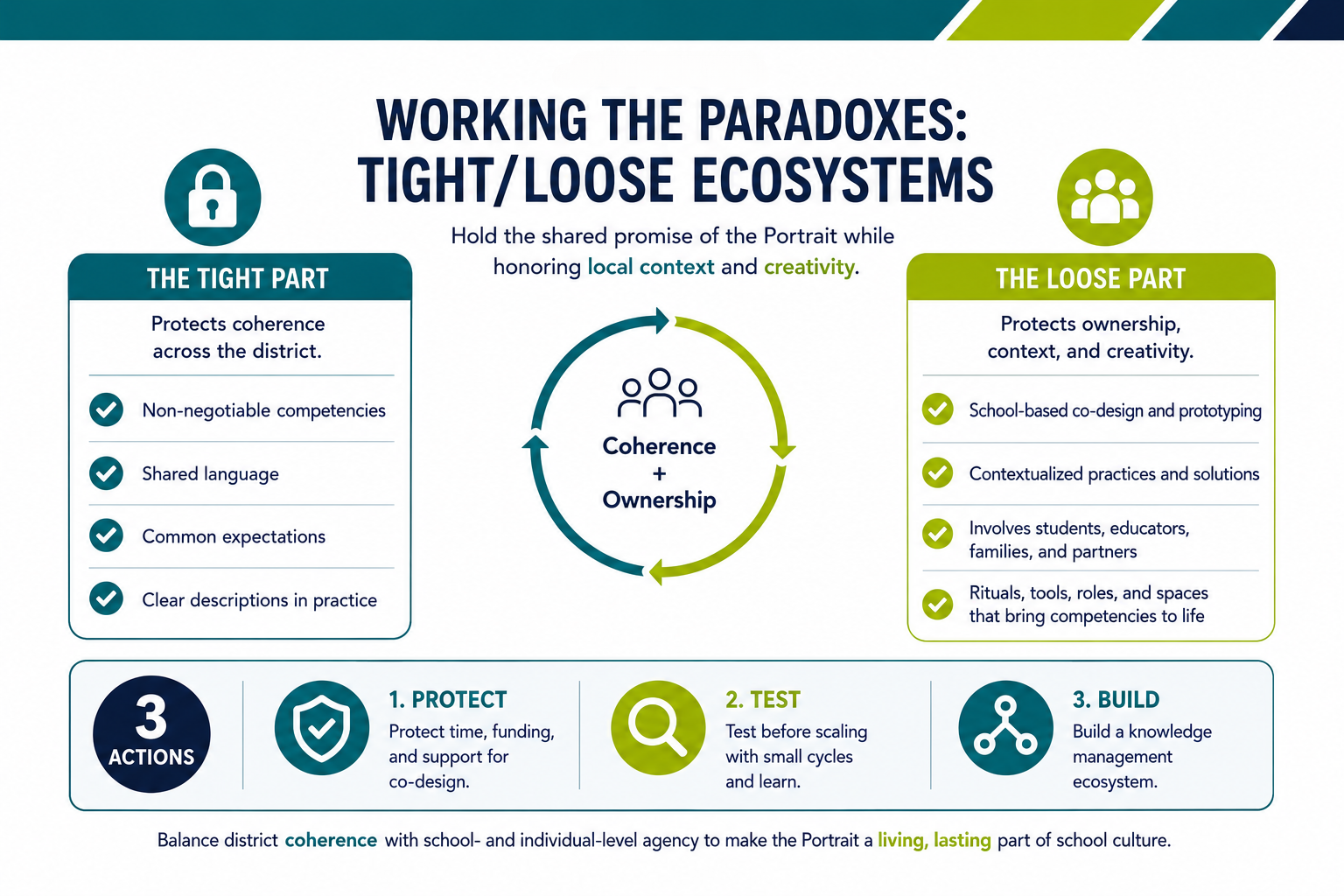 To scale and sustain this approach, districts can consider three connected actions:
Protect time, funding, and support for co-design. Portrait implementation cannot depend solely on volunteer energy. Districts may need to allocate non-instructional time, coaching, facilitation, and resources so educators can design, test, and refine practices without simply adding more work to an already full plate.
Test before scaling. Instead of launching new portfolios, rubrics, or reflection systems districtwide, implementation teams can use small Design Thinking Prototyping and Testing or small Plan-Do-Study-Act cycles with representative groups of early adopters. These cycles allow teams to study what works, what feels burdensome, what students understand, and what needs adjustment before broader use.
Build a knowledge management ecosystem. Districts need ways to document, share, and learn from implementation. This may include aligning professional learning, student information systems, grading or portfolio platforms, communication routines, and board-level reporting so authentic demonstrations of learning are visible and useful across the system.
By concurrently utilizing the user-centered flexibility of design thinking and the disciplined execution of implementation science, school districts can ensure their Portrait of a Graduate remains a living, lasting, and continuously improved part of school culture.
In short, thoughtful coordination across practice, policy, and systems is needed to take the work to the next level. As I said before, intentional integration matters at all levels, across all content, all stakeholders, and contexts.
The tensions above explain why Portrait implementation becomes challenging. The breakdowns that follow illustrate how those tensions often show up in everyday practice. When leaders recognize these patterns early, they can respond intentionally rather than reactively.
Breakdowns and Build-Ups: Moving from Approval to Ownership
A Portrait of a Graduate often begins with energy and shared hope. The community names what it wants young people to know, do, and become. The board approves the language. The graphic is finalized. The district has something visible to point to.
The real test comes next. A Portrait becomes meaningful only when it moves from approval into daily practice, student ownership, adult decision-making, and systemwide coherence.
 Breakdown #1: The Portrait Becomes a Poster
What is not working and why:
The Portrait is visible, but not lived. It appears on walls, websites, board slides, and strategic plan documents, but it does not shape what students experience or what adults decide.
You might notice:
Students recognize the graphic but cannot explain how it connects to their learning.
Teachers refer to the Portrait only during special events or required activities.
Leaders use the Portrait in communication, but not in decisions about curriculum, assessment, professional learning, or resources.
The competencies are celebrated, but not taught, practiced, reflected on, or assessed.
Build-Up: Make each competency usable.
Turn each Portrait competency into a practice profile. For each competency, collaboratively define:
What it looks like for students.
What it looks like for adults.
What it looks like across grade bands and settings.
What examples and non-examples look like.
What evidence might show growth?
This is where implementation science helps. National Implementation Research Network (NIRN) describes usable innovations as practices that are clearly defined, teachable, learnable, doable, and assessable in practice. Design thinking strengthens this by inviting students, educators, families, and community partners to test whether the definitions feel real, useful, and understandable. When competencies become clear enough to teach, practice, recognize and celebrate the Portrait begins moving from aspiration to everyday action.
 Breakdown #2: The Competencies Are Too Broad
What is not working and why:
Words like collaboration, resilience, communication, and critical thinking are powerful, but they are too large to guide practice without clearer behavioral meaning.
You might notice:
Staff agree with the competencies but interpret them differently.
Rubrics feel vague or disconnected from classroom practice.
Students cannot name what they are doing to grow in a competency.
The same competency looks completely different across buildings with no shared throughline.
Build-Up: Reduce the grain size.
Define each competency at three levels:
Disposition/Trait: Resilient.
Competency: Persists through challenge and adapts strategies.
Skill/Behavior: Uses feedback to revise work after an initial attempt.
Then create grade-band progressions and local examples. A kindergarten example will look different from a high school capstone or a CTE internship, but the district can still share a definition of growth.
Use design thinking to gather examples from real classrooms and student experiences. Use implementation science to document the core features so the competency can travel across the system without becoming generic. Greater clarity doesn't limit innovation, nor is it a constraint. Instead, it creates the shared understanding that allows the competencies within the Portrait to flourish.
 Breakdown #3: Adults Own the Language More Than Students Do
What is not working and why:
The Portrait lives in adult-facing spaces, but students do not yet use it to understand or tell the story of their own learning.
You might notice:
Students can name the competencies only when prompted.
Reflection is occasional rather than routine.
Student work does not include Portrait language or evidence of growth.
Learners do not see themselves in the Portrait, especially students whose strengths are not always captured by traditional academic measures.
Build-Up: Make the Portrait student-facing.
Create tools that help students use the Portrait language in their own voice:
“I can” statements.
Reflection prompts.
Student-led conference questions.
Portfolio or scholar profile templates.
Exhibition, capstone, or presentation prompts.
Getting Smart’s reporting on Norwalk’s Portrait work emphasizes that public demonstrations, student-led conferences, exhibitions, portfolios, and scholar profiles can help students tell the story of their own learning and develop ownership of Portrait competencies (Benedetto & Erickson, 2026). Start small. Invite students as co-designers. Ask them what would help them show growth in ways that feel authentic. When students can tell the story of their own growth, the Portrait becomes something they own rather than something adults describe.
 Breakdown #4: Evidence Becomes a Burden
What is not working and why:
The district tries to prove implementation by adding more surveys, charts, forms, or reporting tools. The evidence system becomes heavier than the learning it is meant to support.
You might notice:
Staff experience Portrait documentation as compliance.
Evidence is collected but rarely studied or used.
Teams create new forms rather than using existing artifacts.
Leaders cannot tell whether the Portrait is becoming more deeply embedded over time.
Build-Up: Create a low-burden evidence system.
Use what the district already produces:
Student work.
Student reflections.
Newsletters.
Social media stories.
Board updates.
Showcase materials.
Classroom artifacts.
Family communication.
Capstone, CTE, or community partnership evidence.
Tag existing artifacts by competency. This is often an opportunity for AI tools to do what they do best. For example, a district could upload all its Portrait of a Graduate artifacts, including Learning Progressions or rubrics, then ask Claude.ai (or an AI platform of their choosing) to generate an alignment dashboard demonstrating all the publicly available social media posts, news, board updates, etc., that connect with each competency. Note, if additional student work or non-public documents are used in this exercise, data must be deidentified for safety and ethical reasons. Review patterns quarterly to see which competencies are well documented, what’s missing, and areas of opportunity. Another option might be to use a small PDSA cycle to ask: What did we expect to see? What did we notice? What should we adjust? NIRN describes PDSA cycles as a way to test changes, refine practices, support scale-up, and align policies with new ways of work.
The best evidence systems illuminate learning. They don't compete with it.
 Breakdown #5: The Portrait Floats Separately from the System
What is not working and why:
The Portrait becomes “one more thing” instead of a coherence tool. It sits apart from MICIP, MTSS, curriculum, CTE, early literacy, student wellness, AI literacy, workforce pathways, and strategic planning.
You might notice:
Teams talk about the Portrait in separate meetings from improvement planning.
New initiatives are added without asking how they connect to the Portrait.
Professional learning, assessment, and communication use different languages.
The Portrait depends on a few champions rather than shared systems.
Build-Up: Use the Portrait to organize the work.
Create an adaptive initiative inventory. Ask:
Where does each competency already live? Which students have access to those experiences?
Which initiatives reinforce the Portrait?
Which efforts duplicate, compete, or create overload?
What should be strengthened, connected, redesigned, or stopped?
Implementation drivers can help districts build the infrastructure needed for sustainability, including competencies, organizational supports, leadership, coaching, data systems, and facilitative administration. Design thinking keeps the inventory from becoming only technical by asking how students, staff, and families actually experience the system.
When the Portrait becomes the lens for decision-making, it shifts from being another initiative to becoming the district's shared direction. You might also call this coherence!
The Larger Build-Up: Shared Ownership
The goal is not simply to implement the Portrait. The goal is for the Portrait to become owned.
Students should use it to understand their growth. Educators should use it to design learning and feedback. Leaders should use it to make decisions. Families and community partners should see how it connects school to life beyond graduation.
That requires both design thinking and implementation science. Design thinking keeps the work human, contextual, and responsive. Implementation science keeps it clear, supported, studied, and sustainable. Together, they help the Portrait move from approval to practice, from practice to iteration, and from iteration to shared ownership across the educational ecosystem. In short, a Portrait fulfills its purpose when it no longer depends on champions because it has become the visible foundation or true through-thread of your healthy culture.
Returning to the Beginning: What Leaders Can Listen For
At the beginning of this article, we framed "Portrait of a Graduate 201” as the move from motion to action. The approved Portrait matters, but approval is not the destination. The real work is whether the Portrait becomes something learners recognize and own, educators teach and model, families understand and reinforce, and communities help sustain.
That shift requires leaders to listen differently. Not only for whether the Portrait is being named, but for whether it is shaping behavior, decisions, relationships, and learning experiences across the system.
Leaders can listen for:
Language students use when they describe their own growth. Do they see themselves becoming stronger communicators, collaborators, problem solvers, contributors, or learners? Can they point to moments in their school day when those competencies are practiced, reflected upon, and valued?
Ways educators talk about the Portrait. Does it feel like another initiative, or is it helping staff make sense of curriculum, instruction, assessment, advisory, student voice, community partnerships, and school culture? Are educators being given time and support to translate the competencies into practice, or are they being asked to add Portrait language on top of already crowded expectations?
Decisions being made in meetings, professional learning communities, cabinet conversations, board updates, and community partnerships. Is the Portrait influencing what the district starts, stops, strengthens, and studies? Is it helping leaders notice duplication, gaps, inequities, and opportunities for coherence? Is it shaping resource allocation, professional learning, assessment, communication, and improvement planning?
These are signals to you! Are you trying to “build new capabilities on top of old dysfunction rather than assessing and developing core stability and functional strength first” (Brown, 2026, p. 19). I get it, the idea of slowing down to do anything can be paralyzing, but Brown (2026) says, “at the very least, we should be building new capabilities while at the same time doubling down on core stability and functional strength. Developing core stability and functional strength in organizations means investing in people because, for an organization, people and our connection to each other are the strong ground.” (p.19).
Again, this is where intentional implementation integration matters. Design thinking keeps the Portrait connected to people, experience, belonging, and context. Implementation science keeps the Portrait connected to clarity, support, evidence, and sustainability. Together, they create conditions for continued iteration, evolution, and shared ownership.
That ownership has to reach all the way down to behavior and decision-making: the question a teacher asks during a conference, the way a student reflects on a project, the feedback a coach gives, the decision a principal makes about meeting time, the criteria a district uses to evaluate a new program. It also has to reach all the way up to the larger educational ecosystem: policy, partnerships, pathways, accountability, resource allocation, community expectations, and the broader story a district tells about what success means for its graduates.
A Portrait of a Graduate should not remain static or safe. It should become a living part of the system, strong enough to provide direction and flexible enough to keep learning. When districts integrate design thinking and implementation science with intention, the Portrait can move beyond words on a wall and become a shared way of seeing, deciding, teaching, learning, and improving.
Conclusion
A Portrait of a Graduate is never simply about creating a better graduate. At its heart, it is about creating better learning experiences, stronger school systems, and communities that intentionally prepare every learner for a future none of us can fully predict.
That is why this work cannot end with approval, implementation, or even successful integration. Portrait work is ultimately about building a culture of continuous learning—for students, educators, leaders, families, and communities alike. Every conversation, classroom experience, partnership, improvement cycle, and leadership decision becomes another opportunity to ask whether we are helping young people become who we hope they will be.
Throughout this Portrait of a Graduate 201 series, we have explored how districts can move beyond vision statements and posters toward meaningful implementation. We have examined how Design Thinking keeps the work deeply human by centering empathy, voice, creativity, and lived experience. We have seen how Implementation Science provides the structures, routines, coaching, data, and continuous improvement processes that allow meaningful innovations to endure. Together, these two disciplines create something far more powerful than either could accomplish alone: a Portrait that is both adaptive and dependable, inspiring and sustainable.
The journey, however, belongs to the people who live it every day.
Students must come to recognize themselves in the Portrait—not simply memorize its competencies. Educators must see it reflected in the learning experiences they design and the feedback they provide. Leaders must use it to guide priorities, allocate resources, shape professional learning, and make difficult decisions. Families and community partners must experience it as a shared promise rather than a school initiative.
When that happens, the Portrait no longer hangs on a wall. It lives in conversations, classrooms, relationships, and decisions. It becomes part of the organization's identity and part of every learner's story.
Perhaps the most encouraging truth is that no district ever arrives. The strongest Portrait systems are not the ones that have eliminated every tension or solved every challenge. They are the ones that continue listening, learning, adapting, and improving together. They understand that implementation is not a destination but an ongoing practice of curiosity, reflection, collaboration, and courage.
As you leave this series, I encourage you to return to one simple question:
If a visitor spent a week in your district, what evidence would convince them that your Portrait of a Graduate is truly shaping the experiences, opportunities, and futures of every learner?
The answer will not be found in a document, a website, or a strategic plan. It will be found in the people, the culture, the daily decisions, and the countless moments where your shared vision becomes lived reality. That is where Portraits move from aspiration to ownership. That is where meaningful and significant change takes root and grows!
In short, the most powerful Portrait is never the one hanging in the hallway—it is the one quietly shaping thousands of decisions, experiences, and futures every single day.
*Disclaimer: The graphics included in this content may have been created or enhanced using artificial intelligence-based tools.
Citations
Anaissie, T., Cary, V., Clifford, D., Malarkey, T., & Wise, S. (2021). Liberatory design. https://www.liberatorydesign.com
Benedetto, A., & Erickson, K. (2026, April 27). From understanding to ownership: When students tell their story through the Portrait of a Graduate. Getting Smart. https://www.gettingsmart.com/2026/04/27/from-understanding-to-ownership-when-students-tell-their-story-through-the-portrait-of-a-graduate/
Brown, B. (2025). Strong ground: The lessons of daring leadership, the tenacity of paradox, and the wisdom of the human spirit. Random House.
Bryk, A. S. (2020). Improvement in action: Advancing quality in America's schools. Harvard Education Press.
Bryk, A. S., Gomez, L. M., Grunow, A., & LeMahieu, P. G. (2015). Learning to improve: How America's schools can get better at getting better. Harvard Education Press.
Collaborative for Academic, Social, and Emotional Learning. (2026, February). From vision to action: How Portraits of a Graduate align social and emotional competencies and future readiness. https://casel.s3.us-east-2.amazonaws.com/CASEL-From-Vision-to-Action-Portraits-of-a-Graduate-report.pdf
Fixsen, D. L., Naoom, S. F., Blase, K. A., Friedman, R. M., & Wallace, F. (2005). Implementation research: A synthesis of the literature. FPG Child Development Institute, University of North Carolina at Chapel Hill. https://implementation.fpg.unc.edu/wp-content/uploads/Active-Implementation-Overview-M1.pdf
Hasso Plattner Institute of Design at Stanford University. (2018). Design thinking bootleg. https://dschool.stanford.edu/tools/design-thinking-bootleg
IDEO. (2012). Design thinking for educators (2nd ed.). https://designthinkingforeducators.com/toolkit/
Langley, G. J., Moen, R. D., Nolan, K. M., Nolan, T. W., Norman, C. L., & Provost, L. P. (2009). The improvement guide: A practical approach to enhancing organizational performance (2nd ed.). Jossey-Bass.
Lyon, A. R. (2017, July). Implementation science and practice in the education sector. Substance Abuse and Mental Health Services Administration. https://education.uw.edu/sites/default/files/Implementation%20Science%20Issue%20Brief%20072617.pdf
Ma, X., Shen, J., & Reeves, P. (2023). Measuring integrity and fidelity of program implementation: Validating an instrument designed for school renewal. Evaluation and Program Planning, 100, Article 102341. https://doi.org/10.1016/j.evalprogplan.2023.102341
Michigan Department of Education. (2024). MICIP process guide: Fall 2024 update. https://www.michigan.gov/mde/-/media/Project/Websites/mde/MICIP/Resources/MICIP_Process_Guide.pdf
Moen, R. D., & Norman, C. L. (2010). Circling back: Clearing up myths about the Deming cycle and seeing how it keeps evolving. Quality Progress, 43(11), 22-28. https://deming.org/wp-content/uploads/2020/06/circling-back.pdf
National Implementation Research Network. (2015). Active implementation frameworks. FPG Child Development Institute, University of North Carolina at Chapel Hill. https://implementation.fpg.unc.edu/wp-content/uploads/Active-Implementation-Overview-M1.pdf
Panke, S. (2019). Design thinking in education: Benefits and challenges. In Teachers as designers: Creative solutions for complex challenges (pp. 1-15). Cast Publishing. https://edtechbooks.org/teachers-as-designers/kttnynptiw
Penuel, W. R., Fishman, B. J., Haugan Cheng, B., & Sabelli, N. (2011). Organizing research and development at the intersection of learning, implementation, and design. Educational Researcher, 40(7), 331-337. https://doi.org/10.3102/0013189X11421826
Peterson, B. E. (2022). Using design thinking as an instrument for school improvement and innovation in public schools [Doctoral dissertation, Murray State University]. Murray State Theses and Dissertations, 253. https://digitalcommons.murraystate.edu/etd/253/
Schell, J. (2018). Design thinking has a pedagogy problem... and a way forward. https://designcreativetech.utexas.edu/design-thinking-has-pedagogy-problem-way-forward
VanGronigen, B. A., Bailes, L. P., & Saylor, M. L. (2023). Stuck in this wheel: The use of design thinking for change in educational organizations. Journal of Educational Change, 24(3), 401-423. https://doi.org/10.1007/s10833-022-09462-6
Wise, S. (2022). Design for belonging: How to build inclusion and collaboration in your communities. Ten Speed Press.
Wolfe, R. E. (2026, January). Can't get there from here: A framework for the start, spread, and scale of bottom-up innovation in education. Hoover Institution. https://www.hoover.org/sites/default/files/research/docs/Wolfe_Can%E2%80%99t%20Get%20There%20From%20Here_web-260116.pdf

Tovah Sheldon
School Design Strategist
Dr. Tovah Sheldon is a School Design Strategist for Michigan Virtual. For 20+ years, Dr. Sheldon has served pK-12 and higher education as a dynamic leader and educator driving positive change. Her expertise ranges from instruction to capacity building to systems change. She has a passion to cultivate relationships, bring innovation to spaces managing complex change, and promote equity and opportunities for ALL. Additionally, Dr. Sheldon serves on various boards while enjoying time with her family and going on adventures.
Related Posts
Choosing Your Next Right Move: How Metaphors Help District Leaders Build Alignment and Coherence in Their Complex Systems
Many districts are doing ambitious transformation work, yet one of the most common risks is not lack of effort. It is fragmentation. This article explores how alignment and coherence, brought to life through seven powerful metaphors, can help leaders see their systems more clearly and make better decisions about what to do next.
Beyond Resistance: Understanding & Using Change Sets to Support Transformation
Leading meaningful change requires more than the right mindset. It takes the right combination of skills, tools, coaching, and systems. Explore the Change Sets framework to uncover why transformation stalls, identify what people truly need to move forward, and lead change with greater clarity and purpose.

Portrait of a Graduate 201 Article 2
Many districts have already done the work of approving a Portrait of a Graduate, naming what they want students to know, do, and become. The harder question now is how that vision moves from approval into everyday practice.
Portrait of a Graduate 201 Article 1
Many districts have already done the work of approving a Portrait of a Graduate, naming what they want students to know, do, and become. The harder question now is how that vision moves from approval into everyday practice.

Kinds of Thinking
We all have a default way of thinking and most of the time, we don’t even notice it. In a complex, fast-changing world, how we think matters just as much as what we think. Overusing one kind of thinking can quietly limit our decisions, our leadership, and our growth. Becoming more intentional about how we think is one of the most important shifts we can make.

Leadership Coaching for Innovation Part 3
At Michigan Virtual, innovation is not a one-time initiative, it is an ongoing, human-centered process. Through the Innovator’s Journeys framework and Leadership Coaching for Innovation, leaders are supported in navigating complexity and driving meaningful, lasting change.