
Introduction
Artificial intelligence (AI) is becoming increasingly visible in teaching and learning, but questions remain about how students and teachers understand its appropriate use in school settings. As AI tools become more accessible and embedded in everyday academic work, educators and students are being asked not only to decide whether to use them but also to navigate when, how, and under what conditions their use is appropriate. These questions are especially important in online and virtual learning environments, where students may encounter AI guidance from multiple sources and may need to make independent judgments about acceptable use, disclosure, and academic integrity. At the same time, schools and educators are continuing to develop policies, expectations, and supports that can help translate broad principles of responsible AI use into concrete practice. Michigan Virtual’s recent AI research has documented this rapidly changing landscape, showing rising educator use, uneven trust, persistent skepticism, growing student adoption, and an ongoing need for clearer implementation supports and guidance.
Against this backdrop, the present study examines student and teacher perceptions of appropriate AI use, guidance, and knowledge in Michigan Virtual courses and related school settings. In particular, this report explores how students and teachers understand acceptable and unacceptable uses of AI, how confident they feel in their understanding of AI expectations, and how they respond to scenario-based judgments about AI use in schoolwork. By focusing on both students and teachers, the study provides insight not only into how AI is being used but also into how its boundaries are interpreted by the people expected to work within them. In doing so, the report contributes to a growing need in K–12 education: moving beyond broad enthusiasm or concern about AI to better understand how expectations for responsible use are actually experienced, interpreted, and applied in practice.
Recent research suggests that artificial intelligence is becoming a more visible part of K–12 teaching and learning, though adoption remains uneven across roles and contexts. Michigan Virtual’s 2024 and 2025 statewide educator studies found that AI use among educators was increasing, but trust and use varied meaningfully by role, with teachers generally reporting lower trust and lower use than administrators and a notable subgroup of educators remaining skeptical of AI altogether (Michigan Virtual, 2024, 2025). At the student level, Michigan Virtual’s research similarly showed that AI was already becoming an important part of online learning and that student use grew substantially over time, even as teacher responsiveness and course design remained more consequential for student success than any AI tool itself (McGehee, 2024, 2025). Findings from outside Michigan Virtual point in a similar direction. Andersen and Yang (2025) found that K–12 teachers most often reported using generative AI for instructional design and administrative efficiency, while College Board (Adair et al., 2025) documented expanding student use at the high school level alongside substantial variation in local school and district policies. This literature suggests that AI is already being incorporated into educational practice, but its use is still being interpreted and negotiated rather than applied within a stable, widely shared set of expectations.
The guidance literature reflects that same transitional moment. Rather than treating AI as wholly separate from earlier technology policy, recent guidance has generally emphasized adapting existing acceptable or responsible use frameworks to address AI-specific opportunities and risks. Ross (2024) argued that many education organizations already have policy foundations that can be extended to AI, while also calling for clearer definitions of prohibited uses, age-appropriate expectations, and stronger stakeholder input. The U.S. Department of Education (2024) likewise emphasized the importance of helping schools distinguish between appropriate, inappropriate, and high-risk uses of AI through transparent, human-centered policy development. At the classroom level, the Southern Regional Education Board (2025) framed AI as a tool that should support student learning rather than replace it, stressing responsible and transparent use. Across these sources, a consistent theme emerges: as AI use expands, the need for clear guidance has become increasingly urgent, particularly guidance that helps students and educators understand not only whether AI can be used, but when, how, and for what purposes its use is considered appropriate or acceptable.
Current Research Study
Survey Development and Distribution
To better understand student and teacher perceptions of artificial intelligence (AI) in school contexts, Michigan Virtual developed and administered a survey focused on appropriate AI use, AI-related guidance, and AI knowledge. The survey was designed to gather information about how students and teachers understood acceptable and unacceptable uses of AI, where they received guidance about AI use, and how they responded to selected knowledge and scenario-based items related to responsible AI use in educational settings.
The student survey included closed-ended questions about recent AI use for schoolwork, sources of guidance regarding appropriate AI use, confidence in understanding AI-related expectations, and judgments about specific AI use scenarios. Open-ended responses were also collected in selected items to provide additional context about how respondents interpreted their own AI use and nonuse. The teacher survey included parallel items to allow for comparisons across groups, particularly regarding AI knowledge, perceptions of appropriate use, and understanding of expectations for responsible AI use.
The survey was distributed to Michigan Virtual students and teachers. A total of 612 student responses and 74 teacher responses (11 full-time and 63 part-time teachers) were included in the analysis. Not all respondents answered every question, and some items allowed respondents to select more than one response option, resulting in a total response count that was either smaller or larger than the total number of respondents.
Survey Analysis
The analysis in this report is primarily descriptive. Frequencies and percentages were used to summarize student and teacher responses, and percentage-point differences were calculated for selected comparisons between groups. Open-ended responses were qualitatively reviewed with ChatGPT to identify common themes and patterns that helped to clarify the meaning of the closed-ended results, particularly in relation to student nonuse of AI and how respondents understood the “Other” response category on questions about AI use.
The findings that follow provide a descriptive overview of how students and teachers in this sample reported understanding, using, and interpreting AI in school-related contexts. The results begin with students’ reported use of AI for schoolwork and then move to patterns in how respondents described that use, judged acceptable and unacceptable uses, and understood the guidance and expectations surrounding AI.
Findings
Student Reported Use of AI For Schoolwork
As shown in Table 1, a majority of students surveyed reported using AI tools for schoolwork in the past 30 days. Nearly 60% of students reported using AI for school-related purposes, while 36.8% said they had not, and 4.8% said they were not sure. These results suggest that AI use for schoolwork was fairly common among students in this sample, while also indicating that a substantial minority reported no recent academic use.
Table 1. Student Reports of AI Tool Use for Schoolwork in the Past 30 Days
Response | n | % |
|---|---|---|
No | 217 | 36.8 |
Not sure | 28 | 4.8 |
Yes | 344 | 58.4 |
Students provided additional context about their reported AI use through a follow-up question about how they used AI for schoolwork in the past 30 days (results shown in Figure 1 below). Students were able to select all applicable uses and provide open-ended responses when selecting the “Other” category. Responses indicate that the most commonly reported uses of AI for schoolwork were brainstorming ideas (41.8%) and editing for grammar or clarity (37.8%). Other relatively common uses included explaining a concept in a different way (29.2%), and solving problems step-by-step (22.9%). Less frequently reported uses included generating citations or a bibliography (5.9%), and debugging code or receiving code suggestions (3.9%).
Figure 1. Student Reports of How AI Was Used for Schoolwork in the Past 30 Days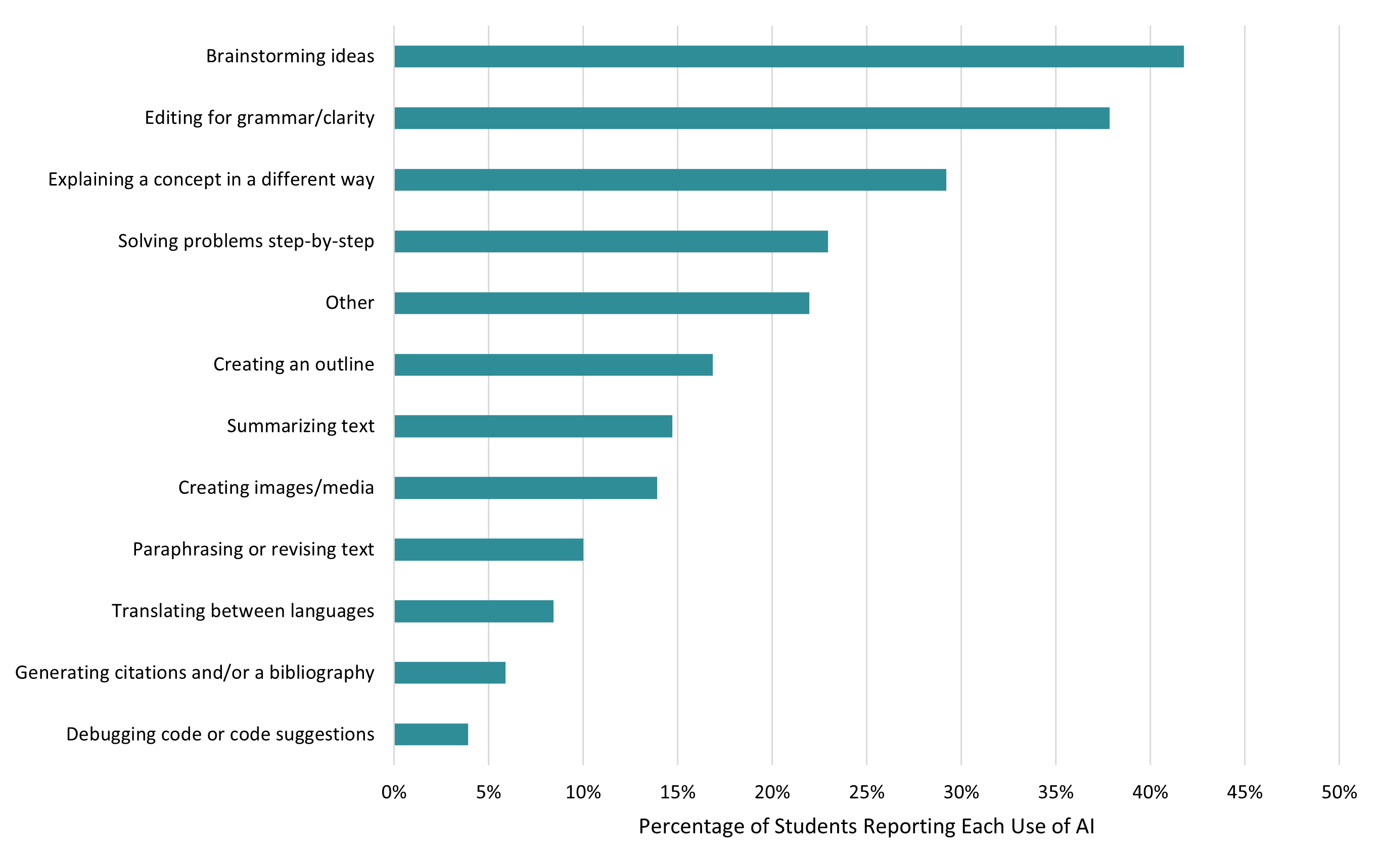 These results suggest that students were most likely to report using AI for idea generation, writing support, and explanatory help rather than for more specialized or technical tasks (such as coding or language translation). The most frequently selected uses point to AI being used primarily as a general academic support tool, especially for getting started on assignments, improving written communication, and clarifying understanding. By contrast, fewer students reported using AI for tasks such as citation generation, translation, or coding support, suggesting that these applications were either less relevant to students’ coursework or less commonly adopted in this sample.
Of the students surveyed, 17% (n = 88) provided open-ended responses in the “Other” category, which were analyzed to gain further insight into students’ AI use and non-use. A notable pattern in the open-ended responses was that many students used the “Other” field not to describe an additional academic use, but instead to indicate that they had not used AI at all or had not used it for schoolwork specifically. Many of these comments were brief and direct, referrencing intention non-AI use, not using AI (broadly), and not using AI in school work.
Indeed, some students described intentionally avoiding AI, often for ethical, environmental, or personal reasons. Other comments referenced concerns about climate impacts, academic ethics, job displacement, and broader opposition to AI. These responses reflected more than nonparticipation alone; for some students, they appeared to represent an active stance against AI use. Taken together, these responses suggest that the group of students reporting no AI use likely included both students who had not used AI and those who deliberately chose not to engage with it.
The remaining open-ended responses provide additional insight into how students interpreted the latter question, “How have you used AI?” Among students who did describe AI use, many responses reflected uses that were either more specific than the preset response options or outside of schoolwork altogether. Some referred to personal or recreational uses, while others described practical everyday uses. A smaller group described academic-support uses such as finding sources, conducting quick research, creating study guides, or generating practice questions. These responses are broadly consistent with the closed-ended results in that they point to AI being used to support studying, research, and assignment preparation, while also suggesting that students sometimes used the “Other” field to name more specific versions of broader categories already represented in the survey. Some students also indicated that their AI use was teacher-directed rather than self-initiated, while others described passive exposure to AI through embedded features such as Google’s AI summaries. Overall, these responses suggest that the “Other” category was used in multiple ways, but was dominated by reports of nonuse, followed by principled avoidance of AI, with the remaining responses capturing more specific academic uses, personal uses, teacher-directed uses, and indirect encounters with AI.
This pattern is important for interpreting the table results. Although a majority of students reported using AI for schoolwork in the past 30 days, the follow-up question suggests that this use was concentrated in a fairly limited set of common academic functions, particularly brainstorming, editing, and explanatory support. At the same time, the open-ended responses indicate that nonuse remained a prominent and meaningful pattern. For some students, this reflected simple nonuse; for others, it reflected a deliberate decision to avoid AI. As a result, the “No” category should not be understood as a single, uniform group, but rather as likely including multiple forms of nonuse with different underlying motivations.
Student and Teacher Performance on AI Knowledge Items
Table 2 below compares student and teacher performance on four AI knowledge items designed to assess understanding of key AI concepts and literacy. Overall, both groups answered the items correctly at high rates, suggesting generally strong baseline knowledge of several foundational AI concepts. At the same time, teachers outperformed students on every item included in the comparison.
Table 2. Comparison of Student and Teacher Performance on AI Knowledge Items
AI literacy item | Teachers correct | Students correct | Difference, percentage points |
|---|---|---|---|
What does it mean when an AI “hallucinates”? | 98.7% | 92.7% | 6.0 |
If you paste your full name and personal details into a public AI chatbot, which is most accurate? | 100.0% | 98.5% | 1.5 |
Which is an example of algorithmic bias? | 97.1% | 93.6% | 3.5 |
If a course or individual assignment allows AI for brainstorming but not for writing sentences, which practice best aligns with responsible AI use? | 98.6% | 84.4% | 14.2 |
Note. The difference was calculated as the percentage of teachers who answered correctly minus the percentage of students who answered correctly.
The smallest difference between the two groups appeared on the item asking about the risks of entering one’s full name and personal details into a public AI chatbot. Nearly all students (98.5%) and all teachers (100.0%) answered this item correctly, resulting in a difference of 1.5 percentage points. Performance was also high for both groups on the item asking students and teachers to identify an example of algorithmic bias, with 93.6% of students and 97.1% of teachers responding correctly, a difference of 3.5 percentage points. Similarly, large majorities of both groups correctly identified the meaning of AI “hallucination,” although teachers again performed somewhat better than students (98.7% vs. 92.7%), a gap of 6.0 percentage points.
The largest difference between students and teachers emerged on the item focused on responsible AI use in the context of assignment guidelines. When asked which practice best aligned with responsible AI use when AI was allowed for brainstorming but not for writing sentences, 84.4% of students answered correctly compared to 98.6% of teachers, a difference of 14.2 percentage points. This was the lowest-performing item for students and the item with the greatest separation between the two groups.
These results suggest that both students and teachers had strong knowledge of several core AI-related concepts, particularly those related to privacy, bias, and hallucinations. However, the larger gap on the responsible-use item may indicate that applying AI knowledge within academic policy or classroom-use contexts was more challenging for students than recognizing general concepts or risks. In contrast, teachers appeared to have both strong conceptual understanding and greater clarity about how AI use should align with instructional expectations and assignment boundaries.
Student and Teacher Agreement on AI Expectations and Use Statements
Student and teacher responses to the AI expectations and responsible use items suggest a mixed picture of confidence, clarity, and consistency. Across most items, students reported higher levels of agreement than teachers, indicating that students were generally more likely to say they understood AI expectations, knew where to find guidance, and felt prepared to use AI responsibly (see Table 3). For example, 86.7% of students agreed that they understood which uses of AI are allowed and which are not, compared with 74.3% of teachers. Similarly, 91.0% of students agreed that they knew how to use AI responsibly to support their learning rather than replace it, compared with 78.4% of teachers. Students were also more likely than teachers to agree that they knew how to check AI-generated information against reliable sources before using it (77.0% vs. 55.4%), representing the largest gap among the items shown.
Table 3. Comparison of Student and Teacher Agreement With Statements About AI Expectations and Responsible Use
Statement | Teacher agreement | Student agreement | Difference, percentage points |
|---|---|---|---|
I understand which uses of AI are allowed and which are not. | 74.3% | 86.7% | -12.4 |
I know when and how to disclose AI assistance. | 61.1% | 60.6% | 0.5 |
Expectations regarding AI use are consistent across my Michigan Virtual courses. | 60.6% | 70.4% | -9.8 |
I know where to find the expectations regarding AI again if guidance is needed (e.g., syllabus, webpage, handout). | 62.0% | 77.4% | -15.4 |
I know how to use AI responsibly to support my teaching or learning rather than replace it. | 78.4% | 91.0% | -12.6 |
I know how to check AI-generated information against reliable sources before using it. | 55.4% | 77.0% | -21.6 |
I can explain to someone else when the use of AI should be disclosed. | 62.16% | 74.8% | -12.6 |
Note. The difference was calculated as the percentage of teachers who agreed with the statements about responsible AI use minus the percentage of students who agreed.
At the same time, agreement was notably lower for both groups on several items related to disclosure and consistency. Only about six in ten respondents in each group agreed that they knew when and how to disclose AI assistance (60.6% of students and 61.1% of teachers). Agreement was also lower on whether expectations regarding AI use were consistent across Michigan Virtual courses (70.4% of students and 60.6% of teachers). These findings suggest that although many respondents expressed general confidence in their understanding of AI use, there may be less clarity around the practical details of disclosure and around whether expectations are communicated consistently across the multiple educational contexts with which they interact.
These results point to an important distinction between broad confidence and procedural clarity. Many students and teachers appeared generally confident about responsible AI use, but fewer indicated strong certainty about when AI assistance should be disclosed or where expectations could be located again if needed. This pattern may suggest that general messages about responsible use are reaching respondents more clearly than the specific practices and policies that govern acceptable use in specific situations.
Student and Teacher Agreement on AI Appropriate and Acceptable Use Statements
Responses to supportive or process-oriented AI scenarios provide additional insight into how students and teachers interpreted acceptable use in practice (Table 4). In general, teachers were more likely than students to judge these uses as acceptable, especially when AI was used to support planning, idea development, or revision rather than replace students’ own work. The largest differences appeared for scenarios involving AI-generated outlines and project ideas. For example, 77.0% of teachers said it was okay for AI to suggest a three-part outline for an essay when the student wrote all sentences themselves, compared with 47.4% of students, a difference of 29.6 percentage points. Likewise, 89.2% of teachers judged it acceptable for AI to suggest several project ideas that the student then developed independently, compared with 61.9% of students, a difference of 27.3 points.
Table 4. Student and Teacher Judgments of Supportive or Process-Oriented AI Uses
Scenario | Teachers deemed acceptable | Students deemed acceptable | Difference , percentage points |
|---|---|---|---|
AI suggests a 3-part outline for an essay and the student writes all sentences themselves. | 77.0% | 47.4% | 29.6 |
A student pastes a draft into AI for clarity and grammar, reviews the suggestions, revises the draft themselves, and discloses the AI use. | 81.1% | 73.8% | 7.3 |
AI suggests several project ideas and the student chooses one and develops it themselves. | 89.2% | 61.9% | 27.3 |
AI summarizes assigned readings for study only and the summaries are not submitted as coursework. | 77.0% | 60.8% | 16.2 |
Note. The difference was calculated as the percentage of teachers who deemed the AI use scenario acceptable minus the percentage of students who did so.
Differences between the two groups were smaller, though still present, for revision-oriented and study-support uses. A large majority of both groups viewed it as acceptable for a student to paste a draft into AI for clarity and grammar, review the suggestions, revise the draft themselves, and disclose the AI use (73.8% of students and 81.1% of teachers). Similarly, 60.8% of students and 77.0% of teachers judged it acceptable for AI to summarize assigned readings for study only when those summaries were not submitted as coursework. These patterns suggest that both groups were more accepting of AI when it functioned as a support for processes, but teachers were generally more likely than students to endorse these uses.
These findings are notable in light of earlier results showing that students commonly reported using AI for brainstorming, editing, and explanatory help. Several of the support-oriented scenarios in Table 4 closely resemble those same kinds of uses, yet student judgments were more cautious and less consistent than the earlier usage data might suggest. This pattern indicates that common use did not necessarily mean students saw those uses as clearly acceptable. Instead, students may have been using AI in ways they found helpful while still feeling uncertain about whether those uses fit within expected boundaries for appropriate schoolwork.
This pattern may indicate that teachers drew a clearer distinction between using AI to support learning processes and using AI to substitute for student thinking or authorship. Students, by contrast, appeared somewhat more cautious in judging whether even supportive uses were acceptable. As a result, the findings suggest that uncertainty may not be limited to identifying inappropriate uses of AI; it may also extend to recognizing when AI can be used appropriately as a support tool within defined boundaries.
Table 5. Student and Teacher Judgments of AI Uses With Strong Consensus That They Are Not Okay
Scenario | Teachers deemed acceptable | Students deemed acceptable | Difference, percentage points |
|---|---|---|---|
A student uses parts of an AI-generated summary in submitted work without citing or acknowledging the AI tool. | 90.6% | 92.3% | -1.7 |
A student pastes a homework problem into AI and copies the step-by-step solution into the assignment as their own work. | 86.5% | 89.2% | -2.7 |
A student asks AI to paraphrase sentences from a source and submits the paraphrase as their own wording. | 89.9% | 79.6% | 10.3 |
A student uses AI to create a bibliography and does not check whether the references are real or match the quotations in the paper. | 92.8% | 94.1% | -1.3 |
Note: The difference was calculated as the percentage of teachers who deemed the AI use scenario acceptable minus the percentage of students who did so.
In contrast to the more mixed judgments surrounding supportive uses, student and teacher responses showed strong consensus on several scenarios that involved unacknowledged, unverified, or misrepresented AI use (Table 5). Large majorities in both groups judged these uses as not acceptable. For example, 92.3% of students and 90.6% of teachers said it was not okay for a student to use parts of an AI-generated summary in submitted work without citing or acknowledging the AI tool. Similarly, 89.2% of students and 86.5% of teachers judged it unacceptable for a student to paste a homework problem into an AI and copy the step-by-step solution into the assignment as their own work. Strong disapproval was also evident for submitting AI-paraphrased source material as one’s own wording and for using AI to create a bibliography without checking whether the references were real or matched the quoted material.
For many of these scenarios, the percentage selecting Definitely not okay was substantially larger than the percentage selecting Probably not okay, suggesting especially strong agreement within both groups about what constitutes unacceptable AI use. This pattern is notable because it suggests that knowing when not to use AI may be easier for both students and teachers than determining when AI use is acceptable. In other words, boundaries around clearly inappropriate uses may be more widely shared than boundaries around supportive or process-oriented uses. Taken together, Tables 4 and 5 suggest that the boundary around misuse was clearer for students than the boundary around appropriate support.
This pattern points to a key challenge in AI guidance and implementation: respondents may have a clearer sense of misuse than of appropriate use. As a result, efforts to support responsible AI use may benefit not only from emphasizing prohibited practices, but also from providing clearer examples of when and how AI can be used appropriately to support learning without replacing student work.
Sources of Guidance Around Acceptable AI Use
As shown in Figure 2, students reported receiving guidance about AI use for schoolwork from a range of sources since the start of the school year. Nearly half of students (48.8%) reported receiving guidance about acceptable AI use from their face-to-face school. Michigan Virtual course-based sources were reported less often, with about one-quarter of students reporting receiving guidance through their online course orientation (26.9%) or online course syllabus (24.8%), while 20.4% reported announcements or messages from their online course teacher. Smaller shares of students identified other people-based sources, including a librarian, coach, or counselor at their school (12.5%), friends or peers (12.2%), or their online course mentor (10.8%). Notably, nearly one in four students (23.8%) reported not receiving any guidance on AI use.
Figure 2. Student Reports of Where Guidance About AI Use for Schoolwork Was Received Since the Start of the School Year
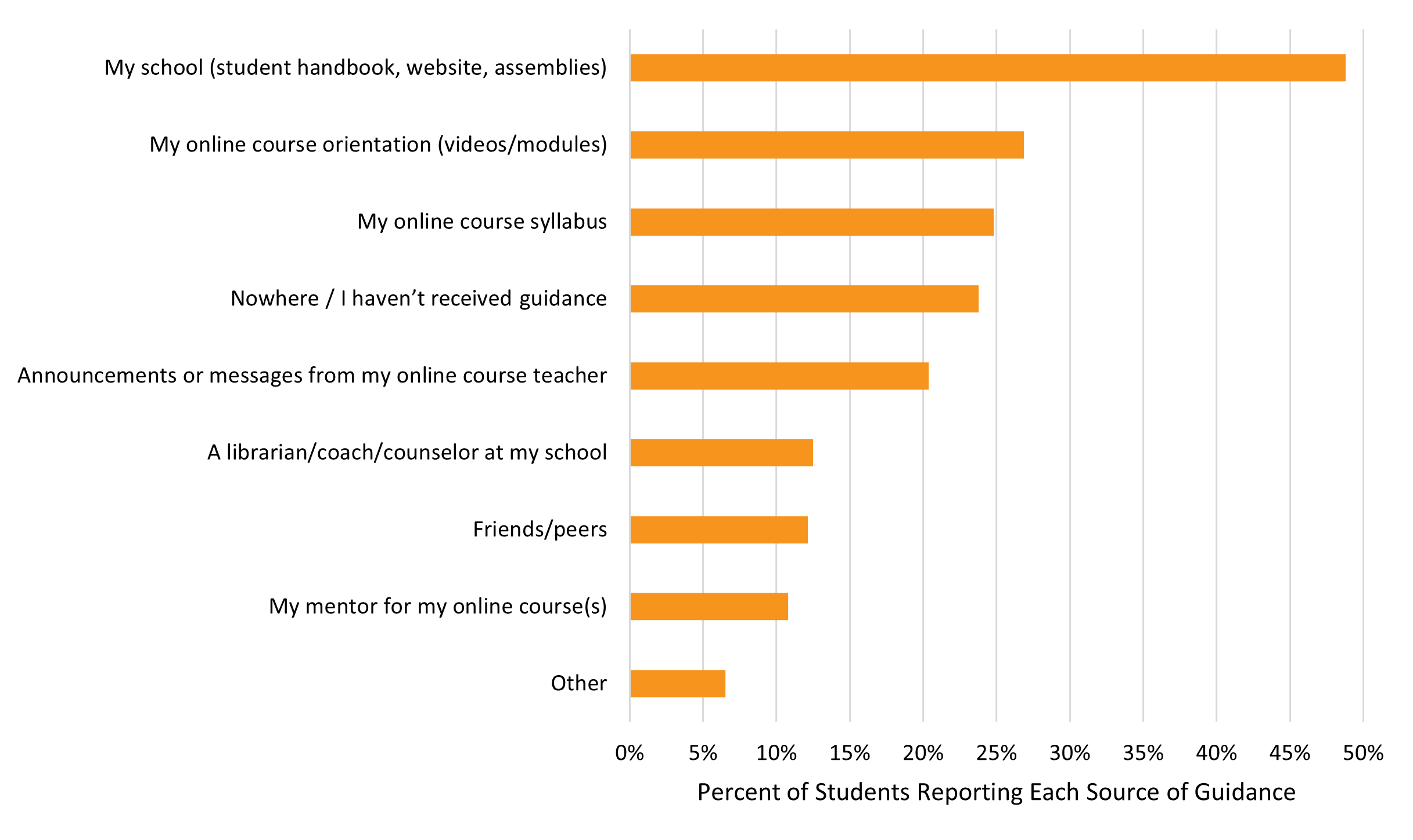 These findings suggest that students were more likely to encounter guidance about AI use through their face-to-face school than through Michigan Virtual course structures or personnel. At the same time, the distribution across sources shown in Figure 2 indicates that guidance was relatively diffuse rather than concentrated in a single channel. This pattern is important because it suggests that students may have been piecing together expectations from multiple contexts, with nearly one-quarter indicating they had received no guidance at all. That finding provides useful context for earlier results showing that, although most students reported confidence in their understanding of AI expectations, lower levels of agreement appeared on more procedural items, such as knowing when and how to disclose AI assistance.
Table 6 further compares student agreement with statements regarding AI guidance in Michigan Virtual and in their face-to-face school settings. The results suggest that students reported relatively high confidence in both contexts on a broad understanding of AI expectations, though earlier findings in the report indicate that this general confidence did not always extend to more specific judgments about acceptable use in practice. Specifically, as shown in Table 6, 86.7% of students agreed that they understood which AI uses were allowed and which were not in their Michigan Virtual course(s), compared with 90.9% in their face-to-face course(s) or school. Students also reported similar levels of agreement about knowing where to find expectations again if they needed clarity or a reminder, with 75.3% agreeing they could find it in their Michigan Virtual course(s) and 77.4% agreeing they could find it in their face-to-face course(s) or school.
Table 6. Student Agreement With AI Guidance Statements for Michigan Virtual Courses and Face-to-Face (F2F) Schools
Statement | Michigan Virtual agreement | F2F school agreement | Michigan Virtual not sure | F2F school not sure |
|---|---|---|---|---|
I understand which AI uses are allowed and which are not. | 86.7% | 90.9% | 8.5% | 5.0% |
I know when and how to disclose AI assistance in my work. | 60.2% | 72.1% | 25.8% | 17.1% |
Expectations about AI use are consistent across courses/classes. | 72.3% | 70.0% | 21.7% | 10.3% |
I know where to find the expectations again if I need clarity or a reminder. | 75.3% | 77.4% | 15.8% | 14.6% |
As also shown in Table 6, larger differences emerged on items related to disclosure and uncertainty. Students were less likely to agree that they knew when and how to disclose AI assistance in their work in Michigan Virtual (60.2%) than in their face-to-face school (72.1%). This 11.9 percentage-point difference suggests that disclosure expectations may have been less clear in the Michigan Virtual context. Uncertainty was also higher for Michigan Virtual on this item, with 25.8% selecting not sure compared with 17.1% for their face-to-face school. This pattern aligns with earlier findings showing that disclosure was one of the less certain areas for students overall, even when general confidence about responsible AI use was high.
Although agreement was high on this broad understanding item, earlier results suggest that students’ confidence may be stronger at the level of general principles than at the level of specific application. That is, students may feel they know, in a general sense, which AI uses are allowed, while still showing greater uncertainty when asked to judge particular uses or explain when disclosure is required.
Students’ views were more mixed on whether expectations about AI use were consistent across courses or classes. As shown in Table 6 above, agreement was similar across the two settings: 72.3% agreed that expectations were consistent across Michigan Virtual courses, and 70.0% agreed that expectations were consistent across face-to-face classes. However, the percentage selecting not sure was notably higher for Michigan Virtual (21.7%) than for face-to-face schools (10.3%). This combination of similar agreement but higher uncertainty may suggest that some students perceived consistency in Michigan Virtual overall, but still lacked confidence about whether that consistency extended across all courses.
Taken together, the results presented in Figure 2 and Table 6 point to a distinction between general awareness of AI expectations and clarity about specific procedures or guidance sources. Students generally reported understanding what kinds of AI use were allowed in both Michigan Virtual courses and at their face-to-face school, and most also reported knowing where to find the expectations again if needed. However, lower agreement and higher uncertainty on disclosure in Table 6 suggest that knowing when and how to acknowledge AI assistance remained a more challenging area. This pattern is consistent with earlier sections, which show that students often expressed broad confidence in their understanding of responsible AI use while showing less certainty about procedural issues, particularly disclosure.
The findings in Figure 2 and Table 6 also help contextualize earlier results related to acceptable and unacceptable AI use. Previous analyses showed that students and teachers shared a relatively strong consensus on clearly inappropriate AI uses, while supportive or process-oriented uses were judged less consistently. The current findings suggest that one reason for this pattern may be that students were receiving guidance from multiple sources, with varying levels of clarity and reach, and that nearly one-quarter reported receiving no guidance at all (see Figure 2). In that context, it is perhaps not surprising that students appeared more certain about clearly unacceptable uses of AI than about the more nuanced boundaries surrounding disclosure, consistency, and appropriate support-oriented uses.
Key Findings
AI was a meaningful part of students’ school experiences, but use remained uneven.
A majority of students reported using AI for schoolwork in the past 30 days, indicating that AI has, to some degree, become a part of academic life for many students. At the same time, a substantial minority reported no recent school-related AI use. The open-ended responses suggest that this nonuse reflected more than one pattern. For some students, it appeared to reflect simple nonuse, while for others it reflected a more deliberate decision to avoid AI based on ethical, environmental, or personal concerns. These findings suggest that student engagement with AI was already substantial, but uneven, and that students were not all approaching AI from the same starting point.
These findings can be understood in light of earlier Michigan Virtual research on educators’ AI use and perceptions. That earlier work found that AI engagement was uneven across educator groups: teachers reported lower trust and lower use than administrators, and the report identified a meaningful subgroup of educators who were skeptical of AI, not actively engaging with it, and in some cases did not want to do so (Michigan Virtual, 2024). More recent educator survey findings suggested that use had grown substantially over time, but that trust and comfort had not kept pace for everyone (Michigan Virtual, 2025). Viewed alongside that earlier work, the current student findings suggest that a similar pattern may be emerging among students.
Students appeared to use AI primarily as a support tool for learning and academic work.
The most commonly reported uses of AI centered on brainstorming, editing, and getting help understanding concepts, while less common uses included citation generation, translation, and coding support. This pattern suggests that students most often used AI to support core academic processes, such as getting started on assignments, improving written work, and clarifying understanding. Responses to the scenario items further reinforce this pattern by showing that both students and teachers were generally more open to AI when it appeared to support learning rather than replace it. Overall, the results suggest that the most common forms of student AI use were relatively practical and process-oriented.
At the same time, later scenario-based findings suggest that these common support-oriented uses were not always matched by equally strong consensus that similar uses were acceptable. Although many students reported using AI for brainstorming, editing, and explanatory help, students were more cautious in their judgment of scenarios involving outlines, project ideas, and other support-oriented uses. This pattern suggests that common use did not necessarily reflect clear confidence that those uses were allowed. Instead, some students may have been using AI in ways they found helpful without feeling fully certain about where the boundary between appropriate support and inappropriate assistance should be drawn.
Students’ broad confidence about AI expectations was not always matched by a clear, consistent, or applied understanding.
Across several parts of the survey, students reported high levels of confidence in their general understanding of AI expectations. Large majorities agreed that they understood which uses of AI were allowed, knew how to use AI responsibly, and could evaluate AI-generated information. At the same time, other findings suggested that this broad confidence did not always extend to more specific or applied judgments. Students were less certain about procedural issues such as when and how to disclose AI assistance, and their responses to scenario-based items showed less consistent views about whether particular support-oriented uses of AI were acceptable. Students also reported receiving guidance from a wide range of sources, and nearly one-quarter reported receiving none.
These findings suggest that many students had a general sense of the norms surrounding AI use, but that this understanding was not always matched by clear, consistent, or actionable guidance on how to apply those norms in practice. This pattern may help explain why students appeared more certain about clearly inappropriate uses than about the more nuanced boundaries surrounding disclosure, consistency, and acceptable support-oriented use. For educators and institutions, the findings suggest that supporting responsible AI use may require more than communicating general expectations; it may also require clearer examples, more explicit procedures, and more consistent guidance across contexts.
There was stronger agreement about what counts as inappropriate AI use than about what counts as appropriate use.
Both students and teachers showed high levels of agreement on scenarios involving unacknowledged, unverified, or misrepresented AI use, suggesting a fairly clear shared understanding of unacceptable uses. By contrast, there was less alignment on supportive or process-oriented uses, particularly those involving brainstorming, outlines, project ideas, and study supports. This pattern suggests that boundaries around misuse were more clearly understood than boundaries around responsible use. It also indicates that uncertainty was more likely to emerge in situations when AI was used to support learning rather than clearly replace student work. In practice, these findings suggest that guidance about AI may need to do more than identify prohibited uses; it may also need to clarify when and how AI can be used appropriately within academic boundaries.
Students and teachers showed different patterns of confidence and judgment around AI use.
Although students and teachers shared common ground on several core issues, their responses also reflected different patterns of confidence and judgment. Students reported higher levels of agreement than teachers on several broad statements about understanding AI expectations and responsible use, suggesting greater self-reported confidence in their general understanding of AI guidance. At the same time, teachers outperformed students on the knowledge item related to responsible AI use in the context of assignment guidelines and were more likely to judge bounded, support-oriented uses of AI as acceptable when those uses were framed as helping rather than replacing student work. These differences suggest that students may have been more confident in general expectations, while teachers may have been more consistent in applying those expectations to specific instructional situations. Taken together, the findings point not simply to one group knowing more than the other, but to different strengths in how students and teachers understood and interpreted AI use in school contexts.
References
Adair, A., Howell, J., Jacklin, A., & Walton Radford, A. (2025, October). U.S. high school students’ use of generative artificial intelligence: New evidence from high school students, parents, and educators. College Board Research. https://research.collegeboard.org/media/pdf/ai-research-brief-1_vf.pdf
Andersen, G., & Yang, S. (2025). A survey of K-12 teachers’ perspectives on teaching with generative artificial intelligence. The Advocate, 30(2), Article 3. https://newprairiepress.org/advocate/vol30/iss2/3/
McGehee, N. (2024). AI in Education: Student Usage in Online Learning. https://michiganvirtual.org/research/publications/ai-in-education-student-usage-in-online-learning/
McGehee, N. (2025). Artificial Intelligence and Student Usage in Online Learning: A Longitudinal Analysis of Usage Patterns, Achievement, and Perceptions in K-12 Virtual Education. Michigan Virtual. https://michiganvirtual.org/research/publications/artificial-intelligence-and-student-usage-in-online-learning-a-longitudinal-analysis-of-usage-patterns-achievement-and-perceptions-in-k-12-virtual-education/
Michigan Virtual. (2024). AI in Education: Exploring Trust, Challenges, and the Push for Implementation. https://michiganvirtual.org/research/publications/ai-in-education-exploring-trust-challenges-and-the-push-for-implementation/
Michigan Virtual (2025). AI in Education: A 2025 Snapshot of Trust, Use, and Emerging Practices. https://michiganvirtual.org/research/publications/ai-in-education-a-2025-snapshot-of-trust-use-and-emerging-practices/
Ross, J. (2024). Guidance for developing policies to govern the adoption and use of artificial intelligence in K-12 schools. Region 8 Comprehensive Center. https://files.eric.ed.gov/fulltext/ED655341.pdf
Southern Regional Education Board. (2025, April). Guidance for the use of AI in the K-12 classroom. https://www.sreb.org/sites/main/files/file-attachments/2025_ai_in_k-12classroom_guidance.pdf?1744905120
U.S. Department of Education, Office of Educational Technology. (2024). Empowering education leaders: A toolkit for safe, ethical, and equitable AI integration. https://files.eric.ed.gov/fulltext/ED661924.pdf