
Introduction
Our 2025 report opened with a statement positioning Artificial Intelligence (AI) as “one of the most transformative forces of our time.” This statement remains true in our 2026 report, as AI continues to embed itself in education with its promises to enhance educator efficiency, personalize learning for students, and reimagine teaching practices. The technology’s rapid evolution and adoption mean that Michigan educators are encountering and using AI tools more frequently, both inside and outside of classrooms.
This expanded opportunity and use, however, requires careful consideration and alignment with local values and goals. Educators continue to question the equity, transparency, data privacy, and professional capacity of AI. AI adoption continues to outpace educator trust, which necessitates ongoing research and expanding the conversation on AI adoption to ensure it is both effective and responsible.
Recognizing these needs, the AI Lab at Michigan Virtual partnered with leading education associations across Michigan through the AI Statewide Workgroup. For the third year in a row, these organizations examine how AI is being used, how educators feel about it, and what supports are needed to move forward responsibly. By conducting annual surveys of educators across the state, the Workgroup is building a foundation of knowledge to guide districts as they navigate this complex and fast-changing landscape.
This 2026 update serves as a new snapshot of the state of AI in Michigan education, offering insights into both continuity and change since the initial 2024 survey and the 2025 follow-up. Many themes surrounding use, barriers, and trust have stayed consistent, but one notable trend is that schools seem to be moving from exploring AI to implementing AI, even as trust decreases to 2024 levels. This dynamic presents both opportunities and challenges for schools, making it more important than ever for district and state leaders to stay engaged, informed, and proactive in their approach to AI.
What Exactly is AI?
Throughout this report, we use the term artificial intelligence (AI). For consistency and comparability, we continue to rely on the same operational definition used in the 2024 report, drawn from Michigan Virtual’s Planning Guide for AI: A Framework for School Districts:
In this report, the term “AI” is used broadly to refer to both:
Artificial Intelligence (AI): A branch of computer science that involves the development of intelligent systems capable of performing tasks that typically require human intelligence. AI enables machines to learn from experience, adapt to new data, and make decisions based on patterns and algorithms.
Generative AI: This type of AI encompasses algorithms and models designed to produce new content—be it text, images, or video—by learning from vast amounts of existing data.
While the definition remains the same, what has changed since 2024 is the speed at which educators are encountering these technologies. Generative AI in particular has become more visible in both public and professional settings, underscoring the importance of shared understanding around terminology. By continuing to ground our discussion in a common definition, we aim to support clarity, consistency, and meaningful dialogue among educators and leaders across Michigan.
Current Research Study
As with previous years' studies, this research was developed based on conversations with and input from the Statewide AI Workgroup. The following research questions guided the current study:
Are educators using AI in their professional roles, and if so, how?
Do educators trust AI systems? What are their primary concerns about AI?
How do educators envision the future of AI?
To answer these research questions, the AI Statewide Workgroup again distributed a survey designed to assess educators’ experiences, challenges, and perceptions of AI in Michigan schools. The 2026 survey mirrored the instrument used in 2025 to ensure consistency and comparability over time. It included demographic questions regarding educators’ roles, ages/levels served, and educational environments; questions assessing trust in AI and AI use; and questions about AI implementation in schools, including potential barriers and concerns.
As in the prior year, the survey consisted of a core set of questions answered by all respondents, along with role-specific items tailored to participants’ professional positions. Role-specific questions were developed for the following groups: teachers, building principals/assistant principals (referred to as building administrators), superintendents/assistant superintendents, school board members, curriculum directors, and technology directors (collectively referred to as district administrators). The wording of these questions was adjusted to reflect each role’s context. For example, “Are you using AI in your classroom/building/district?”, while maintaining alignment across groups to allow for meaningful comparison.
The survey was shared with and distributed to the AI Statewide Workgroup’s membership, resulting in 136 unique responses as of July 7, 2026. Responses with no recorded answers were deleted from the dataset. Please note that tables may not add up to 136, as respondents were given role-specific questions, were not required to answer every question, and for some questions, were able to select more than one option. Survey responses were collected in SurveySparrow and analyzed in Excel. ChatGPT was used to assist in analyzing and summarizing responses to open-ended questions.
Findings
Educator Demographics
Table 1 below details the professional education association memberships. Six professional organizations contributed 10 or more participant responses each within the survey. While participation was down from previous years, professional organization membership remained fairly consistent.
Table 1. Distribution of Professional Education Association Membership, 2024-2026
Professional Education Association | 2026 | 2025 | 2024 |
|---|---|---|---|
48.8% | 26.8% | 22.3% | |
32.8% | 13.5% | 13.0% | |
8.0% | 11.6% | 9.9% | |
Other | 17.6% | 11.1% | 2.1% |
5.6% | 7.1% | 6.8% | |
3.2% | 5.3% | 7.7% | |
MASA (Michigan Association of Superintendents and Administrators) | 8.0% | 4.0% | 6.8% |
REMC Association of Michigan (Regional Educational Media Center Association of Michigan) | 8.0% | 3.8% | 12.0% |
3.2% | 3.6% | 1.2% | |
MEMPSA (Michigan Elementary & Middle School Principals Association) | 4.0% | 3.3% | 3.7% |
MAISA (Michigan Association of Intermediate School Administrators) | 4.0% | 2.6% | 3.0% |
MI-ASCD (Michigan Association for Supervision and Curriculum Development) | 1.6% | 2.5% | 1.5% |
MAASE (Michigan Association of Administrators of Special Education) | 5.6% | 1.5% | N/A |
0.8% | 1.5% | 1.4% | |
0.8% | 1.3% | 7.3% | |
5.6% | 0.4% | 1.5% | |
2.4% | 0.1% | N/A |
As part of the demographic questions, educators were asked about their primary role. Table 2 below provides details of their responses. Continuing trends of previous years, building-level roles (72.1% of total responses) represented the largest group of educators, with teachers specifically representing the largest individual group (47.1% of respondents), followed by coaches/consultants (10.3%), collectively providing valuable insight into how AI is being used in classrooms and with students. Additionally, 13.3% of the total responses came from district-level leadership roles, further providing diverse perspectives on district-level AI perceptions, needs, and concerns. While the total number of responses has decreased steadily since 2024, the sample's makeup has remained consistent, with teachers representing the largest demographic group across all three years of the survey.
Table 2. Distribution of Primary Educational Roles, 2024-2026
Primary Educational Role | 2026 | 2025 | 2024 |
|---|---|---|---|
District Level | |||
Superintendent / Asst. Superintendent | 5.9% | 5.2% | 4.3% |
School Board Member | 1.5% | 4.3% | 6.8% |
Curriculum Director | 2.2% | 3.7% | 1.4% |
School Business Official / CFO | 0% | 3.2% | 3.9% |
Technology Director | 3.7% | 1.7% | 3.5% |
Human Resources | 0% | 0.4% | 0.3% |
Building Level | |||
Teacher | 47.1% | 43.2% | 40.0% |
Building Principal / Asst. Principal | 3.7% | 15.0% | 15.3% |
Coach / Consultant | 10.3% | 6.7% | 6.6% |
Special Education Provider | 2.9% | 1.7% | 3.2% |
School Support Staff | 1.5% | 1.5% | 1.7% |
Library / Media Specialist | 5.1% | 0.6% | 2.8% |
Educational Support Professional | 1.5% | 0.6% | 0.8% |
K-12 Peripheral Supports | |||
Other (Please specify) | 11.0% | 8.0% | 6.3% |
ISD Administrator | 3.7% | 3.0% | 1.1% |
College Faculty | 0% | 0.7% | 1.8% |
Higher Ed Support Professional | 0% | 0.6% | 0.2% |
Are Educators Using AI in Their Professional Roles, and if so, How?
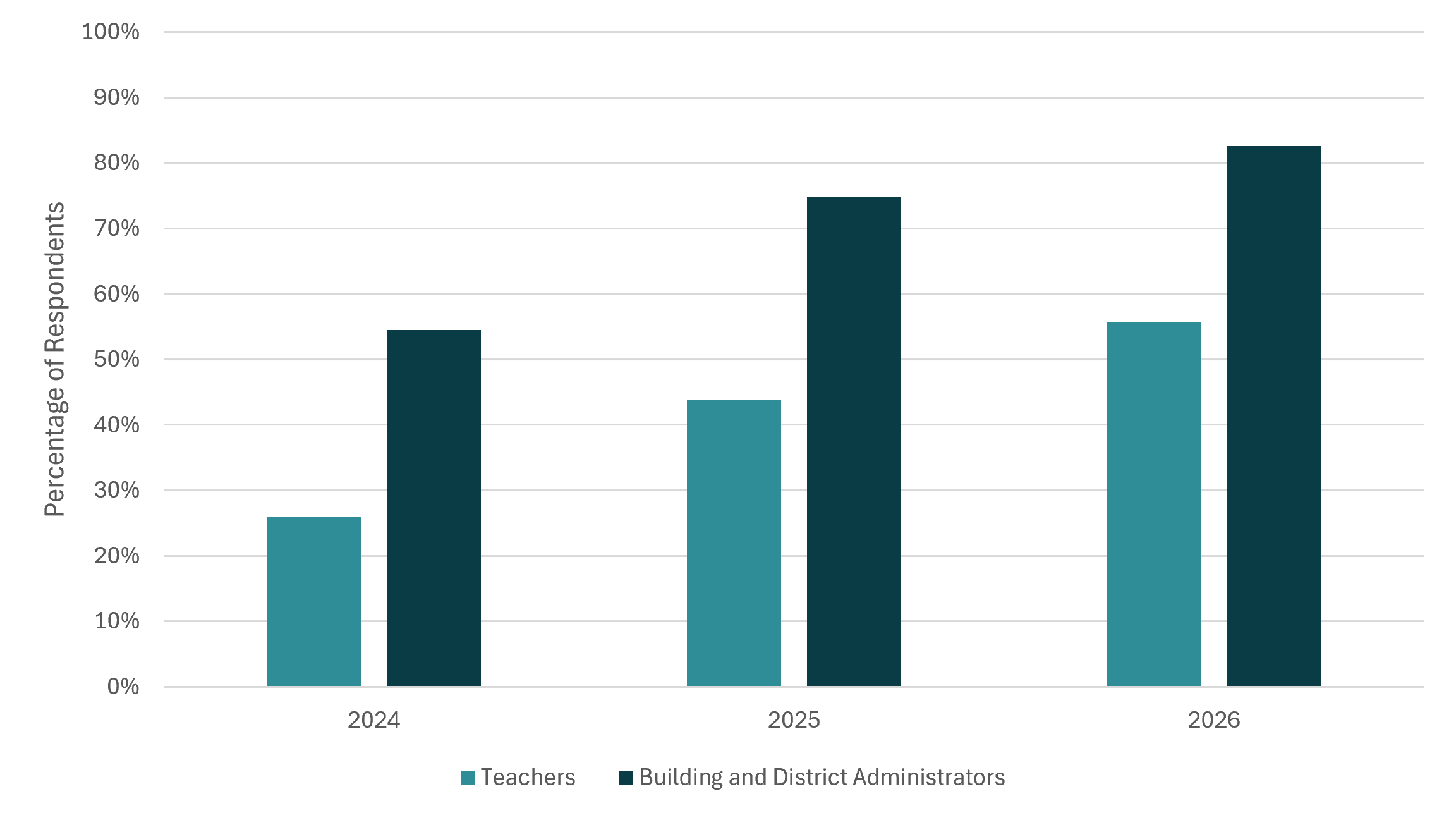
Educators were asked, “if they (teachers) were using AI in their classroom”, or “if teachers were using AI in their school” (building administrators and district administrators). The responses, detailed in Figure 1 below, indicate that for the third consecutive year, building and district administrators report that AI is being used at a higher rate in schools and classrooms than teachers reported using it in their own classrooms. While both groups reported an increase in classroom AI use, the gap between administrators and teachers remained relatively consistent (around 30 percentage points) across the three years. The reasons for this difference are not known and may reflect differences in the settings represented by each respondent group, administrators’ broader visibility across classrooms, or differences in how respondents recognize and define AI use. Additionally, teachers reported classroom AI use more than doubled from 2024 to 2026, continuing the previously identified year-over-year trend toward greater use.
Figure 1. Reported AI Use in Classroom or Building/School, 2024-2026
 Educators were also asked about their broader experience using AI personally and professionally. As shown in Figure 2 below, more than 80% of educators in 2026 reported having used AI both personally and professionally, compared with approximately 75% in 2025. In the 2026 survey, an additional approximately 10% reported using AI only in their professional role, while about 5% reported using it only in their personal lives. Relatively few respondents indicated that they were still exploring how they might use AI, had not used AI and did not plan to, or were unsure whether they had used it. Overall, the findings suggest that experience with AI is no longer limited to a relatively small group of early adopters. For most respondents, AI use now extends across both their personal and professional lives.
Figure 2. All Educator Experience with AI 2026
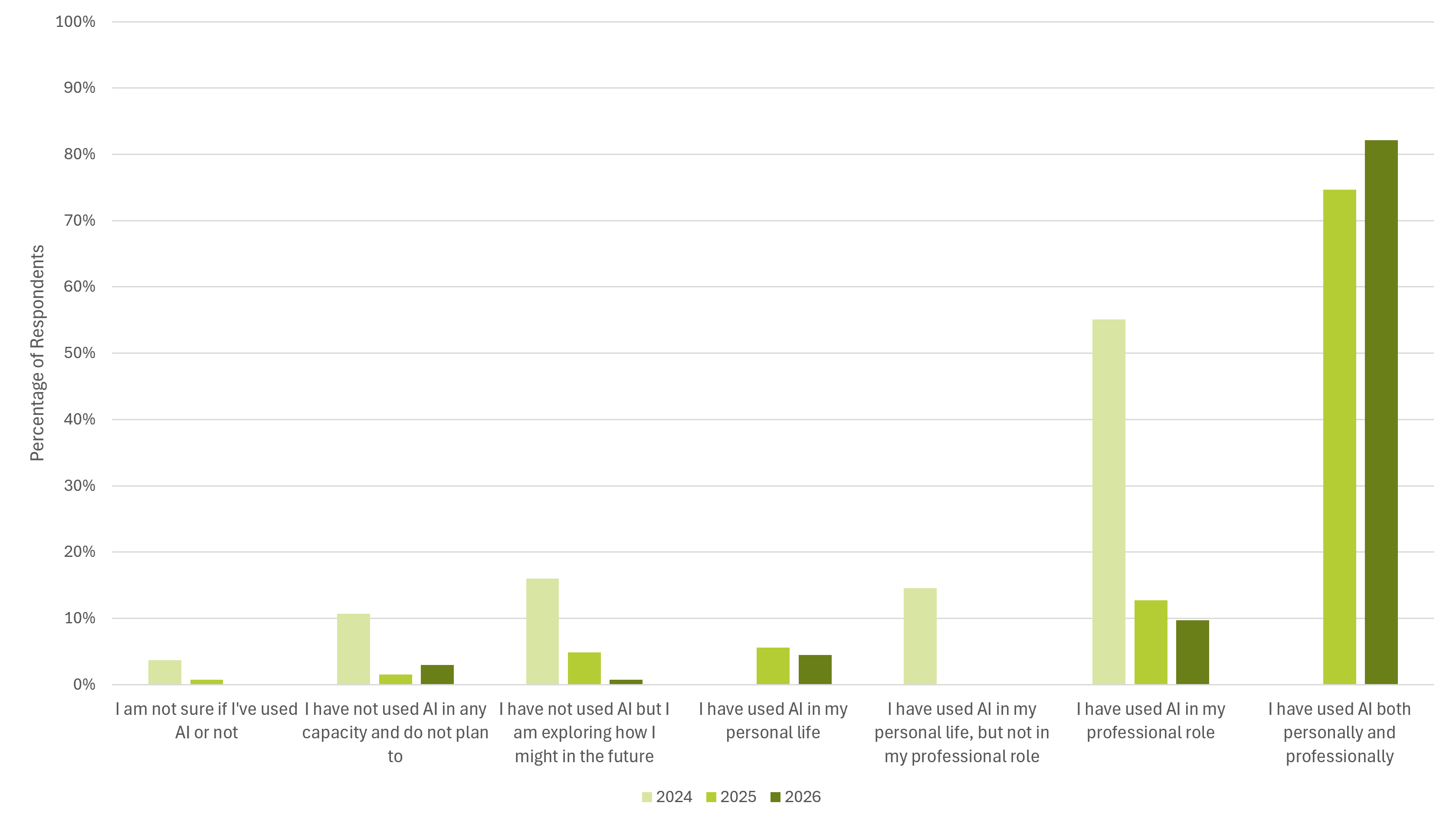 Note. The response options for this question changed between 2024 and 2025. In 2024, respondents could indicate that they had used AI in their professional role, but there was no separate option for those who had used AI both personally and professionally. Beginning in 2025, the survey distinguished between professional-only use and use in both personal and professional contexts. As a result, the 2024 professional-use response is not directly comparable to the narrower professional-role category used in 2025 and 2026. Year-to-year differences should therefore be interpreted with caution.
Viewed together, the three years of data suggest a continuing shift from initial awareness and exploration toward widespread, routine experience with AI. In 2024, the findings showed substantial variation in educators’ experience and willingness to use AI, including a sizable group of teachers with no plans to use it. By 2025, the reports indicated that many educators had moved from curiosity to actual classroom and district use. The 2026 results extend that pattern, as reported classroom use continues to grow, most educators have now used AI in both personal and professional contexts, and comparatively few remain entirely unfamiliar with it.
Practically, this means that schools and districts may need to move beyond introductory efforts focused only on raising awareness. Educators are increasingly likely to need clear guidance on appropriate use, opportunities to deepen their skills, access to vetted tools, and support for evaluating when AI adds instructional value and when it does not. The persistent difference between teacher and administrator reports of AI use also points to the importance of including teachers directly in implementation planning so that district strategies reflect classroom realities rather than relying solely on leadership-level perceptions. This implication is consistent with the earlier reports’ emphasis on pairing expanding use with professional learning, policy guidance, attention to educator concerns, and meaningful stakeholder involvement.
What Barriers do Educators Report to AI Integration?
When asked about barriers to using AI in their professional roles or with students, educators most often discussed a need for more training, familiarity, and time to learn. Several respondents described feeling unsure about which tools to use, how to apply them within their specific teaching context, or how to keep up with the rapid pace of change. Beyond training needs, many comments reflected deeper concerns about student learning, including worries that AI may reduce opportunities for students to think independently, develop skills, or complete work authentically. Other frequently cited barriers included the need for district policies or clearer expectations, concerns about environmental impact and job security, student cheating or plagiarism, and questions about privacy, cost, and data security.
Educators were also invited to share any final thoughts at the end of the survey, and in response, most frequently shared concerns about student learning, development, and human connection. Many emphasized that AI should not replace the kinds of thinking, communication, creativity, and face-to-face interaction that support student growth. At the same time, the responses reflected a range of perspectives. Some educators were cautiously optimistic, describing AI as a useful tool when implemented intentionally and with clear attention to purpose, age appropriateness, and learning outcomes. Others called for more professional development, stronger district policies, clearer guidance, student voice in decision-making, and more research before AI is used for high-impact instructional or assessment decisions. A smaller group, but one that has been vocal in all three years of the survey, expressed strong opposition to AI in education, often citing concerns about overuse, environmental impact, screen time, cheating, or the perception that AI is being pushed too quickly.
The 2026 open-ended responses largely reinforce the findings of the 2025 AI report that educators recognize AI’s potential, but implementation continues to outpace confidence, clarity, and trust. Across both questions, respondents emphasized practical barriers including limited training and time, uncertainty about tool selection, unclear policies, privacy and security concerns, and student misuse, while also raising broader concerns about student development, human connection, environmental impact, and the pace of AI’s introduction into schools. Together, these responses suggest that educators are not simply asking whether AI should be used, but under what conditions it can be used responsibly and effectively. Even among those who see value in AI, there is a shared call for intentional implementation, professional learning, clear expectations, age-appropriate guardrails, and stronger evidence that AI enhances meaningful learning without replacing the core human work of teaching and learning.
Do Educators Trust AI Systems?
Educators were asked to rate their level of trust in AI systems on a scale from 0 to 100, with 0 indicating no trust, 100 indicating complete trust, and 50 indicating a moderate level of trust. As shown below in Figure 3, trust increased from 2024 to 2025, then declined in 2026. Among all educators, average trust rose from 49.4 in 2024 to 58.4 in 2025, then fell to approximately 46.5 in 2026. Teachers followed the same pattern: average trust increased from 43.7 in 2024 to 53.6 in 2025 before declining to 43.7 in 2026. Across all three years, teachers reported lower trust than educators overall.
In 2026, building administrators reported an average trust level of 44.4, only slightly higher than teachers’ average of 43.7, while district administrators reported a substantially higher trust level of 54.1. These role-based differences suggest that the overall educator average may conceal important variation, particularly the higher level of trust among district administrators compared with educators working more directly at the school and classroom levels.
Figure 3. Level of Trust in AI by Year for Teachers and All Educators, 2024-2026
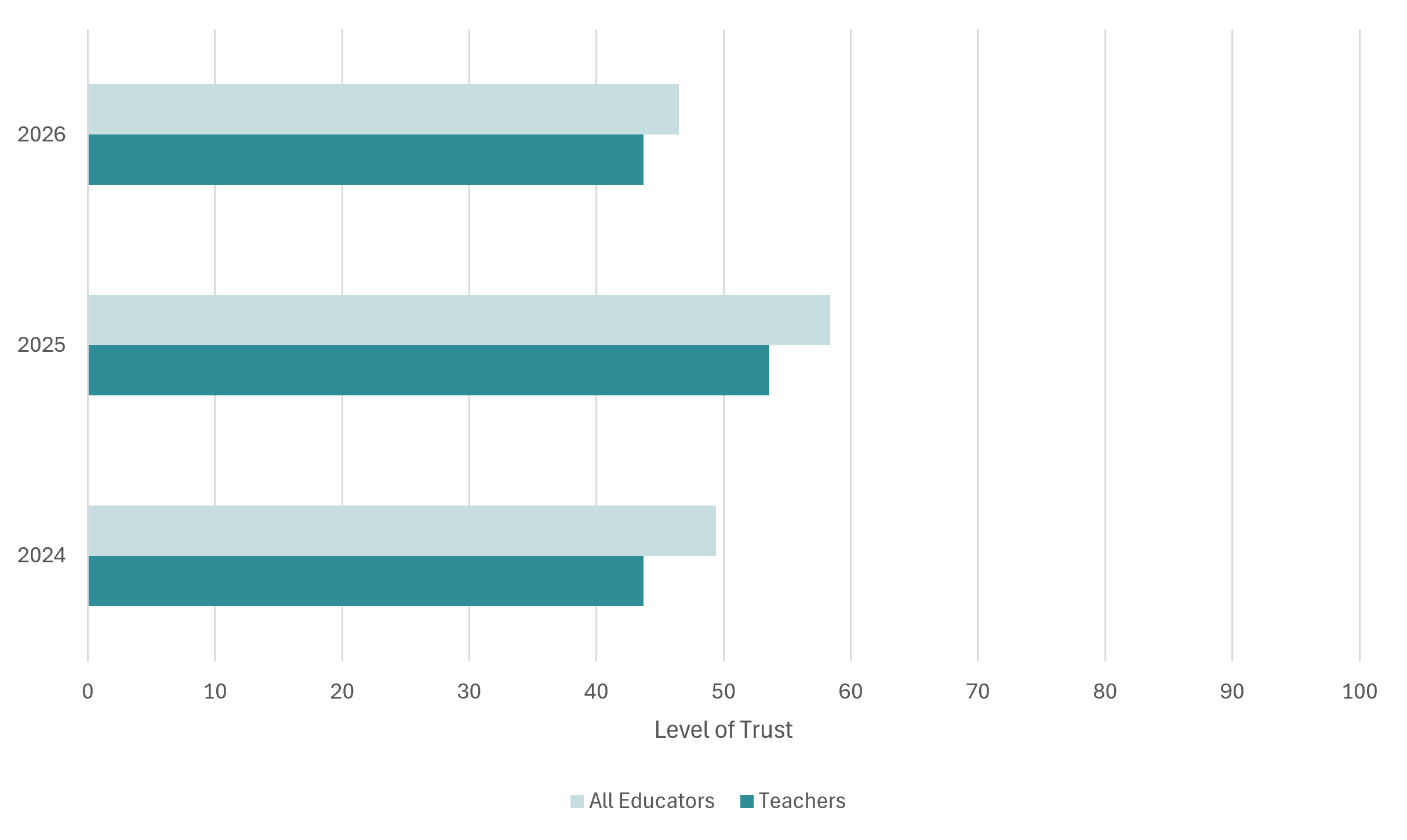 The decline in trust in 2026 is particularly notable because it occurred alongside continued growth in educators’ personal and professional use of AI. In 2025, the report identified that growth in AI use appeared to be outpacing growth in trust; the 2026 findings extend this pattern, showing that widespread use does not necessarily translate into increased confidence in AI systems. As educators gain more direct experience with AI, they may also become more familiar with its limitations and the need to verify its outputs. However, the survey data do not establish the reasons for the decline, and changes in trust should therefore be interpreted cautiously.
Viewed across the three years, the findings suggest that trust is neither stable nor guaranteed to increase as AI becomes more common in education. The return of teachers’ average trust closer to its 2024 level, combined with the similar 2026 score among building administrators, indicates that reservations about AI remain especially relevant among those closest to classroom implementation. Practically, schools and districts should not interpret increased use as evidence that educators feel confident about AI or believe that all applications are appropriate. Implementation efforts should pair access to AI tools with clear expectations for human review, transparent guidance about appropriate use and system limitations, and opportunities for educators to evaluate tools within their own professional contexts and share their feedback. The higher trust reported by district administrators also reinforces the need to include teachers and building leaders in planning so that district-level decisions account for concerns and experiences at both the classroom and school levels.
How Do Educators Envision the Future of AI?
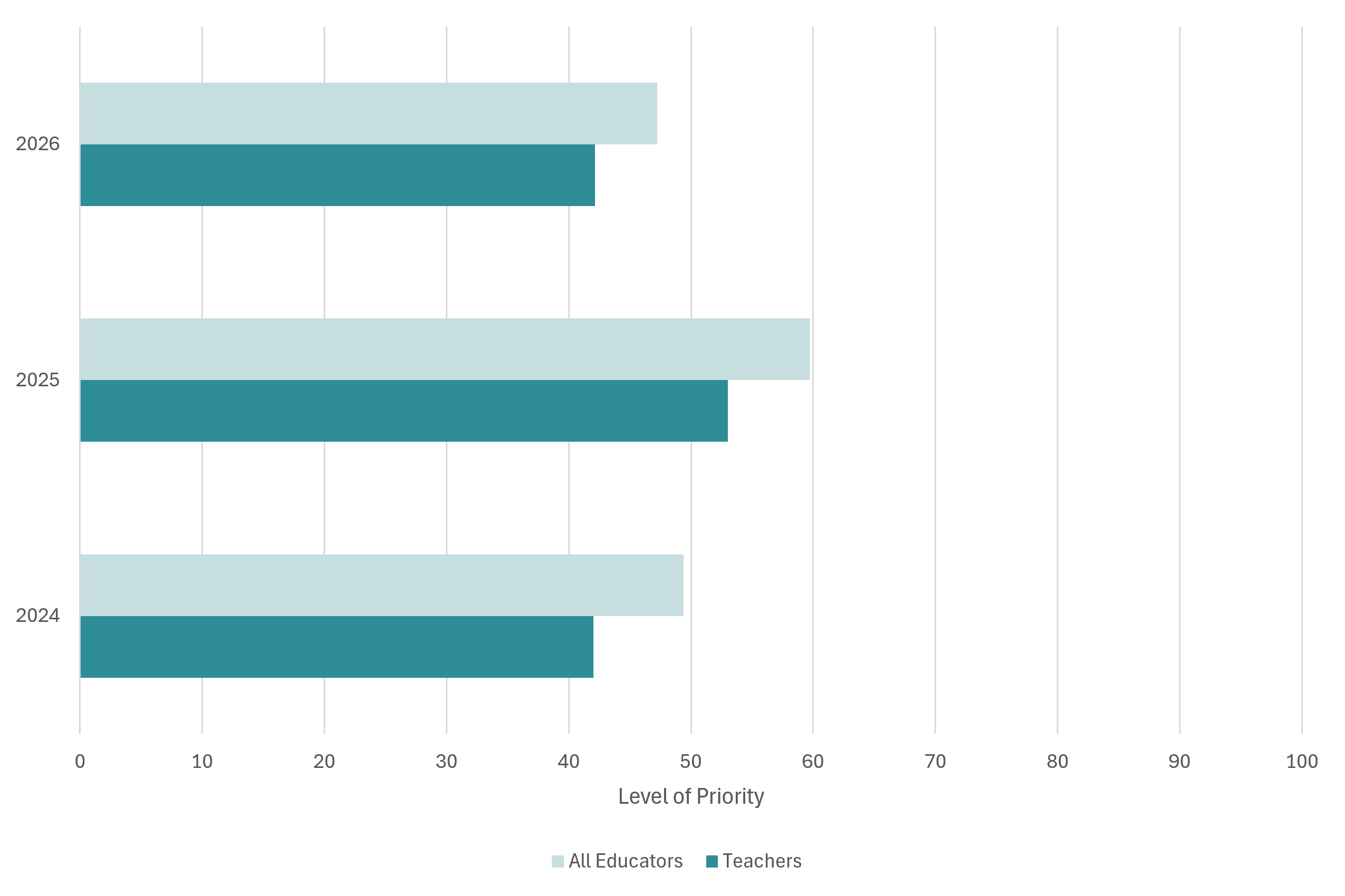
Similar to trust, educators were asked to rate the level of priority they placed on integrating AI into classrooms and schools on a scale from 0 to 100, with higher scores indicating greater priority. As shown in Figure 4, the priority assigned to AI integration increased from 2024 to 2025 before declining in 2026. This pattern was evident among both teachers and educators. Teachers continued to place a lower priority on AI integration than the full educator sample in each year. In 2026, the average priority level was approximately 42 among teachers and 47 among all educators, returning close to the levels reported in 2024 after having reached their highest point in 2025. This decline occurred even as educators reported greater experience using AI, suggesting that increased use does not necessarily translate into greater urgency to expand its integration.
Figure 4. Educators' Level of Priority of AI Integration in Classrooms and Schools, 2024-2026
 Administrators were also asked how AI aligned with their district or school mission, vision, or strategic plans. As shown in Table 3 below, 72.2% of administrators responding in 2026 indicated that AI was already included in these plans or that their plans were being revised to include it, compared with 46.8% in 2025 and 30.6% in 2024. At the same time, the percentage reporting that they had not yet considered AI’s alignment with their mission, vision, or strategic plans declined from 62.6% in 2024 and 51.9% in 2025 to 22.2% in 2026. A smaller proportion, 5.6%, reported having no intention of incorporating AI in 2026. Although the small 2026 administrator sample warrants caution, the results suggest movement away from initial consideration and toward more formal planning among the administrators represented in the survey. The 2024 and 2025 reports similarly identified strategic alignment as an important component of moving from experimentation toward intentional implementation.
Table 3. AI Alignment With District or School Mission, Vision, and Strategic Plans, 2024–2026
Response category | 2026 | 2025 | 2024 |
AI already included or plans currently being revised to include AI | 72.2% | 46.8% | 30.6% |
Have not yet considered alignment | 22.2% | 51.9% | 62.6% |
Have no intention to incorporate AI | 5.6% | 1.3% | 6.8% |
Note. Comparisons across years should be interpreted with caution because the 2026 results are based on a much smaller sample of administrators than those in 2024 and 2025. With only 18 respondents in 2026, each individual response has a larger effect on the overall percentages, and apparent year-to-year differences may reflect changes in the respondent group as well as changes in practice.
Together, these findings reveal two related but distinct dimensions of how educators envision AI’s future. At the individual level, educators placed less priority on AI integration in 2026 than they did in 2025. At the organizational level, however, a larger share of administrators reported that AI had become part of formal planning. This may indicate that schools and districts are increasingly acknowledging AI as a strategic issue, even as educators remain cautious about how prominently it should feature in classroom and school priorities. Practically, formal inclusion in a mission, vision, or strategic plan should not be treated as evidence of shared readiness or support. Schools and districts will need to translate broad commitments into clearly defined goals, appropriate-use guidance, professional learning, and opportunities for teachers and other stakeholders to influence implementation decisions. The persistent difference between organizational planning and educators’ moderate level of priority reinforces the previous reports’ recommendation that policy, vision, and classroom practice evolve together rather than on separate tracks.
Key Findings
AI use continues to grow despite moderate trust levels, with important differences across professional roles.
Teacher-reported classroom use of AI more than doubled between 2024 and 2026, and more than four out of five educators reported using AI both personally and professionally. At the same time, trust declined from its 2025 high. Teachers’ average trust returned to 43.7, the same level reported in 2024, while building administrators reported a similar level of trust at 44.4. District administrators were more trusting, with an average score of 54.1.
These findings reinforce an established trend from earlier reports: educators’ use of AI is increasing more consistently than their confidence in the technology. They also add nuance to previously identified differences by professional role. Administrators continued to report greater teacher use of AI than teachers reported in their own classrooms, but the trust results suggest that the divide is not simply between teachers and administrators. Building administrators’ trust was much closer to teachers’ level of trust than to district administrators’. This may reflect differences in proximity to classroom implementation, the types of AI applications encountered, or involvement in district-level planning.
Practically, schools and districts should not treat the use of AI as evidence of trust, readiness, or support for every AI application. Implementation efforts should include teachers and building leaders in tool selection, guidance development, and planning while also helping educators critically evaluate outputs, understand system limitations, protect privacy, and determine when AI use is appropriate.
Formal AI planning is advancing faster than shared expectations for practice.
Among the administrators responding in 2026, 72.2% reported that AI was already included in their district or school mission, vision, or strategic plans or that those plans were being revised to include it. This increased from 30.6% in 2024 and 46.8% in 2025, although the small 2026 administrator sample means the change should be interpreted cautiously. At the same time, educators assigned AI integration only a moderate priority, and the average priority level declined from its 2025 high.
The findings from AI in Education: Perceptions Around Use, Disclosure, and Guidance help explain why formal planning alone may not result in consistent practice. Teachers and students demonstrated clearer agreement about obviously inappropriate uses of AI than about uses intended to support learning. The study also identified uncertainty around disclosure and uneven access to guidance. Together, the findings suggest that schools and districts may increasingly recognize AI in formal plans without yet translating those plans into clear, shared, and usable expectations.
The practical challenge is to connect strategic language with classroom-level decisions. Broad commitments should be accompanied by concrete examples of acceptable and unacceptable use, disclosure expectations, professional learning, and opportunities for educators and students to help shape guidance.
The implementation challenge is shifting from adoption to responsible and sustainable use.
The 2024 report described a period of growing interest and use accompanied by limited guidance, uneven preparation, and substantial concern. The 2025 report documented continued adoption, emerging district planning, and persistent needs related to trust, policy clarity, and professional learning. The 2026 findings suggest that Michigan educators and schools are entering a more mature yet more complex phase, one in which AI experience is widespread, classroom use continues to increase, and more organizations are formally incorporating AI into their plans.
The central question is increasingly not whether educators and students will encounter AI, but how its use will be governed, supported, and connected to educational goals. The findings from the disclosure and guidance study reinforce the need for practical distinctions between AI that supports thinking and AI that substitutes for it, as well as clear expectations for acknowledging AI assistance.
Schools and districts may therefore need to move beyond introductory awareness efforts. Priorities should include role-specific professional learning, vetted tools, clear expectations for human oversight and disclosure, teacher and student involvement in implementation decisions, and ongoing evaluation of where AI contributes meaningful instructional or operational value, and where it does not.
Final Thoughts
The 2026 findings point to a new phase of AI implementation in Michigan schools. AI use is becoming increasingly common, with most educators reporting experience in both their personal and professional lives, and teacher-reported classroom use continuing to rise. Yet greater use has not resulted in greater trust or priority. Trust declined from its 2025 high, and teachers and building administrators remained more cautious than district administrators.
At the organizational level, AI appears to be receiving more formal attention. A growing share of administrators reported that AI was already included in school or district plans or that those plans were being revised. However, formal planning does not necessarily indicate shared readiness or clear expectations for practice. Related findings about use, disclosure, and guidance indicate that educators and students still need practical guidance on when AI supports learning, when it replaces meaningful work, and how its use should be appropriately acknowledged.
Moving forward, the central question is no longer whether AI will be present in schools, but how it will be used responsibly while remaining connected to larger educational goals. Schools and districts will need to pair strategic planning with clear guidance, meaningful professional learning, and opportunities for teachers, building leaders, students, and other stakeholders to shape implementation. Continued attention to trust, transparency, and educator judgment will be essential as policies and practices evolve alongside the technology.