
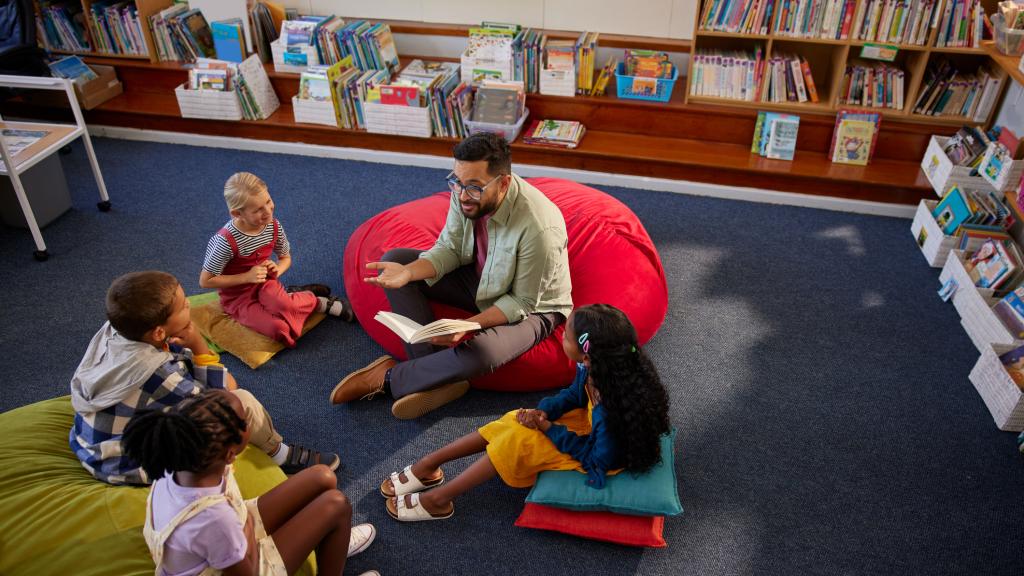
Everyone Has a Story

Learn how one Michigan educator helps students connect with each other and with the power of storytelling.
Back when I began teaching high school in the early 2010s, it was easy to search the internet and find blog posts of teachers explaining their practice, including specific strategies and lesson plans. I often wanted to try something new that none of my building-based colleagues had attempted. And it was pretty easy to find a real teacher, somewhere, talking about the exact thing I wanted to do.
I know that probably makes me sound like a nostalgic millennial. Don't get me wrong: in some ways, I love how the internet has evolved since then. Objectively, though, it just seems a lot harder to use a search engine to find real teachers talking about their actual practice.
MI Strategies: Real Teachers Sharing Real Stories
Earlier this year, Michigan Virtual launched a new course called MI Strategies: Success In Michigan Classrooms. We wanted to give space for educators to celebrate what’s going well in Michigan classrooms, learn from each other, and earn some SCECHs along the way.
As a Professional Learning Specialist here at Michigan Virtual, I’ve had the opportunity to explore the strategies that educators across the state have submitted for this course. It’s been awesome to read about the amazing things happening in local classrooms.
And it’s also given me an idea: Why not be that… internet… change I want to see and share these strategies with the wider world?
In that spirit, I’d like to share one Michigan teacher’s strategy with you. It’s called “Everyone Has a Story,” and it was submitted by middle school teacher Erin Bennett.
Erin’s Strategy: “Everyone Has a Story”
What and Why
This strategy, “Everyone Has a Story” has a dual purpose: it helps build social emotional learning (SEL) skills and writing skills.
According to Erin,
“This has transformed my classroom because it creates deep connection and fosters relationship building.”
The strategy was designed for 7th-grade students. Speaking as a former high school teacher, I can say that I can definitely see it working in my old classroom. I can imagine it working for younger students, too. It’s one of the reasons I love this: I can see it working in a variety of settings and with a variety of ages.
Materials and Background Knowledge
Another reason I love this strategy? It doesn’t require extensive preparation or lots of materials.
Erin explains,
“Teachers just need paper or computers, writing instruments, indoor or outdoor space, music or quiet, [and] a safe classroom community.”
In terms of the background knowledge that students need, this strategy is also uncomplicated:
“Students need to have basic writing abilities. They must know how to form sentences, string ideas together to create a paragraph, how to share a story from beginning to end, have a basic understanding of punctuation and grammar, and have confidence to share something personal from their life.”
Warm-Up: Diving Into Stories
The objective of this lesson is really straightforward: Students will understand the basic elements of storytelling and create a short personal or fictional story using a structured prompt.
To dive in and get students engaged, start with a question:
“What’s the best story you’ve ever heard? Why did it stick with you?”
Have students turn and talk to a partner to discuss the story and why it was so memorable.
Ask for a few students to share out.
This is a great opportunity to model positive responses and make connections between the responses that students give.
As a transition, emphasize: “Good stories stay with us because they connect to emotions or ideas that matter.
Mini-Lesson: What Makes a Good Story?
To transition into this mini-lesson, you might say something like: “Good stories have a few common elements. Knowing these elements can help you understand stories more deeply and write your own. You might know about them already, but let’s review them together.”
Display and briefly explain 5 Key Story Elements:
Characters – Who is in your story?
Setting – Where and when does it happen?
Problem/Conflict – What goes wrong or needs to be solved?
Events/Action – What happens?
Resolution – How does it end?
If you’re an ELA instructor, this serves as a great review not only for this lesson, but for reading and writing instruction more generally. It’s possible that you use different language to describe the parts of a story, so feel free to switch it up so that it makes sense for your educational context.
If you teach another subject, you might be wondering how these elements are relevant. You could skip them - they’re not totally essential. However, these elements provide simple support for students to write their own stories in the next part of this strategy. You can definitely keep it brief.
After you’ve covered the story elements, provide a model for students. Tell a 1-minute story aloud. Keep it simple but engaging. For example:
“Last year, I got lost on a school field trip to the museum. I took a wrong turn and ended up in the dinosaur exhibit... alone. I had to ask a kind stranger to help me find my group. I learned to always stay closer and speak up if I’m unsure.”
After telling your story, you might involve students in debriefing the story with you and identifying the 5 Key Story Elements that you introduced earlier.
Student Story Creation
Now it’s time to let creativity flow! Students are going to write their own brief stories.
Display and read the prompt:
“Write about a time when something unexpected happened to you. It can be funny, awkward, or exciting. Use the 5 elements.”
Before they write, you might want to:
Let students know how they’ll be sharing their work.
Encourage creativity and risk-taking.
Relieve anxiety by letting students know that their stories don’t have to be perfect or even good yet - this is just a fun activity to help with connection and learning.
Allow students to write quietly for 8–10 minutes. Walk around and encourage students who need help getting started.
Sharing and Feedback
Invite a few volunteers to share their stories, or parts of their stories.
For each student, provide positive feedback. Ask classmates to also give positive feedback. You can encourage this by displaying sentence starters like:
● “I liked how you...”
● “Your story made me feel...”
● “One part I remember is...”
You can also incorporate the story elements from earlier in the lesson with this prompt:
“I liked [pick one of the 5 story elements] because….”
After modeling this positive feedback, you may have students partner up, share their stories, and provide feedback for each other. This would give every student in the classroom a chance to share and connect.
Reflection and Wrap-Up
You can end the lesson with a simple exit ticket.
Display the following questions for students to respond to:
“What’s one thing you learned about storytelling today?”
Or:
“What kind of story would you like to tell next time?”
Ask students to write on notecards. You can collect the notecards and return to them in a subsequent lesson, or have students place the cards in a designated display space in the classroom to return to at another time.
More Thoughts and Ideas About Stories
This strategy can definitely stand alone on its own. It’s a great way for students to share their experiences, get to know each other, and practice productive communication.
But it can also be the beginning of a larger unit or project. In fact, that’s the case for Erin:
“Moving forward, I take this story writing and expand it. The students write stories about their families and invite family members in to interview, share, and celebrate. We have a night of deep listening after the stories have been polished (this takes a few months).
We also collect the stories into a book to give to each student. These stories weave together the thoughts, feelings, and experiences that we all have, allowing us to discuss emotions, challenges, strength, support, loss, etc.
We learn a lot about the writing process, [by] reading and writing daily. Keeping journals. Learning how to talk about hard things. Exploring ways to expand our humanity through our own experiences. And, then we celebrate as a connected community.”
I see so many possibilities for next steps on this strategy. In my old classroom, I might have used this strategy to:
Launch a unit about personal narratives. Students would have the opportunity to edit and workshop their written stories.
Introduce the concept of live storytelling, eventually working up to a “The Moth”-style classroom storytelling event.
Reinforce the 5 key elements of a story as the beginning of a short story reading unit.
Share Your Strategies
If, like me, you’ve been inspired by Erin’s strategy, you might be wondering how you can share your own.
We encourage you to register for MI Strategies: Success In Michigan Classrooms. You’ll share your strategy and read about other educators’ strategies. As an added bonus, you’ll earn 2 SCECHs.
And your strategy might even end up on our blog (with your consent, of course!).
I might not be able to fix the entire internet, but I can lift up real strategies from real educators, one blog post at a time.

Danielle Peck
Senior Professional Learning Specialist
Danielle comes to Michigan Virtual’s professional learning services team with over a decade of experience teaching in the classroom. She is passionate about collaborating with educators to create and implement instructional practices that are transformative and liberating. Danielle is a graduate of Michigan State University with a bachelor’s degree in English and history and a master’s degree in curriculum and instruction. In her free time, she enjoys reading, acting, crafting, and spending time with her family.
Related Posts
From Simple Squares to Sweaters: How One Teacher Uses Crochet to Build Confidence
When Erica Gorzen’s students pick up a crochet hook, they choose their own path. Some make simple squares. Others create sweaters and stuffed toys. As the 2026-2027 Regional Teacher of the Year, this Portland High School art teacher shares how choice-based lessons help her students build confidence, independence, and a love of learning that lasts well beyond the classroom.

Build Trust, Boost Autonomy, & Design Smarter Check-Ins With Students
Strong student relationships don't happen by chance. They happen by design. Discover how structured check-ins can build trust, strengthen student autonomy, and help you create more student-centered learning experiences. Plus, access a free template or earn a SCECH while creating a check-in routine for your classroom.

Revisiting the 5:1 Ratio: Reflecting on a "Magic" Ratio Just Too Tidy to be True
A popular idea in education holds that teachers should aim for five positive interactions for every one corrective one. It spread quickly, cited widely, and seemed to just make sense. There was only one problem: the research behind it was never really about teaching at all.
The Power of the 5:1 Ratio: How Fostering Positive Interactions Can Transform Student Learning
The 5:1 ratio has completely changed my thinking about interactions in the classroom. It all started with a question about grading. After all, part of our jobs as teachers is to provide corrective feedback to help students grow. The 5:1 ratio helps to ensure that students can receive this feedback effectively. More importantly, however, it can help us be intentional about creating a classroom environment that centers our humanity.

Time for Teachers: Self-Assessment with Community Support as Individual Solutions
Educators often cite a lack of time as one of their most significant stressors. How can we help teachers find the balance necessary to feel satisfied in their jobs and meet their social and emotional needs? This third post in the Time for Teachers blog series will discuss the importance of a self-assessment in addressing individual problems and solutions teachers face. This is not to say the onus of addressing challenges should fall squarely on the shoulders of individual teachers. Teachers need a community of practice and support to help them identify problems they might face individually that could benefit from solutions that come from consulting with colleagues.

Time for Teachers: Agile Meetings and Short Pulse Surveys as Systemic Solutions
Educators often cite a lack of time as one of their most significant stressors. How can we help teachers find the balance necessary to feel satisfied in their jobs and meet their social and emotional needs? This second post in the Time for Teachers blog series will discuss two possible solutions that can help all educators save time while addressing needs to serve students and communities: agile meetings and short pulse surveys.